
HS DW-DLC: Optimizing Social Network Search by Silencing the Echo
Hybrid Search Scheme for Social Networks Supported by Dynamic Weighted Distributed Label Clustering
This paper proposes a Hybrid Search (HS) scheme for social networks utilizing a Dynamic Weighted Distributed Label Clustering (DW-DLC) auxiliary structure. By combining random walker and flooding mechanisms, the HS DW-DLC method optimizes query propagation to balance search efficiency and message overhead.
TL;DR
Searching for information in massive social networks is a trade-off between speed and noise. The paper "Hybrid Search Scheme for Social Networks Supported by Dynamic Weighted Distributed Label Clustering" introduces a refined search architecture. By combining Random Walkers with a sparse, Dynamically Weighted auxiliary structure, the authors achieve high hit rates while significantly reducing the number of repeated, annoying messages sent to users.
Background & Motivation: The Search Dilemma
In a social network modeled as a graph, finding a specific piece of information—like a product recommendation or a niche opinion—is problematic.
- Flooding is fast but creates a "message storm" that overloads the network.
- Random Walkers save bandwidth but often get lost in the graph, leading to long delays and failed searches.
- Existing Auxiliary Structures (like Dominating Sets or static DLC) tend to be too dense, causing query overlap and repeated, redundant notifications to the same users.
The authors' core insight is that an auxiliary structure doesn't just need to cover the network; it needs to be minimal and representative. By using a dynamic weighting mechanism, they select the most "influential" nodes (those with many unreached neighbors) to act as search accelerators.
Methodology: The DW-DLC Engine
The proposed system operates on two pillars: the structure and the search logic.
1. Dynamic Weighted Distributed Label Clustering (DW-DLC)
Unlike static clustering where weights are fixed based on total degree, DW-DLC recalculates weights in phases. A node's importance is defined by how many undecided (unclustered) neighbors it has. This prevents the over-selection of clusterheads in dense areas.
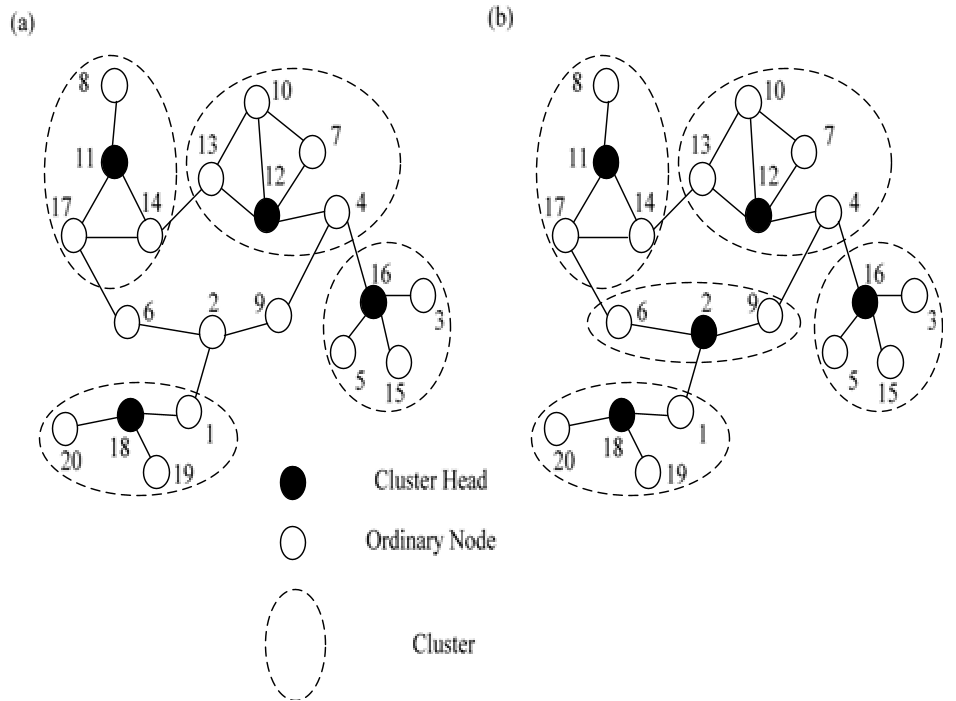 Figure: The two-phase process of DW-DLC. Transitioning from (a) initial clustering to (b) the second phase ensures a more compact set of clusterheads.
2. Hybrid Search (HS) Logic
The search message behaves differently depending on where it lands:
- At a Normal Node: It acts as a Random Walker, forwarding the query to only one random neighbor.
- At a DW-DLC Node: It triggers a Local Flood, broadcasting the query to all immediate neighbors to maximize the chance of a "hit" in a representative neighborhood.
Experimental Validation
The authors simulated a social network of 50,000 nodes following a Power-Law distribution (simulating real-world "influencer" vs. "follower" dynamics).
Key Findings:
- Message Overhead: HS DW-DLC outperformed all other hybrid schemes (DS, CDS, DLC) in terms of message efficiency.
- User Disturbance: The "Ratio of Repeated Messages" was significantly lower. This is a critical metric for user experience in real social platforms—fewer duplicate notifications mean less user annoyance.
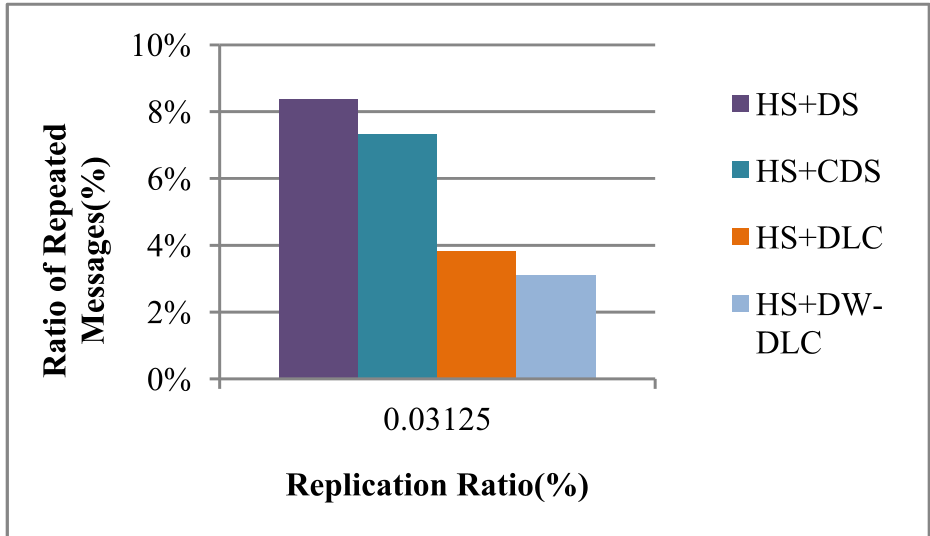 Figure: Comparison of repeated message ratios. HS DW-DLC shows a clear advantage in reducing redundancy.
Critical Insight & Conclusion
The true value of this work lies in its Inductive Bias toward the Power-Law nature of social networks. By dynamically adjusting weights, the algorithm naturally gravitates toward the most efficient "hubs" for information spreading without over-utilizing them.
Takeaway: While flooding might still be the king of "Success Rate," HS DW-DLC provides the most sustainable search model for real-world applications where network bandwidth and user attention are finite and valuable resources. Future work could potentially integrate this with interest-based clustering to further refine search accuracy in multi-topic environments.