
Breaking Paradigm Silos: A Reflective Deep Dive into Hybrid Simulation for Healthcare
Reflections on two approaches to hybrid simulation in healthcare
Deeply analyzing hybrid simulation in healthcare, this paper evaluates two distinct integration architectures: a loosely-coupled System Dynamics (SD) and Discrete-Event Simulation (DES) model for Chlamydia transmission, and a tightly-integrated Agent-Based (ABM) and DES model for Age-Related Macular Degeneration (AMD). By leveraging multi-paradigm approaches, the study achieves a "whole system" perspective that single-paradigm models fail to capture.
TL;DR
Healthcare operations are too complex for a single lens. This paper reflects on two hybrid simulation approaches—pairing Discrete-Event Simulation (DES) with System Dynamics (SD) and Agent-Based Modeling (ABM)—to bridge the gap between microscopic clinic bottlenecks and macroscopic community health outcomes. The findings prove that ignoring these interconnections leads to systemic underestimations of costs and infection rates.
The Motivation: Why One Paradigm is Never Enough
In simulation, we often face a trade-off. DES is fantastic for modeling queues and staff schedules in a clinic, but it treats the "outside world" as a static entry/exit point. SD excels at long-term population trends but treats individual patient variability as a giant "aggregate soup."
The author argues that in healthcare, these levels are recursively linked:
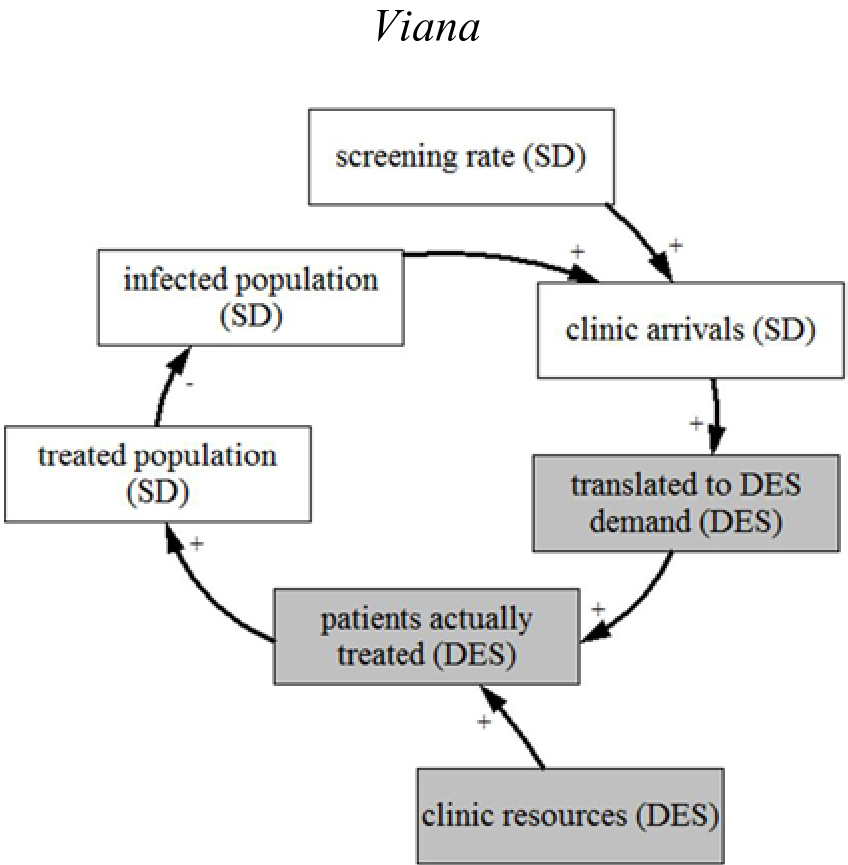
- The Vicious Cycle: If a Chlamydia clinic is understaffed (DES level), patients leave without treatment. This increases disease prevalence in the community (SD level), which in turn floods the clinic with even more demand.
- The Insight: A standalone model of either would miss this feedback loop. Hybridization is not just a technical choice; it's a requirement for accuracy.
Methodology I: The Chlamydia Model (Hierarchical SD-DES)
The first case study focuses on Chlamydia transmission and treatment. It employs a hierarchical architecture where two specialized software packages communicate.
Architecture Breakdown
- Community Level (SD): Built in Vensim, using a "Susceptible-Infected-Recovered" (SIR) structure to model transmission.
- Clinic Level (DES): Built in Simul8, modeling the granular patient pathway and staffing at a GUM clinic.
- The Bridge: Microsoft Excel acts as the data exchange hub. Vensim generates monthly demand, Excel disaggregates this into arrival distributions for Simul8, and Simul8 sends the "average treated" count back to Vensim.
Methodology II: The AMD Model (Integrated ABM-DES)
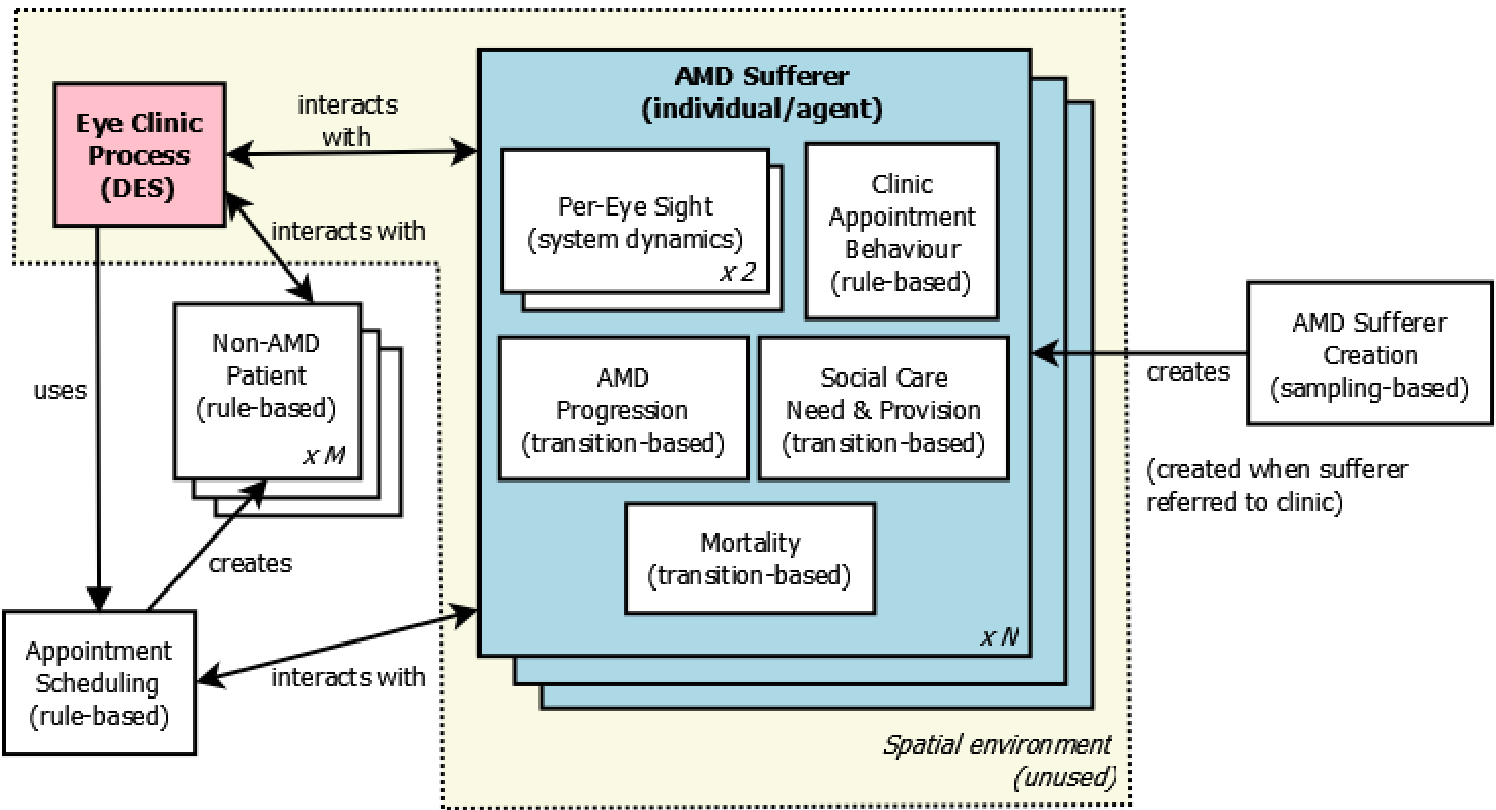
The second case study tackles Age-Related Macular Degeneration (AMD). Unlike the first model, this uses AnyLogic to create a more tightly integrated environment.
The Multi-Scale Agent
Each patient is an "Agent" with:
- Internal SD Logic: Basic continuous models representing sight degradation in left/right eyes.
- ABM Logic: Social care needs and the probability of attending appointments based on their social support network.
- DES Interaction: Agents physically enter the "Eye Unit DES" when appointments are due, competing for actual nurses and equipment.
Key Results: The "Tipping Point" Discovery
The results highlight the dangers of "common sense" healthcare planning without whole-system simulation.
The Chlamydia Findings
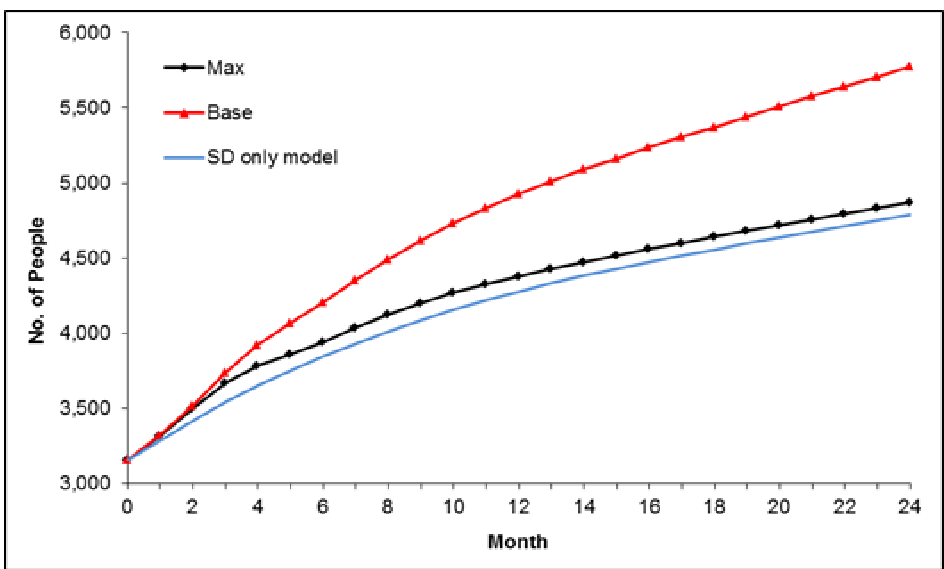
The hybrid model showed that a standalone SD model underestimates total costs. Why? Because it assumes everyone seeking treatment gets treated. When the DES component introduced realistic clinic bottlenecks, the infection "leakage" back into the community caused a spike in long-term complications (sequelae) costs that the SD model alone couldn't see.
The AMD "Tipping Point"
In the AMD model, researchers found that adding more health resources (nurses/doctors) initially reduced missed injections. However, as the simulation progressed (Region D in Fig 5), the "Health + Social Care" scenario actually started seeing more missed appointments. This counterintuitive result occurred because more patients were making it into the system, eventually overwhelming even the expanded resources—a classic case of Limits to Growth.
Critical Analysis & Future Outlook
The author is refreshingly honest about the technical hurdles. While AnyLogic allows for seamless integration, the learning curve for Java and multi-paradigm logic is steep compared to the "Excel-swapping" method.
The Limitations
- Data Snapshots: The clinical DES is often based on current audits, which might not hold as demand shifts.
- Paradigm Rigidness: Most software tools still push a specific "world view." The challenge for future researchers is to remain "paradigm-agnostic."
Conclusion
Hybrid simulation is moving from a "niche ingenuity" to a necessary standard in healthcare operations. By allowing the physical constraints of a clinic (DES) to interact with the behaviors of individuals (ABM) and the dynamics of populations (SD), we can finally model the "Whole System" rather than just its parts.