
Hybrid Intelligence: Decoding Mental Health and Co-morbidity through Social Network Analysis
A hybrid statistical and semantic model for identification of mental health and behavioral disorders using social network analysis
The paper proposes a hybrid framework combining statistical and semantic modeling to identify Psychiatric Disorders and addictive behaviors from social network data via the Psychiatric Disorder Determination (PDD) and Addiction Category Determination (ACD) algorithms.
TL;DR
Mental health diagnostics are moving from the clinic to the cloud. This paper introduces a dual-algorithm approach—PDD for psychiatric identification and ACD for addiction categorization—that leverages statistical Beta distributions and Semantic Web ontologies to detect co-morbid mental health disorders in unstructured social media journals.
Background & Motivation
Mental Health and Behavioral (MHB) disorders account for over 7.4% of global "Disability Adjusted Life Years" (DALYs). The core challenge lies in Co-morbidity: the phenomenon where one disorder (like Anxiety) masks or triggers another (like Substance Abuse).
The authors argue that traditional diagnosis is too reactive. By the time a patient is in a clinical setting, the burden is already high. However, humans "leak" their personality traits through their digital footprints—specifically in how they express themselves in online journals like PatientsLikeMe or GoodNightJournal.
Methodology: The PDD and ACD Pipeline
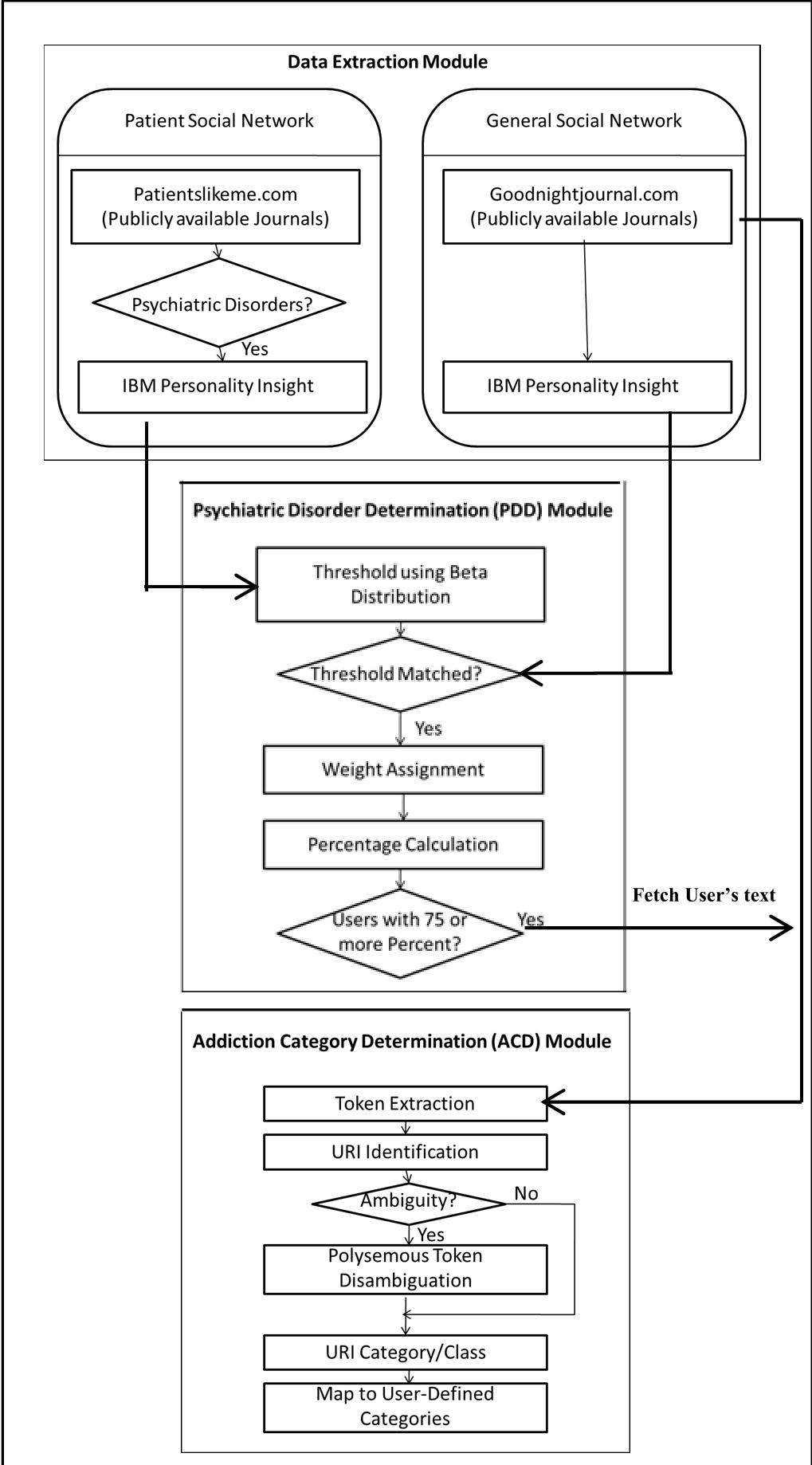
The system architecture is a three-stage pipeline designed to move from raw text to specific clinical insights.
1. Psychiatric Disorder Determination (PDD)
The authors use the Big Five Personality Traits (Neuroticism, Extroversion, Conscientiousness, Agreeableness, and Openness) as the bridge.
- The Logic: People with specific disorders exhibit predictable "Highs" and "Lows" in these traits (e.g., High Neuroticism in Depression).
- The Math: They use a Beta Distribution to establish a "Normal Range" for patients.
2. Addiction Category Determination (ACD)
Once a user is flagged by the PDD module, the system needs to know what they are addicted to. Instead of relying on rigid, pre-trained classifiers like Support Vector Machines (SVM), the authors use OBIE (Ontology-Based Information Extraction).
- Knowledge Graphs: The system queries DBpedia, Freebase, and YAGO2s.
- Disambiguation: Use the LESK algorithm to ensure that if a user mentions "Joints," the system knows if they mean anatomy or substance abuse based on lexical context.
Critical Insight: The Beta Distribution Threshold
Why use Beta distributions? Most human traits are not strictly linear. The Beta distribution allows authors to model random variables limited to a finite interval (0, 1), providing a robust statistical "threshold" that can be adjusted for different disorders.

Experimental Results & Performance
The system was tested on real-world data from PatientsLikeMe and GoodNightJournal.
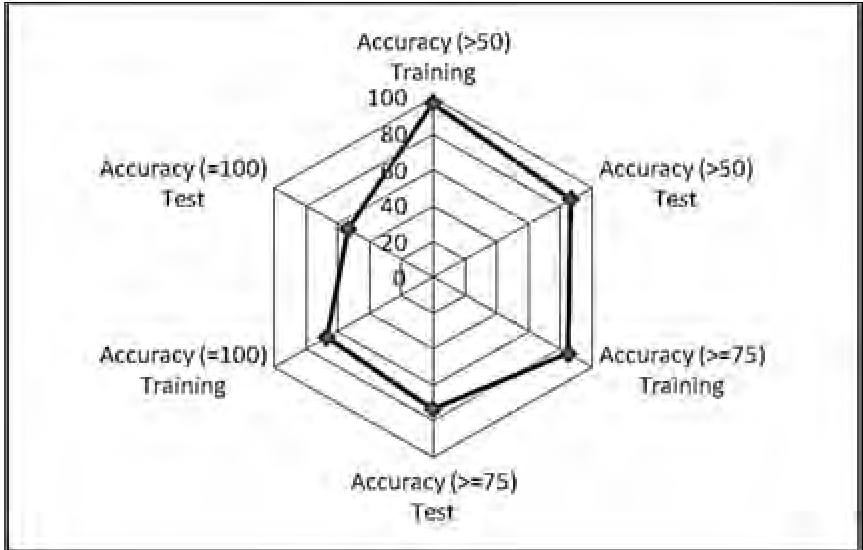
- Accuracy: The PDD algorithm achieved 73.32% accuracy in identifying psychiatric conditions.
- Detection: In a test of 50 general users, 28 were flagged for potential MHB issues.
- Addiction Mapping: The ACD module successfully identified "Night Life" and "Arts" as the highest traction categories for flagged users, suggesting these domains as significant areas for behavioral monitoring.
Critical Analysis & Future Outlook
Contribution: The novelty here is the Dynamic Classification. Unlike traditional ML that requires massive retraining to recognize a new addiction (e.g., a new designer drug), the Ontology-based approach automatically incorporates new knowledge as DBpedia and YAGO are updated.
Limitations:
- Small Dataset: The study used a relatively small sample (25-50 users).
- Linguistic Bias: The IBM Watson tool is highly sensitive to input length and language style.
- Ethical Privacy: The paper touches on using this for "Law Enforcement" and "Health Insurance," which raises significant ethical concerns regarding the surveillance of mental health data without explicit clinical consent.
Conclusion: This work serves as a foundational blueprint for Computational Psychiatry. By bridging the gap between statistical personality theory and the semantic web, we can move closer to a world where mental health support is as proactive as a weather forecast.