
HT-TRUST: Solving the Trust Crisis in Social E-Commerce via Factor Enrichment
A Hybrid Trust Evaluation Framework for E-Commerce in Online Social Network: A Factor Enrichment Perspective
The paper introduces HT-TRUST, a hybrid trust evaluation framework for E-commerce in Online Social (ECOS) networks. It combines private reputation (subjective) and common reputation (objective) while enriching the model with factors like time evolution, anti-fraud mechanisms, and confidence measurement to ensure transaction security.
TL;DR
Transactions in Online Social E-commerce (ECOS) are inherently risky due to decentralized autonomy. HT-TRUST bridges this gap by fusing subjective "Private Reputation" with objective "Common Reputation." By introducing "Factor Enrichment"—integrating time decay, transaction volume risks, and social similarity—it achieves a 12-18% accuracy boost in malicious node detection compared to classic benchmarks like EigenRep.
The Problem: Why "Static" Trust Fails
Conventional e-commerce platforms rely on a central authority (like Amazon or eBay) to aggregate ratings. In social networks, this centralization creates massive communication bottlenecks and fails to account for the "Dynamic" nature of human relationships.
Existing models suffer from three fatal flaws:
- The Static Trap: They treat a rating from 3 years ago the same as one from yesterday.
- The "Small-Gain" Fraud: Malicious users build high reputation through many tiny, honest transactions only to execute a massive fraud.
- Cold Starting: New users have zero data, making them either vulnerable or untrustworthy.
Methodology: The "Factor Enrichment" Strategy
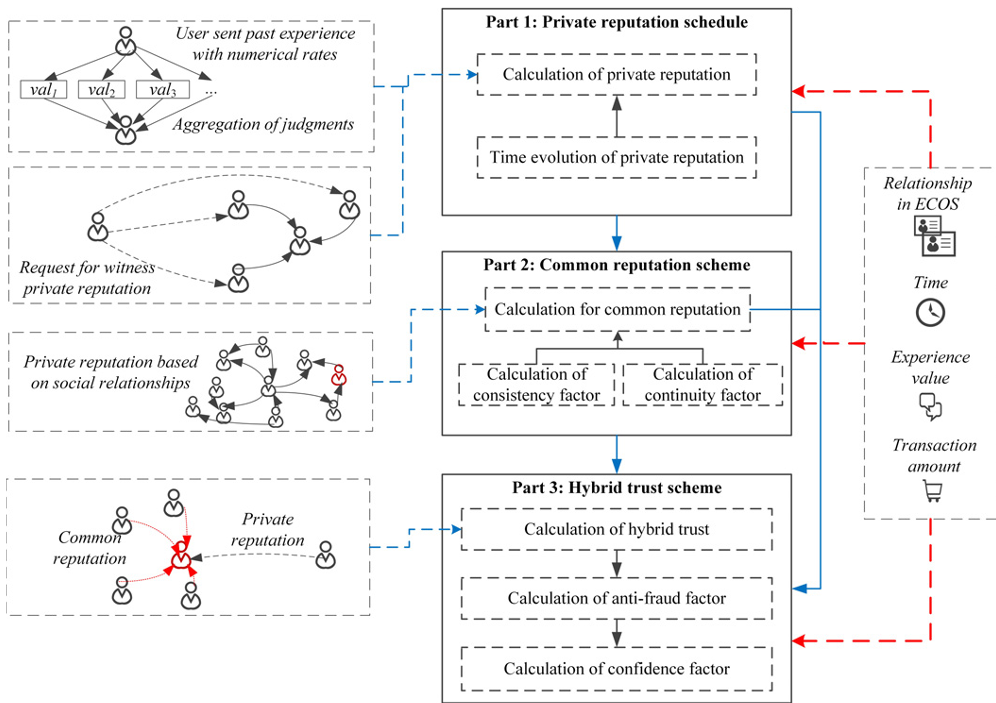
The core innovation of HT-TRUST is the movement beyond simple averages toward a multidimensional trust vector.
1. Private Reputation (Subjective View)
This is based on direct interaction. Instead of a simple sum, it uses an Amount Risk Controlling Factor.
- Insight: If a seller has 100 5-star ratings for 1000 item shouldn't automatically be 100%.
- Time Evolution: The model uses a Poisson Process to simulate trust decay. If you haven't traded with someone in months, your "subjective" impression of them should naturally attenuate.
2. Common Reputation (Objective View)
When you haven't traded with someone, you ask the community. HT-TRUST doesn't value all neighbors equally; it weights them based on User Similarity. If a neighbor buys the same types of items you do, their opinion of a seller is weighted more heavily.
3. The Hybrid Integration
The system uses a dynamic weight () to combine these views: As your transaction history with a specific person grows, increases. You rely on your own experience (PR) more and social gossip (CR) less.
Experiments: Real-World Validation
Using a dataset of 1,063 IDs and 90,000 records from Taobao, the authors tested HT-TRUST against malicious actors.
Accuracy vs. Malicious Nodes
The framework consistently outperformed standard average trust (AT) and Bayesian methods (TB). Even when 40% of the network was malicious, HT-TRUST maintained high precision by utilizing Consistency and Continuity factors to sniff out erratic rating behavior.
Efficiency: The Time-Cost Factor
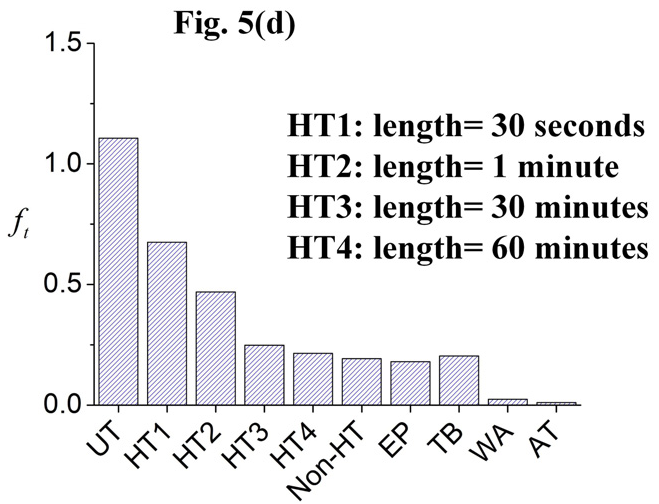
A major win for HT-TRUST is its efficiency. While "Ultimate Trust" (UT) provides high accuracy, its computational cost is prohibitive. HT-TRUST achieves nearly identical accuracy with a significantly lower time-cost () because it updates dynamically at the end of "time slices" rather than after every single packet.
Deep Insight & Conclusion
The genius of HT-TRUST lies in its Inductive Bias: the assumption that trust is a "leaky" commodity that needs constant validation through transaction context.
Takeaways for the Industry:
- Context is King: A "5-star rating" is meaningless without knowing the dollar amount and the date of the transaction.
- Distributed is Better: By allowing users to maintain local trust schedules and only query neighbors, we solve the scalability issues of global trust matrices.
Limitations: The model assumes "neighbor witness evidence" is inherently more reliable, which could still be vulnerable to sophisticated Sybil attacks where a malicious user creates a cluster of "honest-looking" neighbor nodes.
Future research should look into applying this factor-enrichment perspective to cross-platform social commerce where identity is fragmented.