
Virtual Town Square: Engineering Social Affordances for Hyperlocal News
(Hyper) local news aggregation: Designing for social affordances
This paper introduces the Virtual Town Square (VTS), a (hyper)local news aggregation system designed to foster civic engagement through social affordances. It employs Latent Dirichlet Allocation (LDA) for automatic topic clustering of dispersed local content, aiming to replace costly manual editorial models with a self-sustaining digital hub.
TL;DR
The decline of local newspapers has fractured civic life. The Virtual Town Square (VTS) project from Virginia Tech leverages Latent Dirichlet Allocation (LDA) to automatically aggregate and cluster scattered digital news into a social ecosystem. By treating news not just as information, but as a site for social affordances (sharing, tagging, and debating), VTS creates a self-sustaining model for community engagement.
The Motivation: Fragmented Information, Fading Participation
Democratic health relies on the ability of citizens to debate and make informed decisions. However, we are currently facing a paradox: while local print media is dying, there is a "plethora" of digital info scattered across Facebook, Twitter, RSS feeds, and government portals.
The authors argue that existing solutions fail in two ways:
- The Costly Human Model: Platforms like AOL's Patch rely on paid local editors, which is financially unsustainable.
- The Superficial Algorithmic Model: Simple aggregators often pull irrelevant content because they search for keywords (e.g., location names) without understanding the social context or clustering related narratives together.
Methodology: Topic Modeling as a Civic Tool
The core of VTS is its ability to find the "hidden structure" in a day's local news. Instead of a laundry list of headlines, VTS uses Latent Dirichlet Allocation (LDA) to group articles.
The Algorithm
Mathematically, LDA treats each document as a distribution over topics, and each topic as a distribution over words. The joint probability distribution used for this generative process is:
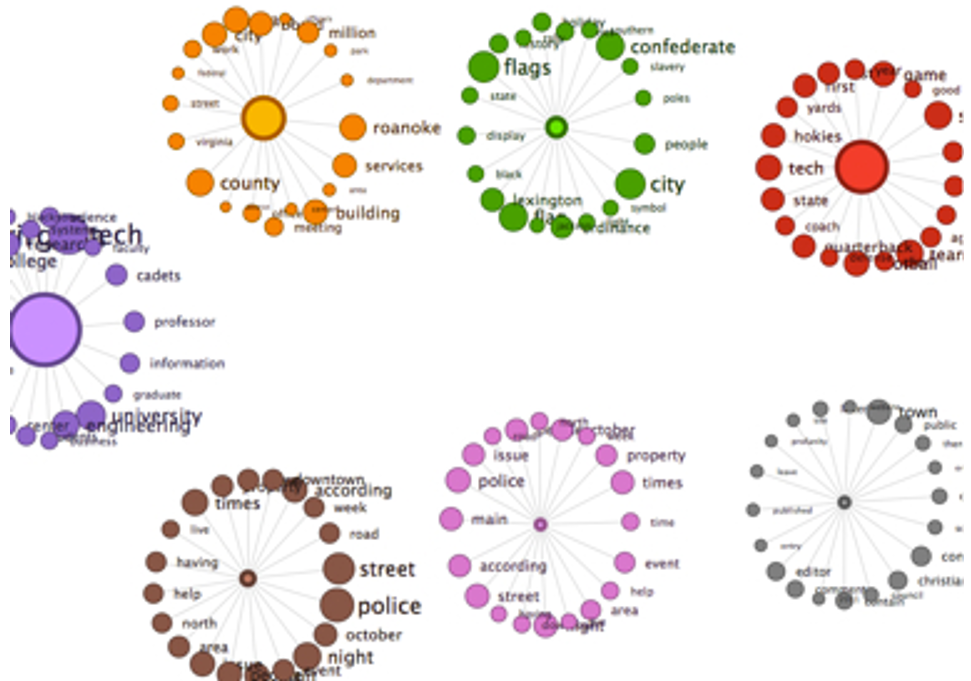
By calculating the posterior probability of this model, VTS identifies the top 5 topics and the top 20 terms for each, creating Tag Clouds that represent the community's "heartbeat" for the day.
Designing for Social Affordances
A key academic contribution of this work is the extension of Affordance Theory into the social realm. The VTS isn't just a database; it’s a space that invites action.
- Activity Streams: Real-time feeding of user interactions to discover popular content.
- Clustered Discussions: Unlike Topix, VTS ensures user-generated content (comments, tweets) is tethered to the specific news topic it belongs to.
- Information Genealogy: Tracking how an idea or rumor spreads from a blog post to a town-wide debate.
Experiments & Results
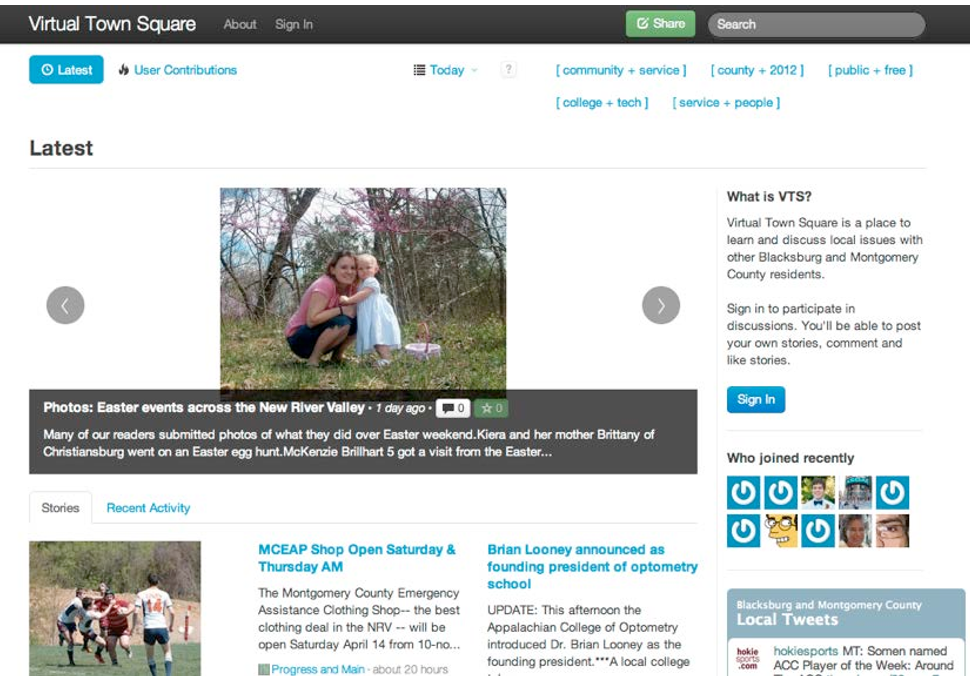
The researchers performed a Cognitive Walkthrough on the VTS prototype. They evaluated whether users could intuitively find the "Share" button or track their location within the news hierarchy using breadcrumbs.
To help users navigate complex news cycles, they implemented Force-Directed Graphs. In these visualizations, bubbles represent topics, and nodes represent keywords. The size of the bubble indicates the volume of news, providing an immediate visual "Pulse of the City."
Strategic Takeaways
The Virtual Town Square proves that hyperlocal news is a data mining problem as much as a journalistic one.
- Sustainability: Automation via LDA eliminates the need for expensive "gatekeepers" (editors).
- Engagement: Social affordances turn "lurkers" into participants by reducing the friction of joining a discussion.
- Future Outlook: The authors suggest incorporating Sentiment (Affect) Modeling to distinguish not just what people are talking about, but the "vibe" of the community (e.g., liberal vs. conservative tensions).
As local news continues to move online, the VTS model offers a replicable blueprint for communities seeking to reclaim their digital town squares.