
Virtual Town Square: Engineering Social Affordances for the Hyperlocal Digital Age
(Hyper) local news aggregation: Designing for social affordances
The paper introduces Virtual Town Square (VTS), a hyperlocal news aggregation system designed to foster civic engagement. It utilizes automated web crawling and Latent Dirichlet Allocation (LDA) topic modeling to cluster fragmented local information into coherent, interactable social spaces.
TL;DR
As local newspapers vanish, our communities are losing their "connective tissue." This paper presents the Virtual Town Square (VTS), a sophisticated aggregator that uses AI-driven topic modeling to pull together scattered local tweets, Facebook posts, and news articles into a single, interactive map-based interface. It’s not just a news site; it’s a digital infrastructure designed to spark civic engagement through "social affordances."
Problem & Motivation: The Splintered Local Commons
The "death of the local newspaper" is more than a business failure; it's a democratic crisis. While information hasn't disappeared, it has become hyper-fragmented. A single local issue—like a new school budget—might be discussed on a government PDF, a private Facebook group, a scattered RSS feed, and a dozens of tweets.
The authors identify two failures in current solutions:
- The Scaling Paradox: Large platforms like Patch or EveryBlock focus on big cities with existing media, ignoring small towns where the information gap is widest.
- Missing Social Affordances: Most aggregators treat news as a "read-only" list. They lack the "functional handles" (affordances) that invite people to tag, rank, and discuss content in a way that builds community trust.
Methodology: The Socio-Computational Engine
The core of VTS is a "self-organizing" system that minimizes human editorial costs—a necessity for small-town sustainability.
1. Automated Aggregation & Clustering
VTS doesn't just list headlines. It uses Latent Dirichlet Allocation (LDA) to discover abstract topics within a collection of documents. This allows the system to group a formal city council report with a resident's angry tweet about the same topic.
2. The Math of Meaning
The system models documents as a distribution over topics () and topics as a distribution over words (). This ensures that even if different sources use slightly different vocabulary, the system can mathematically recognize the shared context.
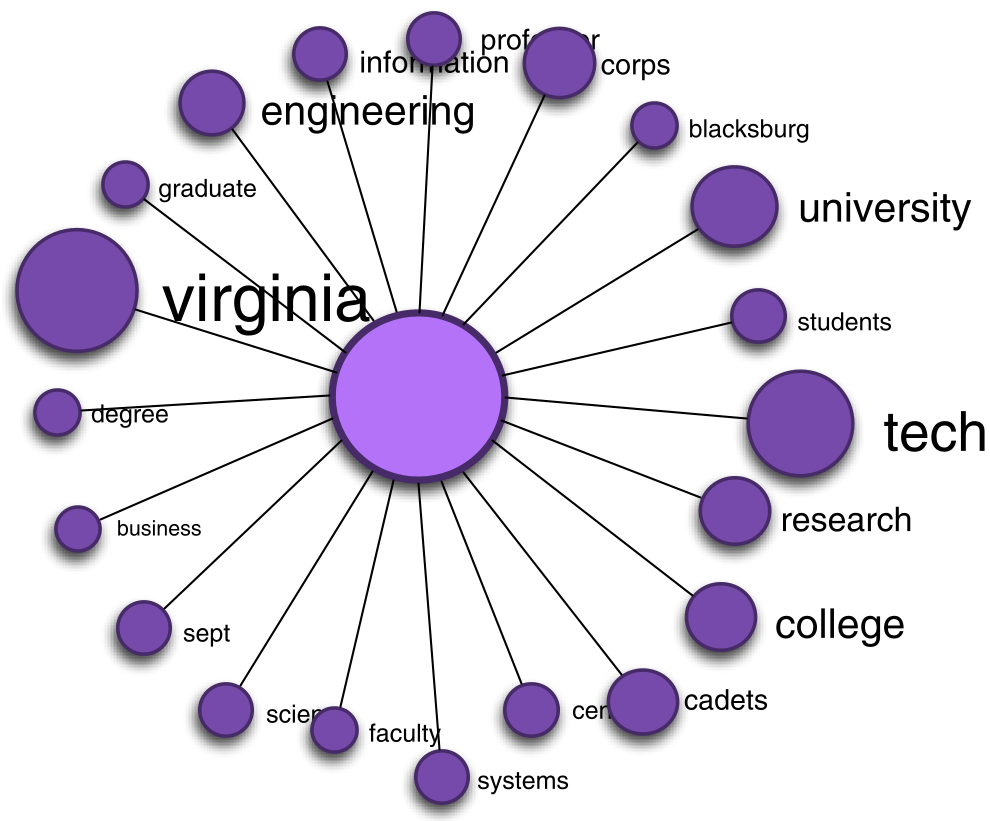 Figure: A force-directed graph showing how VTS visualizes keyword clusters within a single topic.
3. Designing for Social Action
The authors integrated specific "Social Affordances":
- Chatter Integration: Pulling live "vibe" checks from Twitter hashtags and Facebook pages.
- Map-based Navigation: Using Geoparsing and Geocoding to place news stories on a physical map of the town, making the data visceral and relevant to the user's immediate surroundings.
Experiments & Results: Putting the "Town" in Virtual Square
The VTS was deployed in Blacksburg, Virginia. Unlike national aggregators (e.g., Topix) which users found "cluttered with national ads," VTS focused strictly on local relevance.
- User Engagement: The "Chatter" section was the most popular, specifically because it brought younger citizens—who rarely read formal news—into the civic conversation.
- Topic Insight: Using a 5-topic, 20-term configuration for LDA, the researchers found they could reliably represent local "hot issues" in an intuitive tag cloud format.
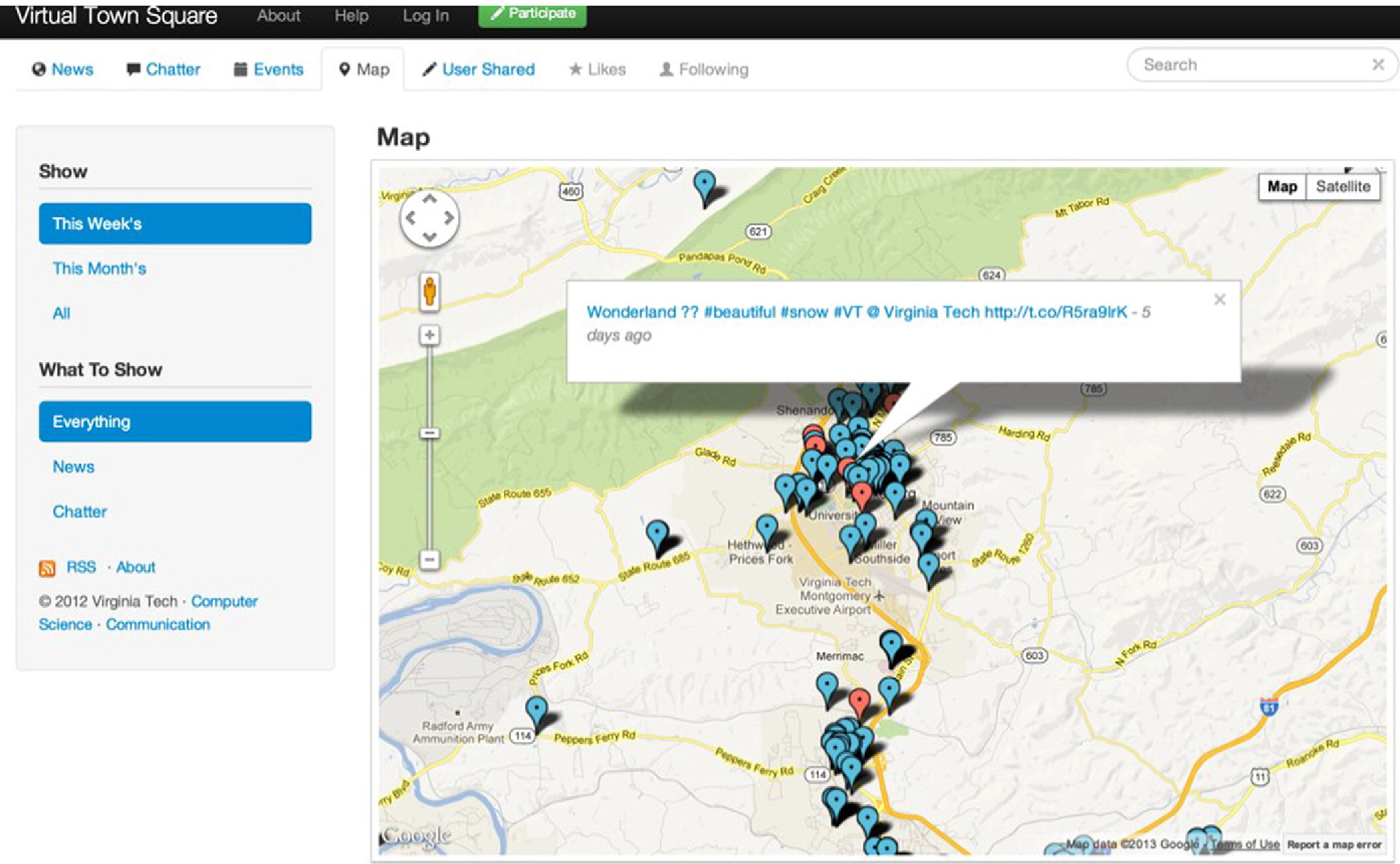 Figure: The VTS map-based interface showing news (red) and chatter (blue) pins, grounding digital talk in physical space.
Critical Analysis & Conclusion
The Takeaway
The Virtual Town Square proves that aggregation is a design problem, not just a technical one. By providing "social affordances"—the buttons, maps, and tags that invite interaction—VTS transforms passive readers into active citizens.
Limitations & Future Work
The authors admit a significant hurdle: encouraging original content. While VTS is great at collecting talk, getting users to start a blog post remains difficult. Future iterations are looking at "Affect Modeling"—moving beyond simple "positive/negative" sentiment analysis to understand deeper political dichotomies like "Big Government vs. Small Government."
In an era of digital polarization, VTS offers a blueprint for how we might use AI to rebuild the "Virtual Town Square" and restore the quality of life in our local communities.