
Beyond Redundancy: Hypergraph Reranking with Absorbing Nodes for Diverse Image Search
A Hypergraph-Based Reranking Model for Retrieving Diverse Social Images
The paper introduces a novel hypergraph-based reranking model for social image retrieval, specifically targeting the balance between relevance and diversity. By modeling images as vertices and high-order relationships as hyperedges, and incorporating "absorbing nodes" into the iterative ranking process, the method achieves competitive performance on the MediaEval 2016 dataset.
TL;DR
When searching for "Paris," most users prefer seeing the Eiffel Tower, the Louvre, and a cozy café rather than twenty nearly identical photos of the same tower. This paper proposes a Hypergraph-Based Reranking Model that uses "absorbing nodes" to naturally suppress redundant visual information during the ranking process, ensuring that the results are both relevant and diverse.
Background: The Relevance vs. Diversity Paradox
Standard image search engines (like Flickr or Google) often prioritize Relevance—how well an image matches the text query. However, relevance alone leads to redundancy. In social media contexts, many users upload similar photos of the same landmark.
The technical challenge is making a trade-off: we want images that belong to the query (Relevance) but represent different "clusters" of information (Diversity). While prior works used simple clustering (like K-Means) after the initial search, this paper argues for a more integrated mathematical approach.
Methodology: High-Order Relationships and Absorbing Nodes
1. The Visual Hypergraph
Traditional graphs connect two nodes (an edge). A Hypergraph allows an edge to connect multiple nodes simultaneously. In this model:
- Vertices: Images represented by CNN-based descriptors.
- Hyperedges: Created by taking an image and its -nearest neighbors, capturing the local manifold of the image space.
2. The Innovation: Absorbing Nodes
The core mathematical contribution is the modification of the iterative ranking formula. In a standard manifold ranking, scores propagate from the query to similar neighbors. This often causes "clumps" of similar images to all get high scores.
The authors introduce Absorbing Nodes (). Once an image is selected for the top of the list, it becomes an "absorbing" point in the graph. In the next iteration of the ranking algorithm:
- Its ranking score is effectively grounded or removed from the propagation.
- It "absorbs" the probability mass, preventing its visual neighbors (duplicates) from climbing the rank.
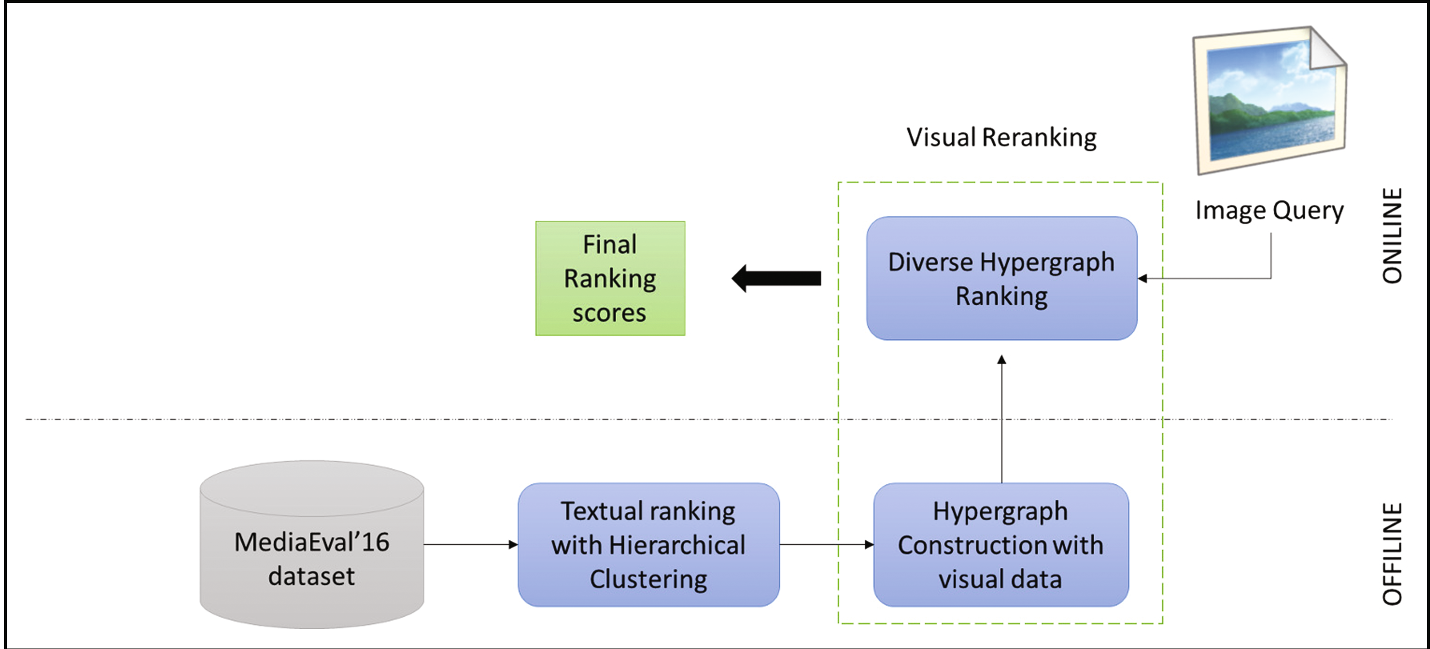 Figure 1: The workflow from initial Flickr results to the final diverse list via hypergraph ranking.
Experimental Validation
The model was tested on the MediaEval 2016 dataset (65 multi-topic queries). The evaluation used three metrics: Precision (P) for relevance, Cluster Recall (CR) for diversity, and F1-measure for the combined performance.
Key Findings:
- Diversity Boost: The proposed approach achieved a significant improvement in CR@20 (0.3738) over the Flickr Baseline (0.3609).
- Stablity: As the "cutoff" (number of returned images) increases, the diversity (CR) improves steadily, proving the model is robust at scale.
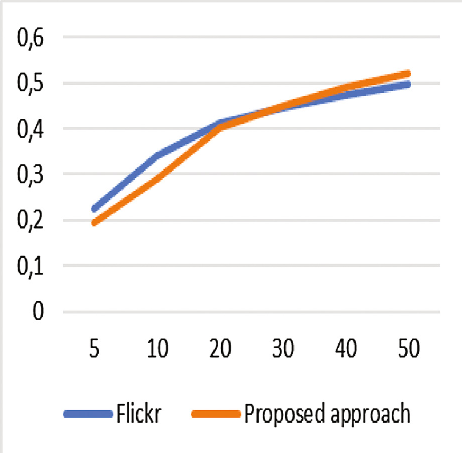 Figure 2: Performance analysis showing the trade-off in Precision as the number of ranked images (N) increases.
Comparison with SOTA
The model achieved an F1-score of 0.4013, outperforming several competitive approaches from the MediaEval challenge, including those by Feki et al. and Castellanos et al. While it trailed slightly behind Tollari et al., the authors note that Tollari's method used additional textual features and specialized visual descriptors (ScalableColor), whereas this model focuses purely on the structural ranking mechanism.
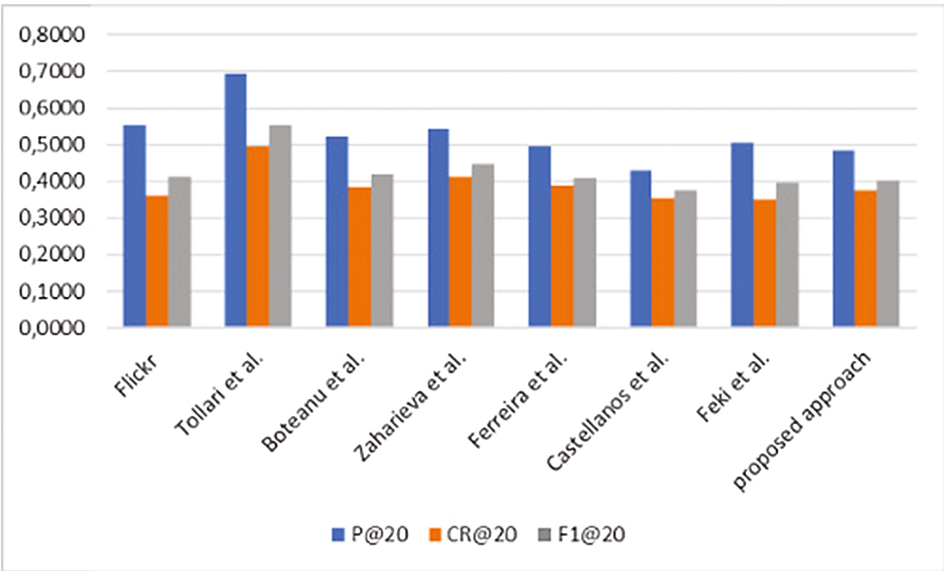 Figure 3: Comparative results against other diversification approaches.
Critical Insight & Conclusion
The beauty of this approach lies in its structural simplicity. By treating diversity as a "diffusion-suppression" problem on a hypergraph manifold, the authors avoid the heuristic "select-and-remove" strategies common in older literature.
Limitations: The model currently relies heavily on the quality of the initial CNN visual descriptors. If the visual features cannot distinguish subtle differences between images, the "absorbing" effect might be too aggressive or too weak.
Future Work: Integrating social metadata (tags, location, user-info) into the hypergraph construction could create a truly "multi-modal" diversification engine, potentially pushing the F1 scores even higher.