
IASR: Why Who You Trust Depends on What You’re Buying
IASR: An Item-Level Attentive Social Recommendation Model for Personalized Ranking
The paper introduces IASR (Item-level Attentive Social Recommendation), a neural model for personalized ranking. It combines a Multi-Layer Perceptron (MLP) architecture with a novel item-level attention mechanism to adaptively weight social influences, achieving SOTA results on CiaoDVD, Delicious, and Epinions datasets.
TL;DR
The IASR (Item-level Attentive Social Recommendation) model addresses the limitations of traditional social recommenders by introducing a neural architecture that dynamically weights social influence. By recognizing that my friend’s advice on a "basketball" is more valuable than their advice on a "bicycle," IASR achieves state-of-the-art ranking performance, particularly for "cold-start" users with little history.
Background: The Social Logic Gap
Most recommendation engines today use social networks to bridge the "cold-start" gap. If we don't know what you like, we look at what your friends like. However, current SOTA methods often make two fatal assumptions:
- The Dot Product Trap: They assume user-item interactions can be simplified into a linear dot product, which misses complex, non-linear patterns.
- The "Static Trust" Fallacy: They assume your trust in a friend is a constant value. In reality, trust is domain-specific.
Methodology: The IASR Architecture
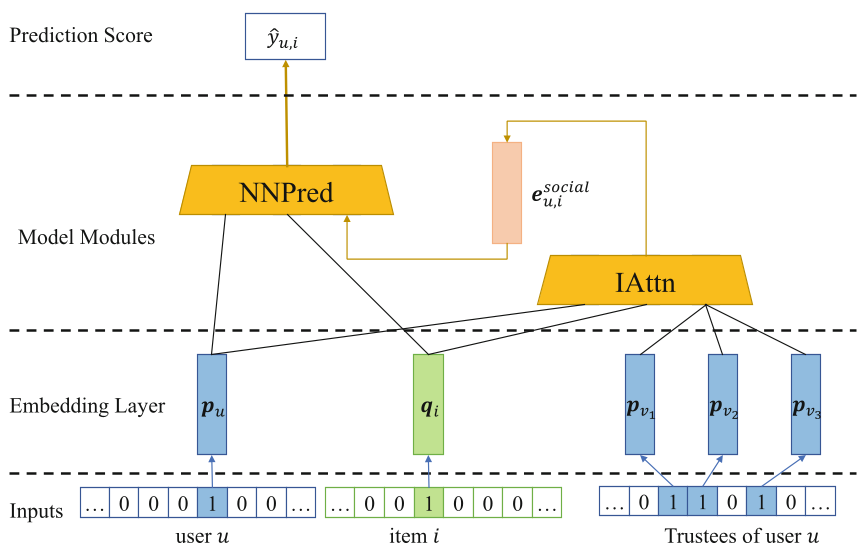
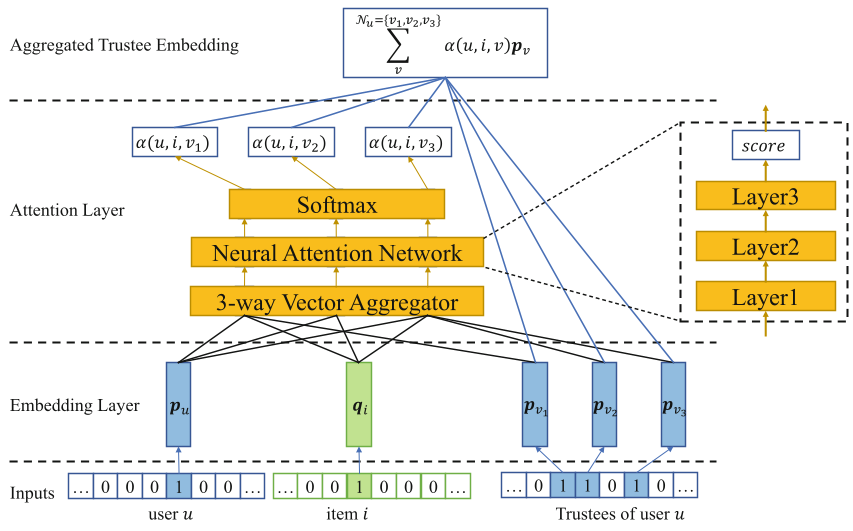
The core innovation of IASR lies in its ability to look at the User, the Item, and the Social Neighbor simultaneously before deciding how much weight to give that neighbor’s preference.
1. K-Way Vector Aggregator
IASR doesn't just stack embeddings; it uses a specialized aggregator to extract first-order (concatenation) and second-order (Hadamard product) information. This ensures that the interaction between the user's personality and the item's features is explicitly modeled.
2. Item-Level Attention
Instead of a global "trust score," IASR computes: This formula means the weight () of neighbor for user changes depending on item . This is the "Item-level" breakthrough.
Experiments: Performance & Cold-Start Resilience
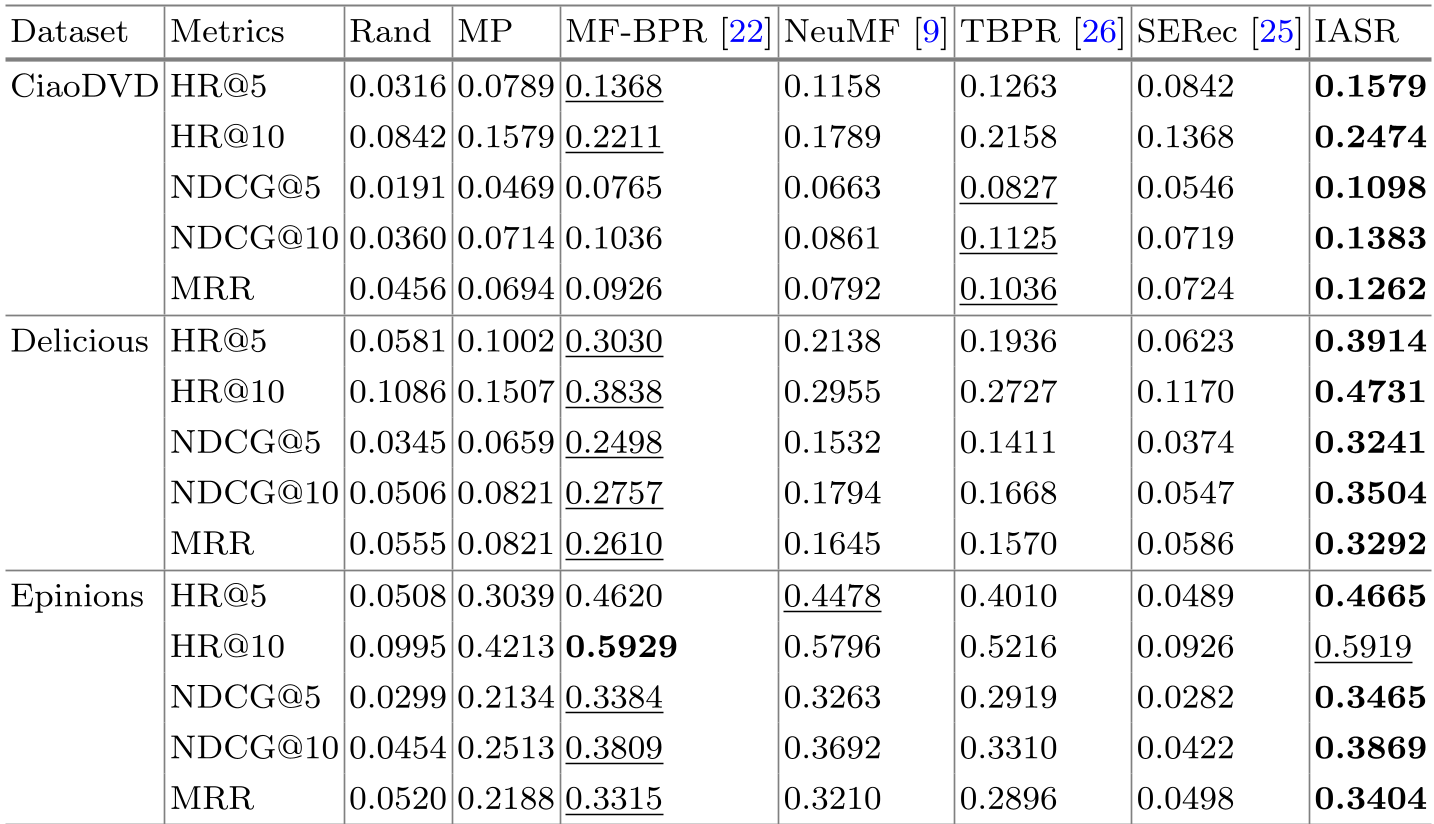
The authors tested IASR against heavyweights like NeuMF and TBPR across three datasets: CiaoDVD, Delicious, and Epinions.
| Dataset | Metric | MF-BPR | NeuMF | IASR (Ours) |
|---|---|---|---|---|
| Delicious | HR@10 | 0.3838 | 0.2955 | 0.4731 |
| Delicious | NDCG@10 | 0.2757 | 0.1794 | 0.3504 |
The Cold-Start Savior
One of the most impressive results is in the Cold-User setting (users with fewer than 5 interactions). While traditional CF models fall apart here, IASR leverages the attention-weighted social graph to maintain high precision. By looking at the right friends for the right items accurately, the model "imagines" a user's preference profile even when data is scarce.
Critical Insight: Why Attention Matters
The paper provides a case study (Table 3) showing that the model successfully puts higher weights on trustees who have actually interacted with the target item. This "evidence-based" weighting is what allows IASR to outperform static social models. It moves the system from "General Trust" to "Contextual Expertise."
Conclusion
IASR proves that in the world of social recommendation, context is king. By combining the non-linear power of Neural Collaborative Filtering with a dynamic, item-aware attention mechanism, the model creates a more human-like recommendation logic.
Future Outlook: The next step for this lineage of research will likely involve Temporal Attention—acknowledging that not only does trust depend on the item, but it also changes as friends grow and change their own interests over time.