
IDE 2.0: Transforming the Coding Environment through Collective Intelligence
IDE 2.0: collective intelligence in soware development
This paper introduces the concept of IDE 2.0, a paradigm shift that transforms Integrated Development Environments from isolated tools into collaborative platforms powered by Collective Intelligence. By integrating implicit usage data and explicit user feedback into a global knowledge base, the authors propose data-driven services for intelligent code completion, personalized code search, and automated documentation.
TL;DR
In this seminal vision paper, Bruch et al. argue that the Integrated Development Environment (IDE) is due for a "Web 2.0" revolution. By shifting from an isolated workstation to a globally connected platform, IDE 2.0 leverages the "wisdom of the crowds" to provide intelligent code completion, better search rankings, and self-healing documentation—moving beyond static tools to dynamic, data-driven assistants.
The Problem: The "Isolated Island" of Development (IDE 1.0)
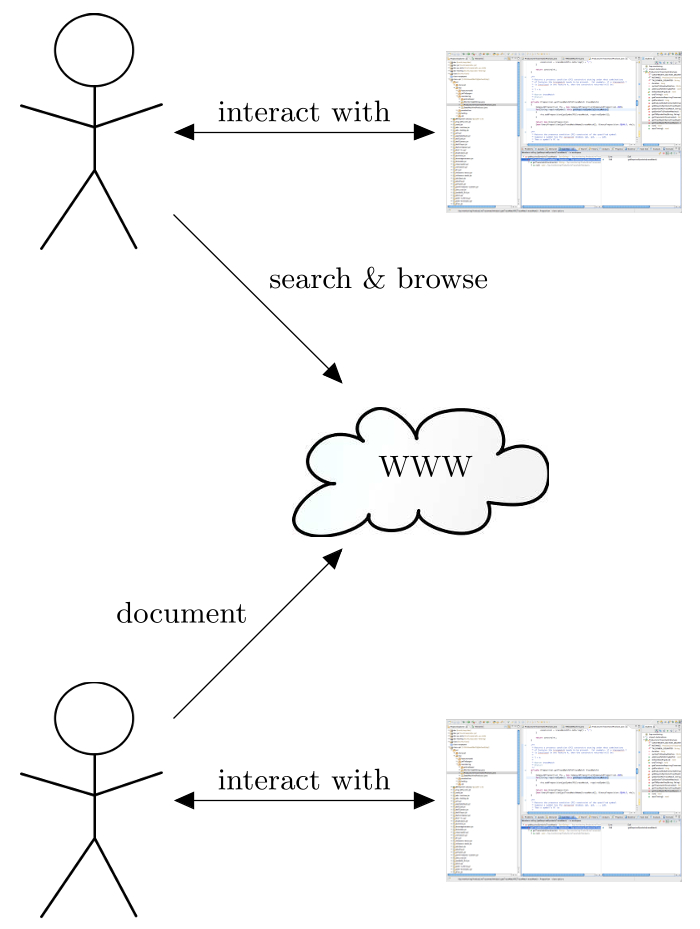
Most developers treat their IDE as a localized suite of tools. When we hit a roadblock—an obscure API or a strange bug—we manually jump to a browser, search for solutions, and then bring that knowledge back to our code. Once the task is done, that insight is effectively "lost" to the rest of the community.
Current systems (IDE 1.0) suffer from:
- Information Overload: A simple code completion trigger on a
JButtoncan return 381 method proposals, most of which are irrelevant to the current task. - Static Logic: Recommendations are often based on simple type-checking rather than how developers actually use the code in the wild.
- Knowledge Decay: Documentation and tutorials quickly become outdated, and there is no automated way to migrate that knowledge to newer API versions.
The Vision: IDE 2.0 and the Wisdom of the Crowds
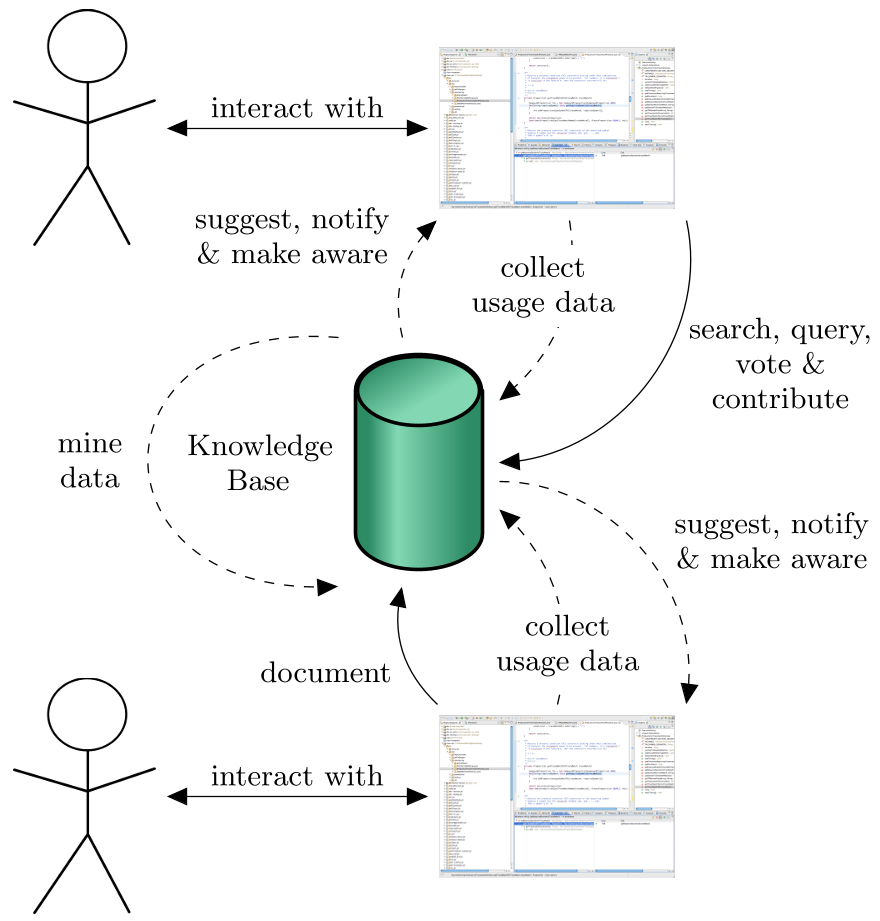
The authors propose a collaborative architecture where the IDE is no longer a silent partner but a node in a global intelligence network.
Key Methodological Pillars:
- Implicit Feedback: The IDE automatically and anonymously sends usage patterns to a central knowledge base. For example, if 90% of developers call
method Baftermethod A, the system learns this as a high-confidence recommendation. - Explicit Feedback: Users contribute documentation and ratings directly within the workflow, much like a Wikipedia for code.
- Data Mining & Intelligence: The cloud-based knowledge base uses machine learning to identify "soft rules." A classic example: "People who write an
equalsmethod almost always need ahashCodemethod."
Methodology: Applying Web 2.0 to Code
The authors identify five principles derived from the Web 2.0 movement that define the IDE 2.0 era:
- Web as Platform: Data and recommendation models are synced between the client and server.
- Data is Key: Success depends on the volume of collected usage data. The authors advocate for Open Data to allow the research community to thrive.
- Harnessing Collective Intelligence: The "Wisdom of the Crowds" provides the inductive bias needed to filter out the noise of thousands of API calls.
- Rich User Experience: Seamless, context-sensitive interfaces (like smarter AJAX-style completion).
- Lightweight Programming Models: Allowing others to build "IDE Mashups" via public APIs.
Practical Evolution: Completion & Search
The paper categorizes the evolution of tools into three stages:
- IDE 1.0 (The Past): Alphabetic lists of every possible method.
- IDE 1.5 (The Transition): Research prototypes that analyze existing source code repositories (like XSnippet or Prospector), yet struggle with scalability when libraries change.
- IDE 2.0 (The Future): Context-aware systems that learn real-time from how the global developer community is currently interacting with an API.
Critical Analysis & Conclusion
The IDE 2.0 vision was remarkably prescient. Published in 2010, it predicted the shift toward the cloud-integrated development environments we see today in tools like GitHub Copilot and Tabnine.
Takeaways:
- Context is King: Recommendations should be based on what others did in a similar structural context, not just what is syntactically legal.
- Openness Matters: For collective intelligence to work, data must be shared and open for research.
Limitations & Future Challenges:
- Privacy: While the authors mention "anonymization," the structural nature of code can sometimes leak proprietary logic, making telemetry a sensitive topic for enterprises.
- Noise: Just because the "masses" use a specific pattern doesn't mean it's the best or most secure pattern.
In conclusion, IDE 2.0 moved the industry's focus from "building tools for the individual" to "building a collective nervous system for developers."