
FHE on Ethereum: Bridging the Gap Between Transparency and Absolute Privacy
10017_A Study of the Applicability of Ideal Lattice-Based Fully Homomorphic Encryption Scheme to Ethereum Blockchain.
This paper explores the feasibility of integrating Ideal Lattice-based Fully Homomorphic Encryption (FHE) and RLWE-based Somewhat Homomorphic Encryption (SHE) into the Ethereum blockchain. It proposes a decentralized Vickrey auction system where bids remain encrypted on-chain, achieving state-of-the-art privacy and post-quantum security.
TL;DR
This research investigates integrating Fully Homomorphic Encryption (FHE) into the Ethereum ecosystem to solve the inherent privacy conflict of public ledgers. By implementing an encrypted Vickrey Auction, the authors demonstrate that it is possible to process sensitive data on-chain without exposing it to the public, achieving post-quantum security at the cost of significant computational "Gas."
The Transparency Hazard in Blockchain
Public Blockchains like Ethereum are built on decentralization and transparency. While these features ensure trust, they are a nightmare for privacy. Every input, parameter, and output of a Smart Contract is visible to all nodes.
Previous attempts to solve this via Multiparty Computation (MPC) require massive communication rounds, and Zero-Knowledge Proofs (ZKP) often require complex proof generation that lacks scalability for multi-user interactions. FHE offers a third way: the ability to compute directly on encrypted data.
Methodology: High-Trust Architecture
The proposed framework divides the workload into two segments:
- Off-Chain: Users generate keys and encrypt their bids.
- On-Chain: The Ethereum Virtual Machine (EVM) executes FHE logic gates (XOR, AND) to compare bids and determine a winner without ever "seeing" the actual prices.
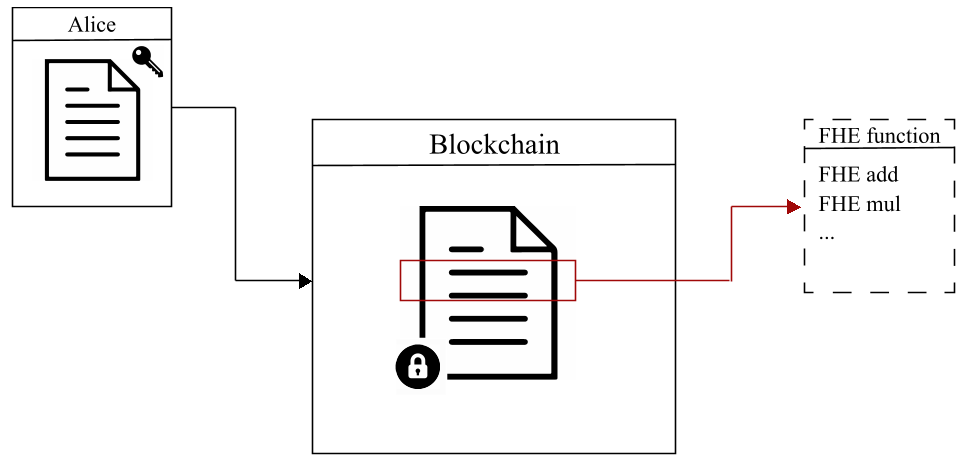 Fig 1. Schematic diagram of the FHE-Blockchain framework.
The Core Logic: Comparison in the Dark
To run an auction, the contract must sort values. The authors decomposed integer comparisons into bit-level FHE operations. For example, a "Swapping" operation involves checking the Most Significant Bit (MSB) of the difference between two ciphertexts.
- Additive Homomorphism: Maps to an XOR gate.
- Multiplicative Homomorphism: Maps to an AND gate.
Experimental Benchmarks: The "Gas" Tax
While bit-level logic is cheap, the complexity compounds quickly. The authors tracked the Gas consumption for various operations:
| Operation | Gas Spent |
|---|---|
| XOR / AND | 290 |
| Full Add | 1,792 |
| Swapping (1-bit) | 1,138,004 |
| Initialization | 290,302 |
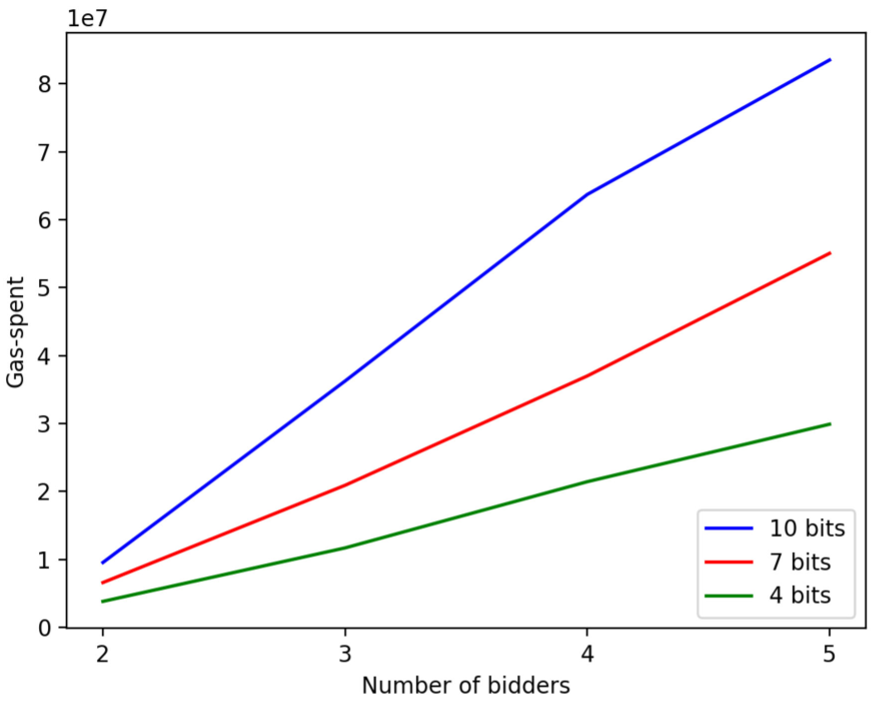 Fig 2. Gas-spent of Vickrey auction with respect to the number of bidders and bit-length.
The study reveals a linear growth in cost relative to the number of participants. A 5-bidder auction costs roughly 15 USD (at 2020 prices). While expensive compared to a standard transfer, it is arguably cheaper than the fees charged by traditional high-end auction houses like Christie's—with the added benefit of absolute privacy.
Critical Analysis & Future Outlook
The Gap to Reality: The research highlights a "significant gap" for RLWE-based SHE schemes. For full post-quantum protection, the required key lengths (over 1.7 million bits) currently exceed what Ethereum can efficiently handle.
Key Takeaways:
- Privacy-Efficiency Trade-off: FHE is functional on Ethereum today, but only for high-value, low-frequency tasks (like large-scale auctions or secret voting).
- Post-Quantum Preparedness: As quantum computing looms, lattice-based FHE provides a future-proof layer that RSA or Elliptic Curve signatures cannot.
- Limitations: The current model assumes a "semi-honest" auctioneer to hold the private key, suggesting a need for integration with Threshold Cryptography in future iterations to remove this single point of failure.
Conclusion
This paper serves as a vital bridge between theoretical cryptography and the practical constraints of distributed ledgers. While "Gas" remains a heavy tax, the ability to perform computations in the encrypted domain on a public blockchain opens the door to a new generation of truly private decentralized finance (DeFi) applications.