
Decoding Digital Identities: A Multi-Dimensional Approach to Identifying Organizational vs. Individual Users
12765_On Identification of Organizational and Individual Users Based on Social Content Measurements.
This paper introduces a multi-dimensional framework to distinguish between organizational and individual users on social networks by measuring social content. It proposes four novel methods—CCI, CNI, MCI, and TSCI—leveraging text complexity, format normalization, multimedia features, and time-series behaviors, achieving a peak identification accuracy of 97.87% on Sina Weibo data.
TL;DR
In the vast sea of social media, distinguishing a corporate entity from a private person is critical for everything from targeted marketing to public sentiment regulation. This paper moves beyond simple keyword matching and proposes four robust metrics—Complexity, Normalization, Multimedia, and Time-Series—to identify users. Their "Content Normalization" method reached a staggering 97.87% accuracy on Sina Weibo data.
Problem & Motivation: The Identity Crisis in Social Networks
Identity is the cornerstone of social activity. However, in the virtual world, it remains largely implicit. Standard identification methods face two major hurdles:
- Sparsity of Truth: Only a tiny fraction (roughly 0.6%) of users on platforms like Sina Weibo are officially "certified."
- The Vocabulary Overlap: Individual and organizational users often use similar language. A simple Naive Bayes model (Probability Model) only achieves about 59% accuracy because the subject matter isn't distinct enough.
The authors' core insight is that the structural and behavioral patterns of an organization—governed by workflows and public relations goals—are fundamentally different from the random, mood-driven behaviors of a human individual.
Methodology: The Four Pillars of Identification
The study breaks down user content () into three sets: Text (), Multimedia (), and Time-Series ().
1. Content Complexness Identification (CCI)
Based on Information Entropy, the authors posit that humans are "messier." We post about lunch, work, hobbies, and sports. Organizations are focused. CCI measures User Content Entropy. High entropy indicates high topic diversity, signaling an individual.
2. Content Normalization Identification (CNI)
Organizations love templates. This method calculates Structure Entropy based on the variance of post lengths and the presence of unified marks (e.g., specific brackets for news topics).
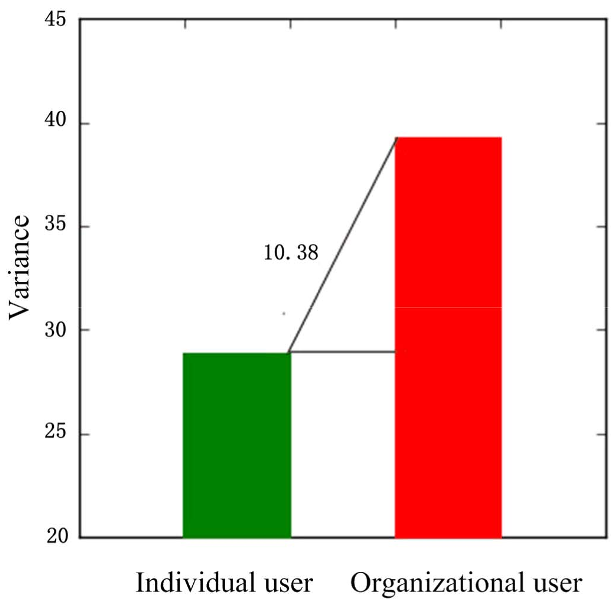 Fig 1: Notice how individual content lengths have much higher variance (39.28) compared to organizations (28.9).
3. Multimedia Content Identification (MCI)
The "Selfie" logic: An individual’s photo stream often features the Same Person (SP). An organization’s feed contains diverse images related to its industry. Using PCA-based face recognition, the system identifies the ratio of "common characters" in a user’s media gallery.
4. Time-Series Content Identification (TSCI)
Humans and corporations operate on different clocks. Organizations peak during 9:00-11:00 and 15:00-17:00 (working hours). Humans peak during "rest hours" like lunch and late night (21:00-23:00).
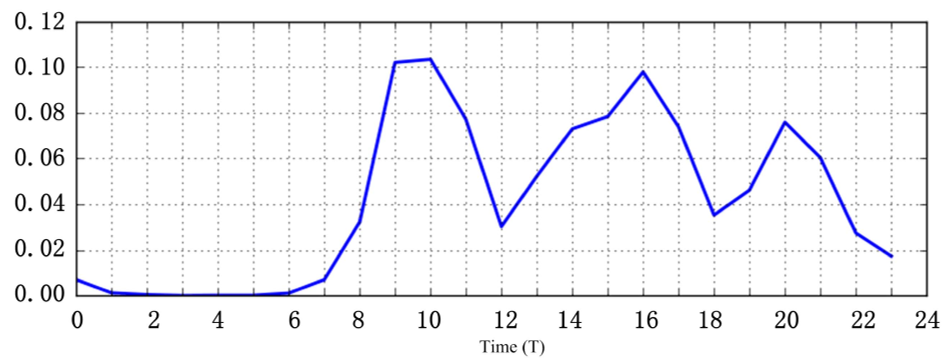 Fig 2: Temporal patterns of individual users showing peaks during leisure time.
Experiments & Results
The researchers tested their methods on a massive dataset of 65,000 Weibo users and 32 million posts.
| Method | Accuracy | F1-Score (Ind/Org) |
|---|---|---|
| Probability Model (Baseline) | 59.4% | 66.92 / 47.46 |
| CCI (Complexity) | 89.10% | 92.4 / 80.7 |
| CNI (Normalization) | 97.87% | 98.5 / 96.2 |
| TSCI (Time-Series) | 80.85% | 85.77 / 70.75 |
The Content Normalization Identification (CNI) emerged as the clear winner. This proves that the "rigidity" of organizational posting (uniform length and formatting) is a nearly perfect biometric for digital identity.
Critical Analysis & Conclusion
Takeaway
The paper successfully demonstrates that identity is encoded in the form of communication, not just the content. For researchers, this means that Entropy-based measurements are highly effective tools for behavioral modeling in noisy environments.
Limitations
- Threshold Dependency: The accuracy is highly sensitive to the identification threshold (). Setting these values currently requires empirical pre-tuning.
- The "Pro" Individual: Professional influencers or "Personal Brands" might mimic organizational structures, potentially confusing the CNI and CCI methods.
Future Work
The authors suggest expanding the dimensionality to include network structure (friendship graphs) and improving the optimization techniques for cross-platform identification. This framework provides a solid foundation for more granular classification, such as identifying a user's specific profession (student vs. white-collar worker).