
To Catch a Gambler: A Game-Theoretic Trap for Careless Crowd Workers
Identifying Careless Workers in Crowdsourcing Platforms: A Game Theory Approach
This paper introduces a game-theoretic mechanism based on the "Chicken Game" to identify careless workers (gamblers) in crowdsourcing platforms. By using monetary incentives to create a competition between speed and accuracy, the authors demonstrate that Task Completion Time (TCT) becomes a powerful discriminator for worker quality.
TL;DR
Researchers from the University of Glasgow have developed a "mathematical trap" to catch low-quality workers in crowdsourcing. By treating relevance assessment as a competitive "Chicken Game," they proved that careless workers (risk-inclined gamblers) will naturally rush to finish tasks faster than others to win a bonus, making Task Completion Time (TCT) a near-perfect signal for poor performance.
Background: The Crowdsourcing Quality Dilemma
Crowdsourcing is the lifeblood of modern AI and Information Retrieval (IR) evaluation, providing the "ground truth" labels necessary for training models. However, the platform is plagued by careless workers—those who prioritize speed over accuracy to maximize their hourly rate.
Traditionally, we catch these workers using "Honey Pots" (test questions with known answers) or "Gold Standards." While effective, these methods are expensive to produce and increase the overall latency of the experiment. This paper asks a deeper question: Can we design a task environment where bad workers naturally expose themselves?
The "Chicken Game" Insight
The authors hypothesize that careless workers aren't just lazy; they are risk-inclined. They are willing to gamble on a random answer for the chance of a quick payout.
To test this, they modeled the task as an n-player Chicken Game. In the classic version, two drivers race toward a cliff; the last to jump out wins, but if neither jumps, both die. In this crowdsourcing version:
- The Goal: Produce a correct result.
- The Incentive: A bonus ($2.00) is given to the fastest correct worker.
- The Penalty: If you are wrong, you don't get paid at all.
This creates two opposing forces: a "push" toward quickness (to win the bonus) and a "push" toward correctness (to ensure payment).
Mathematical Intuition
The paper provides a formal proof (Theorem 1) using Bayesian Nash Equilibrium. The core logic is that a "gambler" overestimates the probability of success in uncertain situations (convex utility curve). Consequently, their mathematical optimum for utility occurs at a significantly lower Task Completion Time (TCT) than for risk-averse or risk-neutral workers.
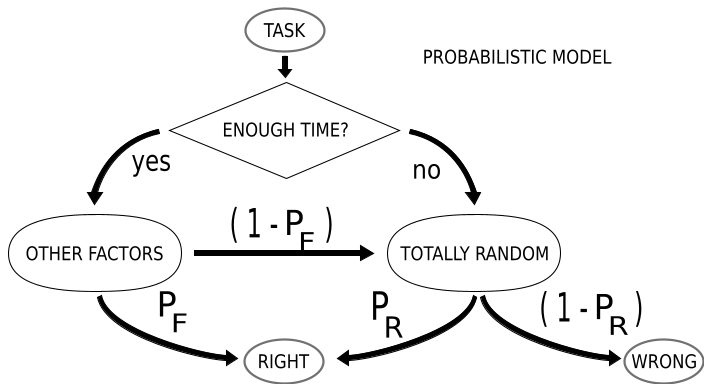 Figure 1: Risk-inclined players (top curve) perceive higher utility in uncertain, fast-paced scenarios.
Methodology and Experimental Setup
The researchers conducted a between-group study on Amazon Mechanical Turk (M-Turk) using 35 topics from the TREC-8 collection:
- Base Group: Standard instructions. "Do the task carefully, or your HIT will be rejected."
- Game Group: The "Trap." "You are competing. The fastest correct worker gets a $2.00 bonus."
All actions were logged at the client-side to remove network latency noise, focusing purely on the cognitive time spent on the relevance assessment.
Results: The Smoking Gun
The experiment confirmed the theorem with striking clarity.
In the Base Scenario, time spent on a task had almost no correlation with accuracy. Some slow workers were bad, and some fast workers were good. The signal was "noisy."
However, in the Game Scenario, a clear pattern emerged: The workers in the lowest performance bracket (0.2 - 0.4 precision) were consistently the fastest. By introducing the competition, the authors effectively "baited" the careless workers into rushing.
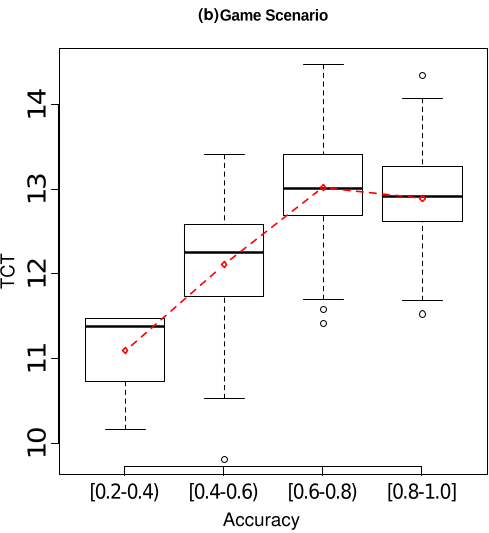 Figure 4: Note the sharp drop in TCT for low-precision workers in the Game Scenario (b) compared to the Base Scenario (a).
Critical Analysis & Conclusion
This paper is a masterclass in applying Mechanism Design to human computation. Instead of adding more "checks" (which cost money), it modifies the reward structure to make behavior more transparent.
Key Takeaways:
- TCT is a dynamic variable: Its value as a quality signal depends entirely on the incentive structure.
- Gambler Detection: Competitive rewards act as a filter. If someone is consistently the "fastest" in a competition but has low accuracy, they are mathematically proven to be a risk-inclined gambler.
Limitations: While brilliant, this method relies on a monetary "bonus" which might increase the cost of a single HIT. However, the authors argue this is "cost-effective" because it eliminates the need for expensive gold-standard data in the long run. Future work could explore if "social prestige" or non-monetary leaderboard points could trigger the same risk-inclined behavior in gamblers.
Final Thought: Next time you design a crowdsourcing task, don't just ask for quality—incentivize speed and watch the bad actors reveal themselves.