
Finding the Pulse: Identifying Early COVID-19 Opinion Leaders on Twitter
Identifying Early Opinion Leaders on COVID-19 on Twitter
This study aims to identify opinion leaders on Twitter during the early stages of the COVID-19 pandemic (Jan-March 2020) using Innovation Diffusion Theory (DOI). By combining Correlation Network Analysis (CNA) and Sentiment Analysis (VADER/LIWC), the researchers mapped conversations from lay users and US President Donald Trump to detect thought leadership patterns.
TL;DR
As the COVID-19 pandemic took hold in early 2020, Twitter became a chaotic arena of information and opinion. This study investigates whether specific "opinion leaders" directed the flow of conversation using Innovation Diffusion Theory (DOI). Despite identifying distinct thematic clusters in politics and health, researchers found that the traditional S-Curve of adoption did not fit the rapid, polarized nature of social media, revealing a fundamental disconnect between classical communication theories and modern digital behavior.
Problem & Motivation: The Chaos of the Onset
In the physical world, ideas often spread through a "two-step flow": mass media informs opinion leaders, who then influence the masses. However, social media has flattened this hierarchy. During the onset of COVID-19, the surge of misinformation and the "infodemic" made it crucial to understand who was actually leading the conversation.
The researchers sought to determine if the emergence of COVID-19 opinions followed the S-Shape Curve—a model where a slow start of "innovators" leads to a rapid "early majority" surge. The central friction lies in whether social media users act as true opinion leaders or if they are simply participants in a polarized echo chamber.
Methodology: Correlation Networks and Sentiment Polarity
The study analyzed over 550,000 tweets from lay users and 1,004 tweets from President Donald Trump. The technical pipeline consisted of:
- Correlation Network Model (CNM): Nodes represented Conversation IDs (ConvIDs), connected only if their correlation coefficient was 95% or higher.
- Cluster Enrichment: Using the Gephi platform and the Fruchterman-Reingold algorithm, the authors grouped users into three primary thematic clusters.
- Sentiment Mapping: Employing VADER (specialized for social media) and LIWC (for psychological linguistic markers like "Clout" and "Analytic" thinking).
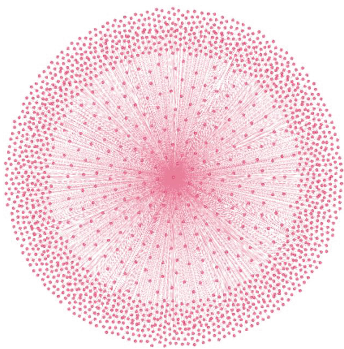 Fig 1: Representation of Cluster 1 (Politics), the most dense community in the network.
Key Insights: Themes over Leaders
The analysis revealed three distinct "communities" of conversation:
- Cluster 1 (Politics): Broadly polarized debate focusing on US policy and the "flu" comparison.
- Cluster 2 (Health): Focused on travel restrictions and health precautions.
- Cluster 3 (Economics): The smallest group, centered on re-opening the economy.
The "Trump" Paradox
A significant portion of the methodology involved comparing lay users to President Trump. While the thematic content of Trump’s tweets was highly correlated with the general public (meaning they talked about the same things), the Tone was vastly different.
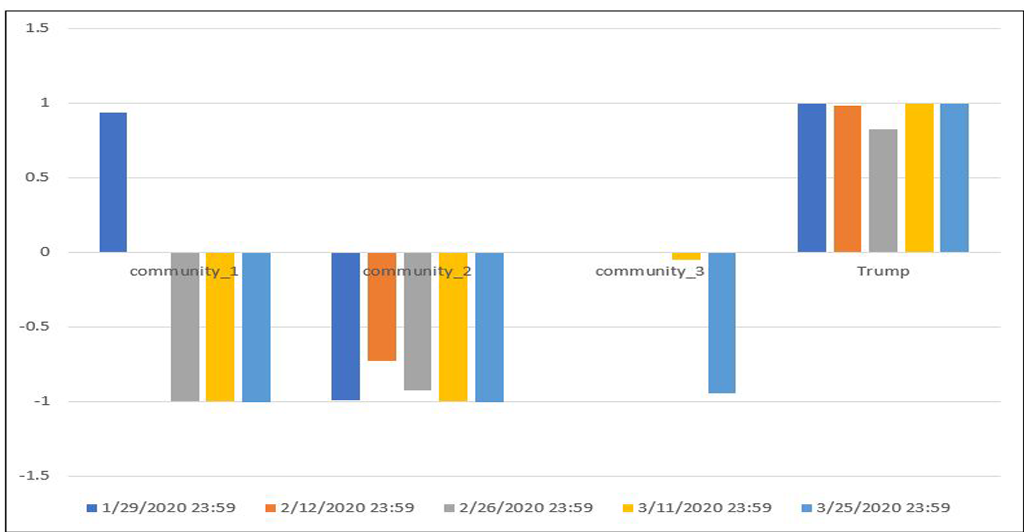 Fig 2: VADER polarity scores over time, showing Trump's consistent positive tone compared to the more volatile and neutral/negative public sentiment.
As seen in the data, Trump maintained a positive sentiment (mean score 0.204) aimed at providing assurance, whereas the general public's COVID-related tweets hovered near a neutral/negative baseline (-0.039).
Experimental Results & SOTA Comparison
The most striking finding was a negative result: the Innovation Diffusion Theory did not apply.
- S-Curve Failure: The researchers could not replicate the 2.5% innovator / 13.5% early adopter distribution.
- Followership vs. Leadership: Many "potential leaders" had high retweets, but there was no evidence that the general public’s specific opinions converged or conformed to these individuals over time.
- The "Two-Tweet" Theory: The authors suggest tweets fall into two buckets: those intended to elicit agreement (echo chambers) and those intended to elicit debate (polarization).
Critical Analysis & Conclusion
Takeaway
The study suggests that in a digital crisis, "Opinion Leadership" is an elusive metric. Influence on Twitter is more about thematic synchronization (everyone talking about the same thing) than ideological persuasion (one person changing the minds of many).
Limitations
- Sample Imbalance: The dataset for President Trump was significantly smaller than the lay user set.
- Static Snapshot: The study only covers the onset of the pandemic. Opinion leadership roles likely shifted as the crisis became a long-term reality.
Future Outlook
For researchers looking to build on this, the next step involves time-lagged correlation. By mapping tweets against real-world events (like CDC announcements), we can see if social media sentiment precedes or follows official policy changes, providing a more dynamic view of "leadership" in the 21st century.