
MNSSM: Unmasking Micro-Level Anomalies in Dynamic Social Networks
Identifying and Evaluating Anomalous Structural Change-based Nodes in Generalized Dynamic Social Networks
The paper introduces the Multiple-neighbor Superposition Similarity Method (MNSSM) to identify and evaluate micro-level anomalous structural changes in generalized dynamic social networks. By leveraging a novel superposition similarity index and Particle Swarm Optimization (PSO), the method achieves state-of-the-art performance in detecting anomalous nodes across undirected, unweighted graphs.
TL;DR
Researchers have developed a powerful new method called MNSSM (Multiple-neighbor Superposition Similarity Method) to detect individuals in a social network who exhibit suspicious structural changes—like a user suddenly and indiscriminately adding friends or a corporate employee shifting communication patterns during a crisis. Unlike previous methods that look at the whole network, MNSSM zooms in on individual nodes, using complex "multiple-neighbor" analysis and Particle Swarm Optimization to achieve superior accuracy.
The Problem: Missing the Trees for the Forest
In the study of dynamic social networks, most researchers have focused on macroscopic changes—detecting when "something" happens in the network overall. However, current tools often ignore the micro-level (individual nodes).
The challenges are twofold:
- Limited Reach: Most algorithms only look at a node's direct neighbors. In reality, a node's influence and structural stability are tied to parts of the network several "hops" away.
- Structural Complexity: Structural change is multi-dimensional. Using a single metric (like node degree or clustering coefficient) is like trying to diagnose a patient's health by only checking their temperature.
Methodology: The MNSSM Framework
MNSSM solves these issues by breaking the process into two intelligent algorithms.
1. Multiple-Neighbor Range Algorithm (MNRA)
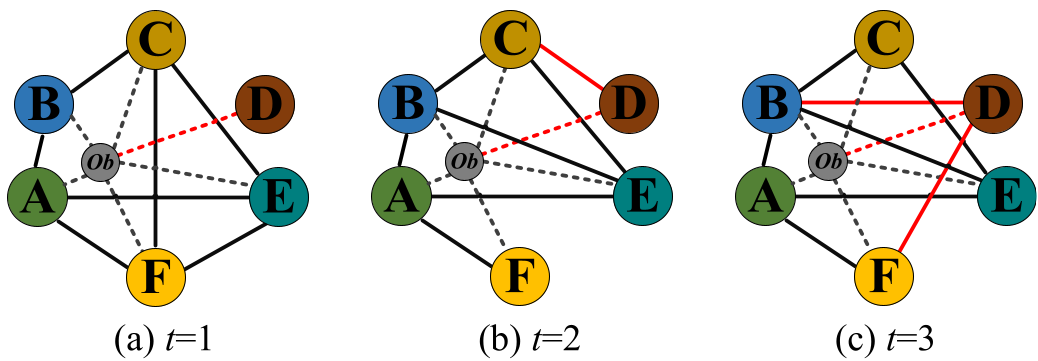
MNRA extends traditional similarity indices (like Jaccard or Adamic-Adar) into multiple-neighbor ranges. It introduces a virtual "observation node" connected to all others to stabilize calculations during drastic changes. It calculates how similar a node at time is to its past self at time by looking at neighbors at range .
2. Superposition Similarity Fluctuation Algorithm (SSFA)
Since different similarity metrics tell different stories, MNSSM uses Particle Swarm Optimization (PSO) to find the perfect "adaptive factors" (). This coordinates various metrics into a single Superposition Similarity Fluctuation Index.
The goal is to maximize the fluctuation value for a node if its behavior deviates significantly from a "criterion period" (a baseline of normal behavior).
Experiments & Results
The authors tested MNSSM against 8 datasets involving email, scientific collaboration, and Wikipedia talk pages.
Performance Comparisons
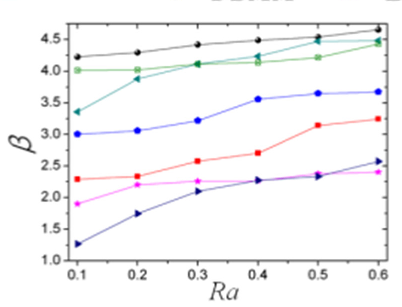
Compared to state-of-the-art methods like RoleD and EBM, MNSSM consistently achieved higher Identification Accuracy (). Even as the ratio of anomalous nodes increases, MNSSM maintains a clear gap over its competitors.
The Enron Case Study
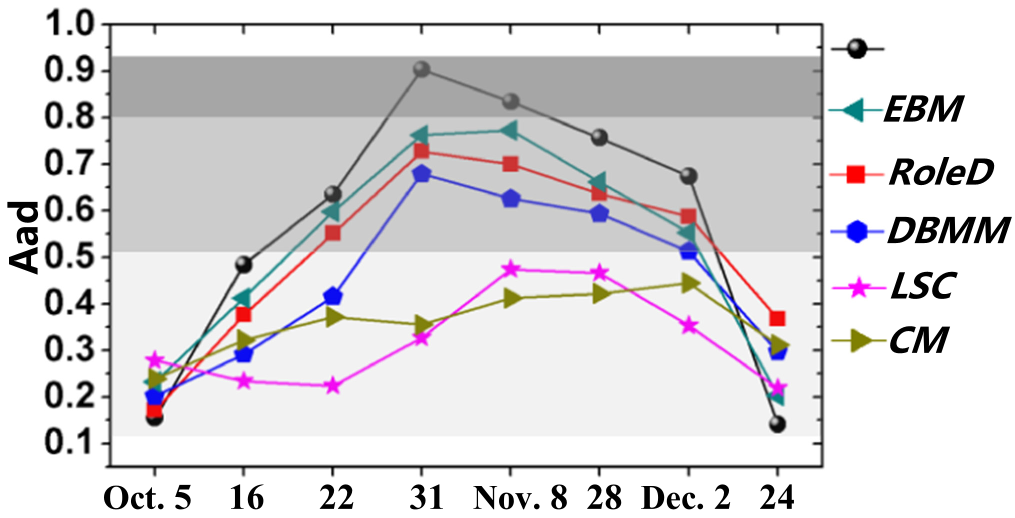
In a high-stakes real-world test using the Enron email dataset, MNSSM was put to work identifying key players during the company's collapse in 2001. The algorithm showed massive "spikes" in anomalous degrees precisely when the SEC launched investigations or when Enron filed for bankruptcy. It successfully flagged the employees whose communication structures were most disrupted by these historical events.
Critical Insight & Conclusion
The core genius of MNSSM lies in its structural intuition: it recognizes that a node is defined not just by who it knows (direct neighbors), but by its place in the broader neighborhood topology. By using PSO to weigh different structural perspectives, it avoids the "one-size-fits-all" trap of previous link-prediction based models.
Limitations: The method is computationally intensive due to the PSO iterations, and the selection of "criterion periods" still requires some manual oversight.
Future Outlook: Integrating this with Community Detection or expanding it to weighted/directed graphs (where intensity of communication matters) could make this the definitive tool for digital forensics and crisis management.