
DMFO: Revolutionizing Influence Maximization with Metaheuristic "Moths"
Identifying Influential Spreaders in Social Networks Through Discrete Moth-Flame Optimization
This paper introduces a Discrete Moth-Flame Optimization (DMFO) algorithm combined with a novel two-hop influence assessment model for Influence Maximization (IM) in social networks. By redefining MFO for discrete spaces and incorporating variance into fitness evaluation, the method achieves accuracy comparable to the greedy SOTA (CELF++) with significantly reduced computational overhead.
Executive Summary
Identifying "super-spreaders" in social networks is critical for viral marketing, epidemic control, and information dissemination. While greedy algorithms provide a theoretical 63% accuracy guarantee, their computational cost on massive graphs is staggering. This paper presents Discrete Moth-Flame Optimization (DMFO), a nature-inspired approach that bridges the gap between the speed of heuristics and the accuracy of greedy methods. By integrating a "variance-aware" valuation model, DMFO identifies seed sets that aren't just powerful but robust against communication failures.
The Core Challenge: Accuracy vs. Efficiency
The Influence Maximization (IM) problem is NP-hard. Historically, researchers chose between:
- Greedy Strategies (e.g., CELF++): High accuracy via Monte Carlo simulations, but painfully slow.
- Centrality Heuristics: Fast (O(N log N)), but they ignore "overlapping influence" (two influencers covering the same friends), leading to poor results.
The authors' insight? Social links are unreliable. Most influence models assume perfect transmission, but true influence requires a "robust" spread.
Methodology: The DMFO Framework
The researchers transformed the continuous MFO algorithm—which mimics moths spiraling toward flames—into a discrete search engine for high-influence node sets.
1. Robust Fitness Function
Instead of just counting neighbor degrees, the authors proposed a two-hop influence estimator: This rewards high total reach () but penalizes high variance (). This prevents the algorithm from picking "unstable" influencers who rely on a single breakthrough connection.
2. Discrete Evolution Scheme
Traditional MFO uses continuous updates. DMFO replaces this with:
- Search Area Selection: To save time, it limits the search to nodes with high potential based on a degree-based heuristic ().
- Local Crossover: Uses "moth" positions to decide which nodes to swap between the current seed set and the global best.
- Mutation: Small probability swaps to prevent the algorithm from getting stuck in local optima.
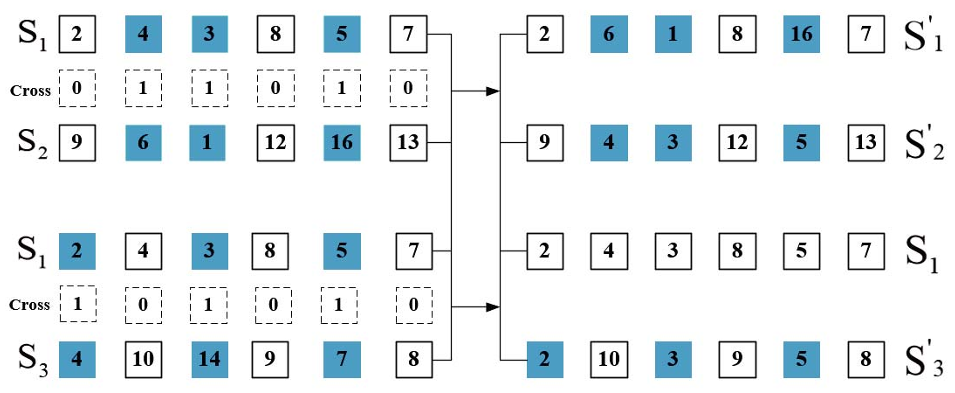 Fig 1: The crossover operation where "Moth" positions guide the evolution of influencer sets.
Experimental Battleground
The algorithm was tested against 8 rivals (including PageRank, GWO, and CELF++) across five real networks ranging from 379 to 11,565 nodes.
Performance & Statistical Significance
The "Influence Power" curves show DMFO (blue line) consistently tracking the performance of the gold-standard CELF++. Statistical Friedman tests prove that there is no significant difference in accuracy between DMFO and the greedy SOTA, but DMFO is significantly faster.
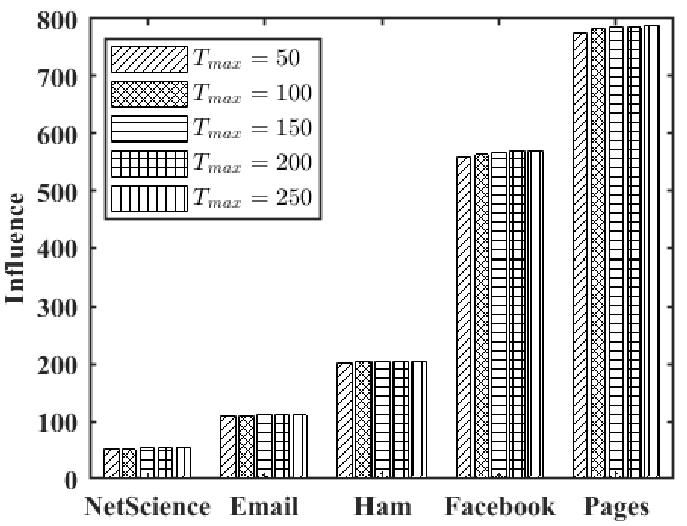 Fig 2: Influence spread comparison across different seed set sizes (k).
Efficiency: The Real Winner
As shown in the running time charts, while centrality methods like Degree Centrality (DC) are fastest, DMFO maintains a flat growth curve compared to the escalating costs of BC and PageRank as network size increases.
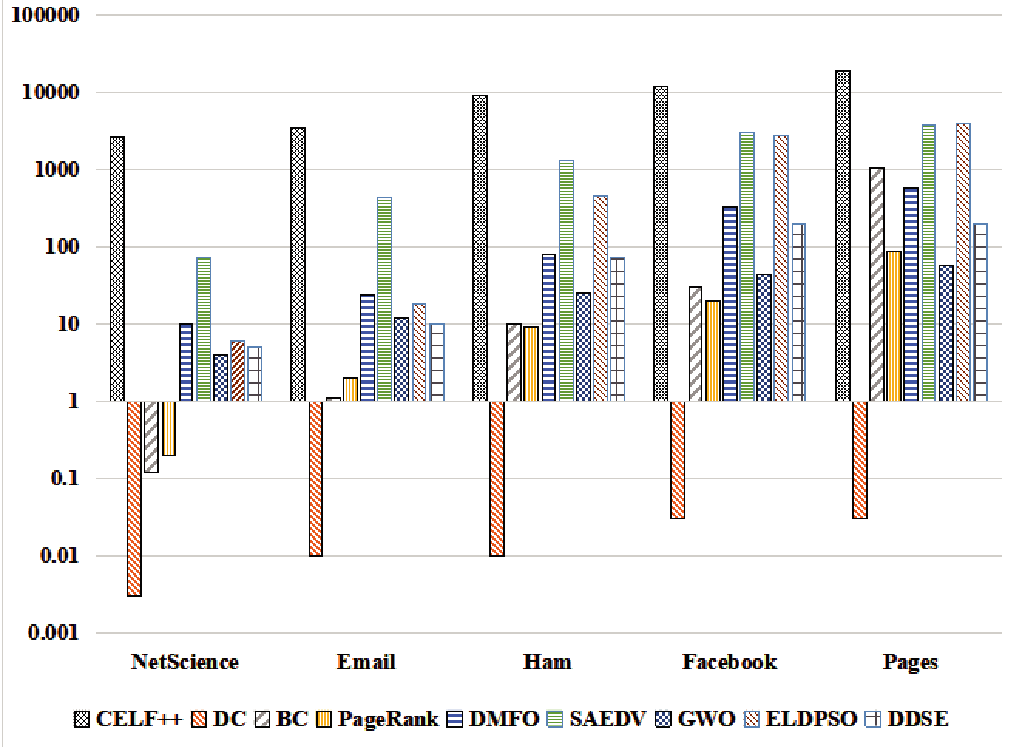 Fig 3: Running time comparison. Note how DMFO remains efficient even as graph scale increases.
Deep Insight & Conclusion
This paper's success lies in its Inductive Bias: it uses graph topology (degree) to narrow the search space but uses a swarm intelligence metaheuristic to intelligently navigate that space. The inclusion of the "valuation variance" adds an element of risk management to influence spread—a factor often ignored in theoretical models but critical in real-world marketing.
Limitations: The reliance on a degree-based search area selection might occasionally miss "bridge nodes" (low degree but high betweenness) in very specific network topologies like bottlenecks.
Future Outlook: The DMFO framework could easily be extended to multi-objective optimization—where we might simultaneously maximize spread while minimizing cost or targeting specific demographics.