
NLC: Redefining Influential Spreaders via Normalized Local Structure Attributes
Identifying Influential Spreaders in Social Networks Via Normalized Local Structure Attributes
This paper introduces Normalized Local Centrality (NLC), a novel metric for identifying influential spreaders in social networks by integrating local topology and neighbor influence feedback. It achieves higher accuracy than traditional centralities (DC, BC, CC) and semi-local methods (LC, LSC) across various real-world and synthetic networks.
TL;DR
Identifying "super-spreaders" in social networks—nodes that can trigger massive information cascades—is critical for viral marketing and epidemic prevention. This paper proposes Normalized Local Centrality (NLC), a method that captures a node's influence by looking at its local neighborhood structure and clustering coefficients. By introducing an automated normalization mechanism, NLC outperforms traditional global metrics (like Betweenness) and local metrics (like Degree) in both accuracy and speed.
The Core Challenge: Accuracy vs. Efficiency
In the study of complex networks, we often face a trade-off:
- Global Metrics (Betweenness, Closeness): Highly accurate because they see the whole map, but computationally "expensive" ( or higher), making them useless for modern networks with millions of users.
- Local Metrics (Degree, k-shell): Lightning fast, but "blind" to the structural nuances. Two nodes with the same number of friends (Degree) might have vastly different spreading potential depending on whether those friends are connected to each other or act as bridges to other communities.
The authors argue that existing "semi-local" improvements often fail because they rely on fixed parameters. For instance, if you weight the clustering coefficient too heavily in one network, the model breaks when applied to another.
Methodology: The NLC Intuition
The NLC measure (Normalized Local Centrality) is built on a simple yet powerful physical intuition: A node's influence is the sum of the "feedback" it receives from its neighbors.
The Formula Breakdown
The NLC of a node is defined as:
Where represents the influence of neighbor . This influence is determined by:
- Quantity: The size of the neighbor's own neighborhood ().
- Quality (): A normalized combination of the neighborhood's connectivity and its Local Clustering Coefficient.
The "Secret Sauce": Normalization
To avoid the "parameter trap," the authors used a square-root normalization function: This ensures that structural attributes of different scales (like a high degree vs. a small clustering coefficient) can be fused fairly without manual tuning.
 Figure 1: Comparison of local structures. While nodes 'a' and 'b' might have similar simple counts, their connectivity patterns differ, affecting their NLC score.
Experiments: Proving Superiority
The researchers tested NLC across five real-world datasets (Blog, Twitter, Email, etc.) and three synthetic models (ER, WS, BA) using the SIR (Susceptible-Infected-Recovered) model as the "ground truth" for spreading efficiency.
1. Superior Ranking Consistency
Using Kendall's Tau () to measure how closely NLC matches the real spreading results, NLC consistently stayed at the top of the charts.
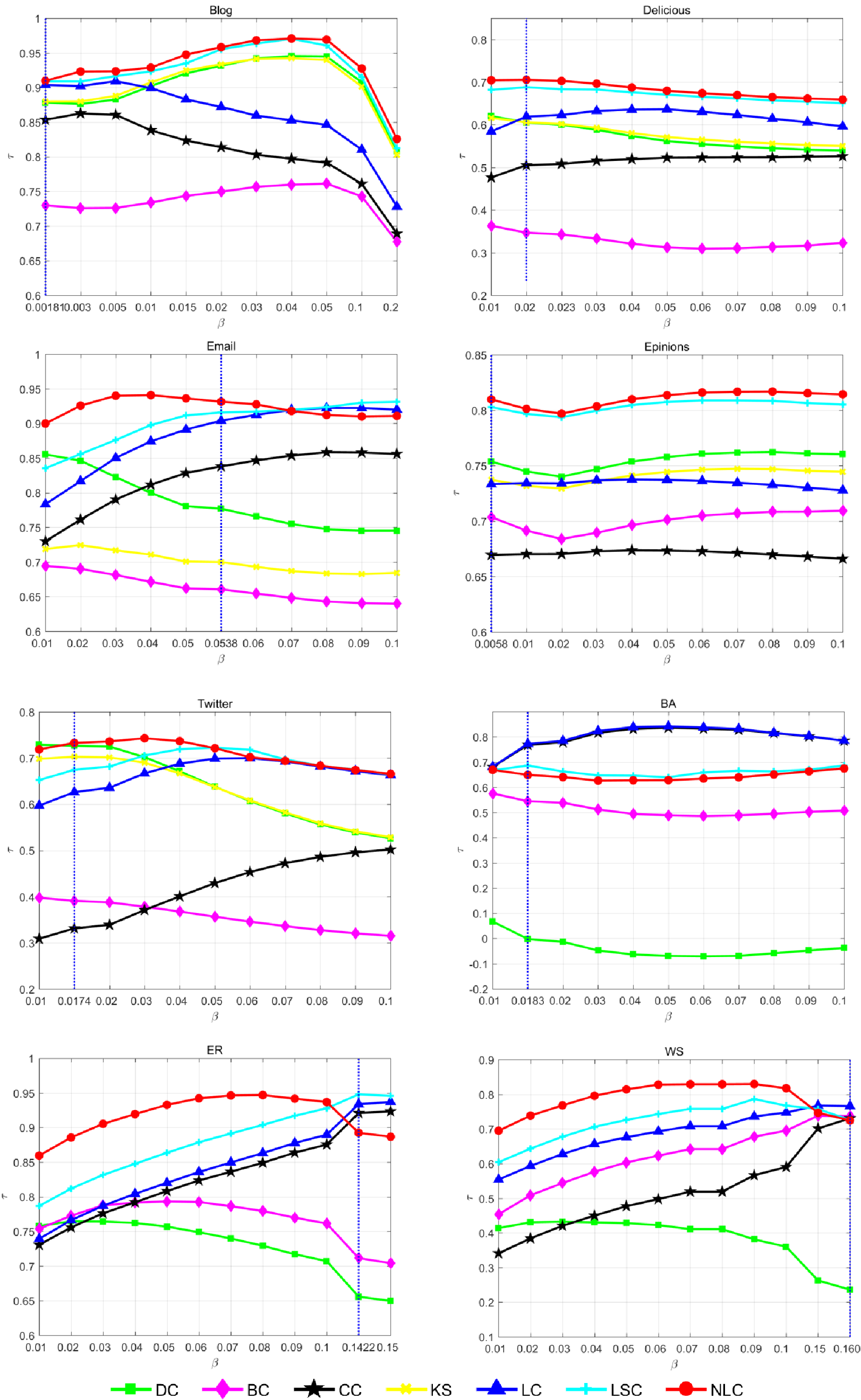 Figure 2: Kendall's Tau results across varying spreading probabilities (). NLC (red line) consistently dominates.
2. Viral Coverage
When the "Top-100" nodes identified by each method were used as seeds for an infection, NLC-selected nodes infected more people faster than any other method. In the Twitter dataset, the improvement was particularly stark, overcoming the limitations of standard Closeness and Betweenness metrics.
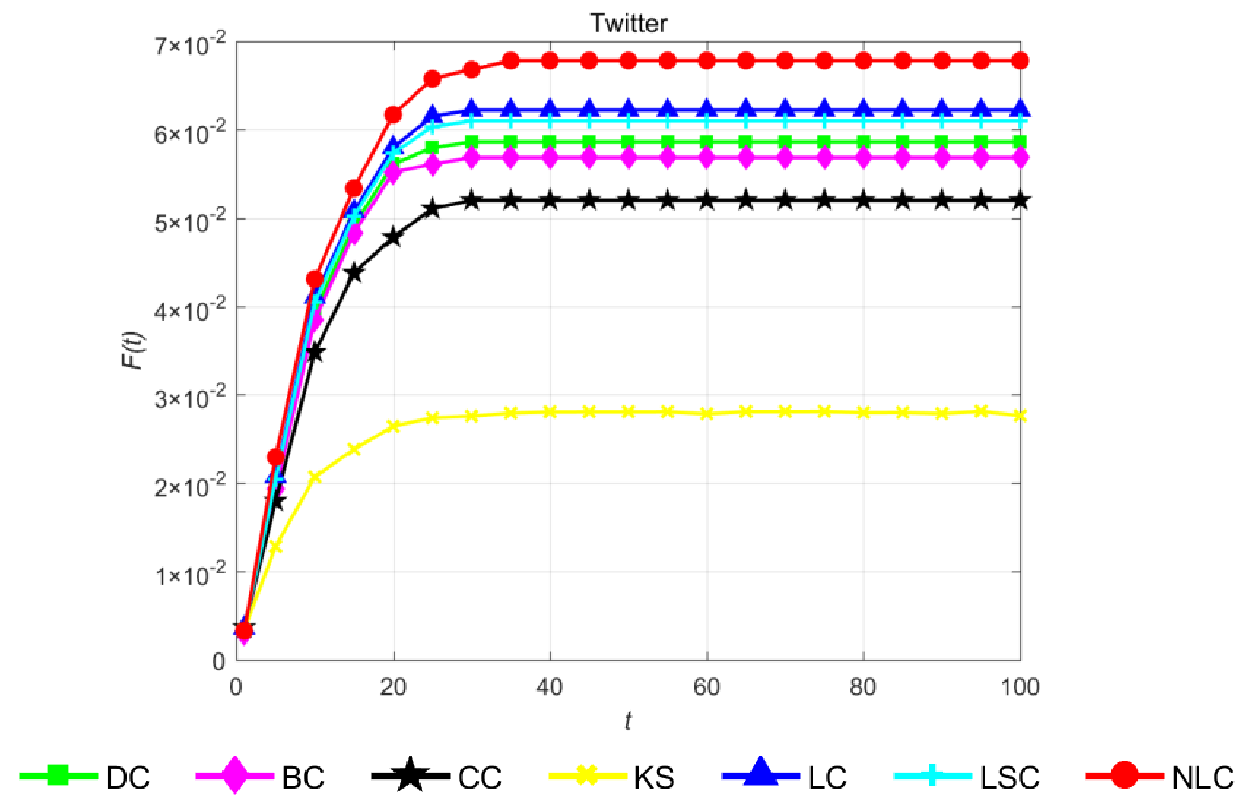 Figure 3: Propagation capability over time. NLC seeds achieve the highest stabilization point (final coverage).
Critical Insight & Conclusion
The true value of NLC lies in its parameter-free design. By using local structure attributes that identify both "Community Leaders" (cluster centers) and "Information Brokers" (bridges), it captures the dual-nature of viral spread.
Limitations: The paper notes that NLC's performance dips slightly on scale-free (BA) networks where clustering characteristics are naturally low. Furthermore, it treats all connections as equal.
Future Outlook: The next logical step for this research is to incorporate semantic context. In the real world, a user might be a super-spreader for "Tech News" but have zero influence in "Fashion." Combining NLC's structural logic with NLP-based interest mapping could lead to the ultimate influence identification engine.