
Identifying Kingpins: Maximizing Marketing Influence through Review Mining
Identifying Key Users for Targeted Marketing by Mining Online Social Network
This paper introduces a method for identifying influential "key users" for targeted marketing by mining online social networks from Epinions. It combines the "Web of Trust" with a "Review Rating Network" into a weighted directed graph to model social influence and proposes a heuristic-based approximation algorithm for influence maximization.
TL;DR
In the world of online shopping, not all users are created equal. This paper demonstrates that by combining "Who trusts whom" with "Who likes whose reviews," we can identify a handful of key users capable of triggering a massive chain reaction of product adoption. By injecting review-rating data into social graphs, the authors show that even simple algorithms can achieve SOTA-level marketing efficiency.
Problem & Motivation: The Context Gap
Most social network analysis treats a "connection" as a binary state—you are either connected or you aren't. However, in targeted marketing, this is a dangerous oversimplification.
The authors identify two fatal flaws in prior work:
- Category Blindness: A user might trust a friend's advice on "Computer Hardware" but ignore their "Book" recommendations.
- Information Sparsity: Many users influenced by a reviewer never officially add them to a "Trust List," making them "invisible" to standard social crawlers.
The insight here is that review ratings (Helpful vs. Not Helpful) are a "paper trail" of actual influence that bridges these gaps.
Methodology: Building the Combined Network
The researchers fused two distinct networks from Epinions into a single weighted directed graph .
1. The Influence Weight Formula
Instead of uniform weights, they used a similarity metric. If user rates user 's reviews, the weight is calculated by treating ratings as vectors in a multi-dimensional preference space. The closer the vectors, the higher the influence.
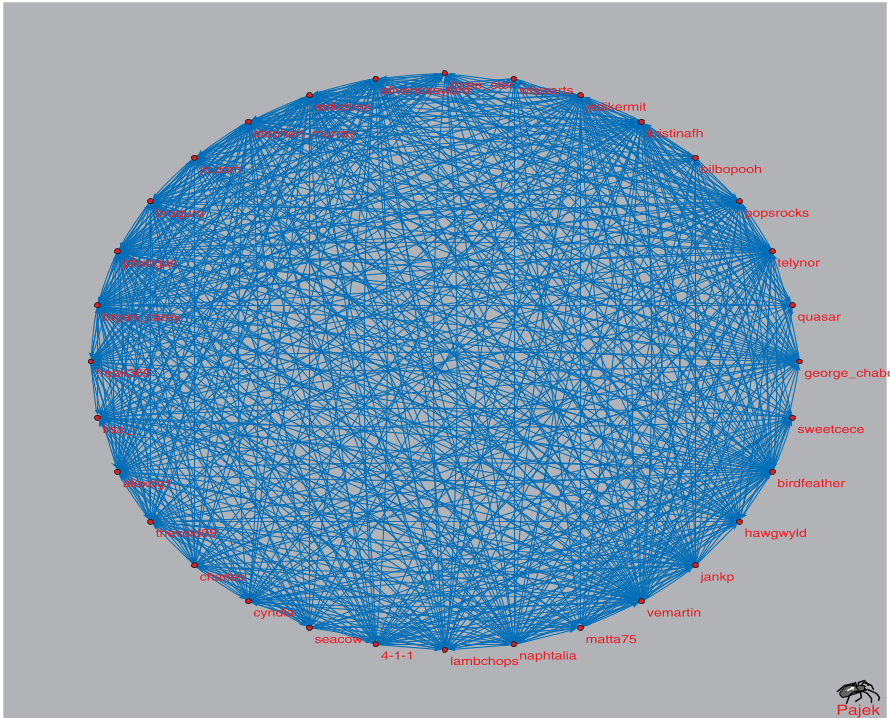 Figure 1: The core trust relationships among top reviewers, forming the backbone of the experimental graph.
2. The Heuristic Search Algorithm
Finding the "perfect" set of users is NP-hard. The authors proposed a hybrid approach:
- Candidates: They harvest top-performing nodes from three different strategies: Degree Centrality (popular nodes), Greedy (mathematical optimization), and Hill-Climbing (local refinement).
- Search: They perform an exhaustive search only on this refined "elite" candidate pool, significantly reducing time complexity while maintaining near-optimal performance.
Experiments & Results: Simplicity Wins
The team tested their approach against six algorithms using a real-world dataset of 1,000 users and nearly 75,000 edges.
Key Findings:
- Heuristic Superiority: Their proposed search method (Search Based on Heuristics) consistently outperformed all others across varying activation thresholds ().
- The "Structural Insight": Paradoxically, In-Degree Centrality performed exceptionally well—often rivaling complex Greedy algorithms.
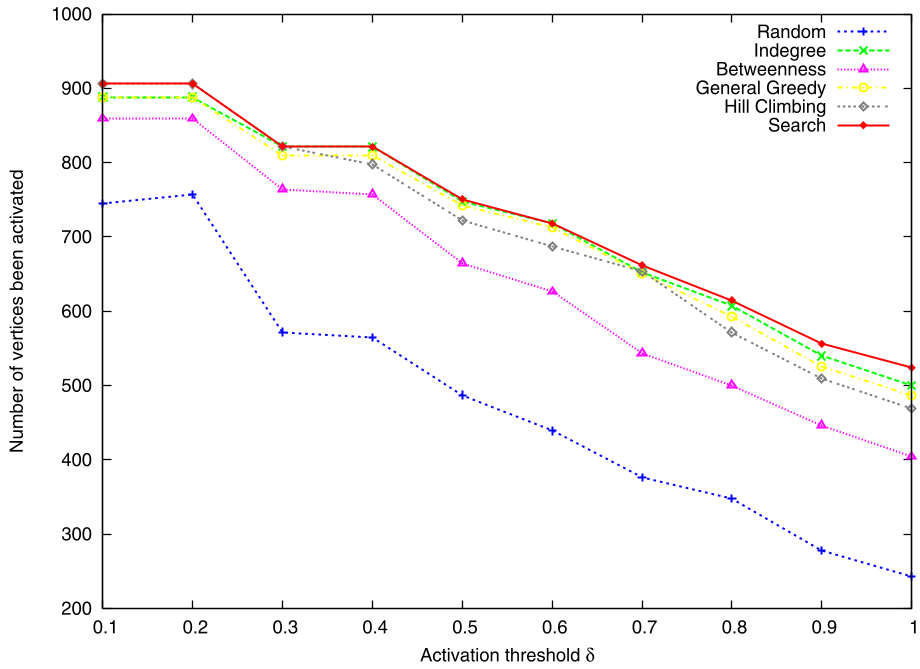 Figure 2: Performance comparison of algorithms. Note how the heuristic search (top line) stays ahead of the pack.
Critical Analysis & Conclusion
The true value of this paper isn't just the specific algorithm, but the Inductive Bias it introduces: If your network structure is enriched with enough qualitative data (like ratings), the complexity of the search algorithm matters less.
Limitations
The study relies on explicit rating data (Helpful/Unhelpful). In modern social media, "ratings" are often passive (view duration, likes), which are much noisier and harder to transform into a clean numerical vector.
Future Prospect
The authors suggest that the next frontier is Sentiment Analysis. By reading the text of the reviews rather than just the star ratings, we could determine why a user was influenced, leading to even more surgical precision in targeted marketing.