
MIV Model: Decoding the DNA of Marketing Influence in the Blogosphere
Identifying bloggers with marketing influence in the blogosphere
This paper proposes the Marketing Influential Value (MIV) model to identify bloggers with significant viral marketing potential in the blogosphere. By combining network-based connectivity metrics and content-based linguistic features through an Artificial Neural Network (ANN), the model achieves 85% accuracy in expert identification, significantly outperforming traditional centrality-based ranking algorithms.
TL;DR
The research introduces the Marketing Influential Value (MIV) model, a sophisticated framework designed to pinpoint "vanguard" bloggers who can trigger viral marketing cascades. By bridging the gap between graph theory (Network Value) and natural language processing (Content Value) via an Artificial Neural Network, the authors provide a data-driven compass for advertisers to maximize ROI in the social media ecosystem.
Problem & Motivation: Beyond the "Link"
In the early 2000s, ranking was synonymous with PageRank. If you had many links, you were influential. However, for viral marketing, a link is just a path; it doesn't guarantee persuasion.
The authors argue that the "sparseness" of the blogosphere makes traditional link analysis insufficient. A blogger might have few friends but high "subjectiveness"—the ability to write compelling, personal reviews that actually move products. The motivation was to move from structural importance to marketing impact, accounting for the "nonlinear" nature of human influence.
Methodology: The Fusion of Network and Content
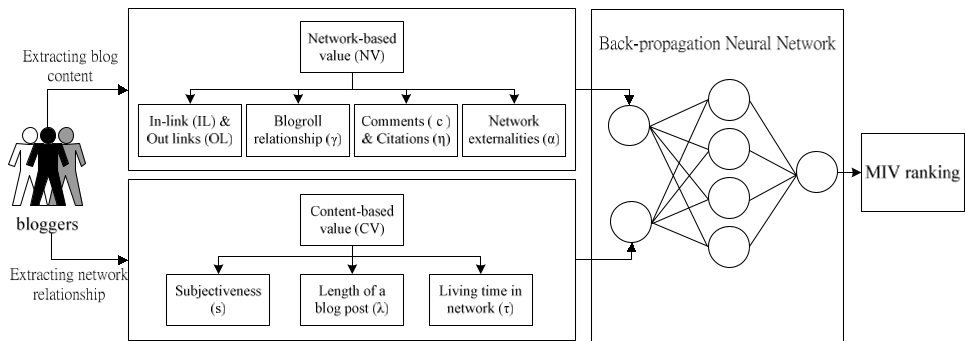
The MIV model is built on two pillars, synthesized by a three-layer Back-propagation Neural Network (BPNN).
1. Network-based Value (NV)
This dimension treats the blogosphere as a directed graph.
- Modified PageRank: Adjusting scores based on in-links (brand power) and out-links (novelty loss).
- Activism: Measuring comments and citations as proxies for the blogger's ability to "generate noise."
- Reputation & Externality: Incorporating traffic (visitors) and trustworthiness (social control mechanisms).
2. Content-based Value (CV)
This is where the model captures the "voice" of the influencer.
- Subjectiveness: Using the HowNet database (4,500+ positive/negative words) to calculate a subjectiveness score (). The insight here is that opinionated content is more influential than neutral reporting.
- Post Length (): Longer posts correlate with higher engagement and authority.
- Living Time (): Temporal persistence indicates a deeper, more established impact on the network.
Experiments & Results: Proving Viral Potency
The authors tested MIV against the Wretch platform (Taiwan's largest blog community at the time). They utilized the Delphi method—a structured communication technique—where 58 e-commerce experts evaluated the top-recommended bloggers.
SOTA Comparison
Compared to standard graph-theory metrics like Betweenness Centrality (which looks for "bridges" between communities) and Out-link Centrality, MIV was vastly superior.
- Precision (Top-20): MIV (55%) > Betweenness (40%) > Out-link (30%).
- Recall: MIV was able to discover official "expert" bloggers much faster in the ranking list than any other method.
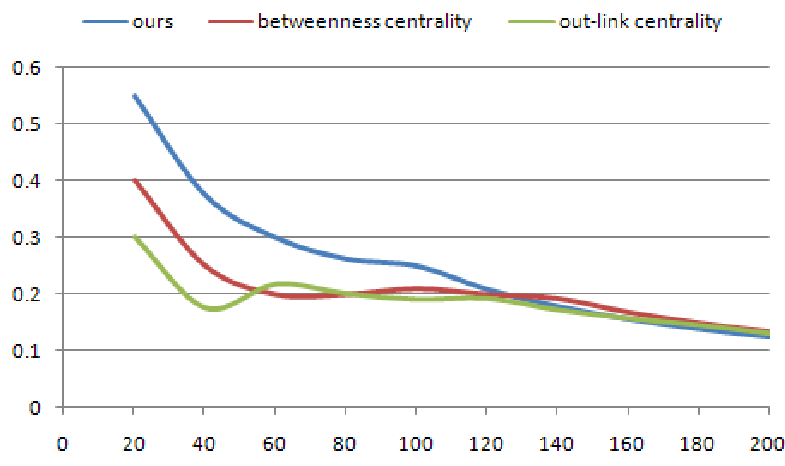 Figure: The precision of MIV (top line) remains consistently higher as the recommendation list expands.
Critical Analysis & Conclusion
Takeaway: The MIV model proves that influence is a composite of where you are in the social graph and what you say. By using an ANN, the authors successfully modeled the non-linear relationship between these factors, providing a blueprint for modern "KOL" (Key Opinion Leader) identification systems.
Limitations:
- The subjectiveness factor treats all positive/negative words with equal weight; modern sentiment analysis (BERT/Transformers) would today provide a more nuanced "semantic vector."
- The model is category-general; future work could tailor weights () specifically for different niches (e.g., Tech vs. Fashion).
Perspective: This 2009 work was ahead of its time, pre-dating the massive Transformer-based influencer analytics we see today. It correctly identified that "Network Effect" (Word-of-Mouth) is the ultimate engine for modern commerce.