
Beyond Degree Centrality: Identifying Opinion Leaders via Dynamic Closeness
Identifying opinion leader nodes in online social networks with a new closeness evaluation algorithm
The paper introduces a novel closeness evaluation algorithm to identify influential opinion leaders in online social networks. By integrating interaction types, frequency (time gap), and multi-hop delays into a weighted betweenness centrality framework, the method achieves superior information spread performance compared to traditional degree or standard betweenness metrics.
TL;DR
In the hyper-connected world of online social networks (OSNs), identifying who truly moves the needle is a complex challenge. This paper moves beyond simple connection counts (Degree) and proposes a weighted closeness algorithm. By accounting for interaction frequency, relationship types, and multi-hop delays, the authors provide a more surgical way to identify "Opinion Leaders" who can maximize positive information spread or suppress harmful rumors.
Background & Motivation: The Weakness of Static Graphs
Most social network analysis treats connections as simple "on/off" switches. However, in reality, your influence on a close friend is vastly different from your influence on a random follower. Prior works like Betweenness Centrality focus on the number of shortest paths passing through a node, but they often ignore:
- Interaction Quality: The difference between a private message (strong) and a public comment (weak).
- Temporal Dynamics: How frequently two users interact.
- Multi-hop Decay: The "word of mouth" effect diminishes rapidly after 3-4 hops.
The authors' insight is simple: ** Closeness should be the weight of the link.** If we can quantify how "close" nodes are, we can find the true bottlenecks of information flow.
Methodology: Quantifying the In-between
The core of the methodology lies in the Closeness Evaluation Algorithm. It calculates weights based on three dimensions:
- Time Interval of Interaction (): Higher frequency (lower ) results in higher closeness.
- Relationship Weights (): Interactions between "friends" are weighted differently than interactions with "strangers" or public accounts.
- Multi-hop Evaluation: For nodes not directly connected, closeness is calculated for paths up to 3 hops, factoring in transmission delays.
Architecture & Logic
The authors adapt the Betweenness Centrality formula to handle these weights. Instead of just counting hops, the algorithm seeks paths with the "minimum sum of closeness weights," effectively identifying the paths of least resistance for information.
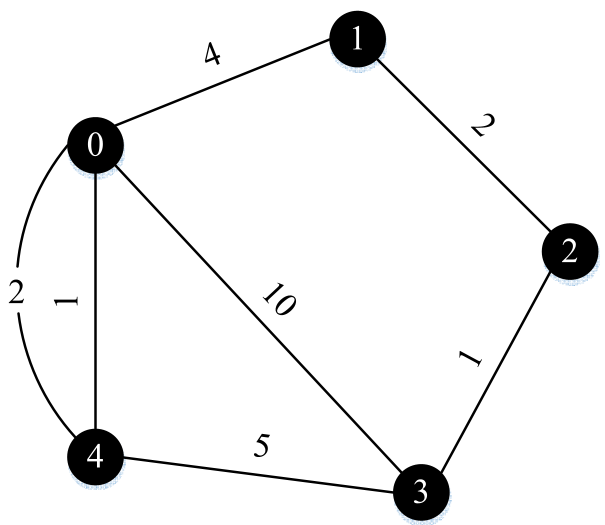 Figure 1: The logic for updating the adjacency matrix based on the multi-hop closeness algorithm.
Experimental Results: Quality over Speed
To test the theory, the authors used an Independent Cascade (IC) Model on a network with small-world and scale-free properties.
Key Findings:
- The "Slow Start" Phenomenon: As seen in the performance graphs, the closeness-based method often starts spreading information slower than degree-based methods. However, it eventually overtakes all other methods, reaching a significantly higher "steady-state" of infected nodes.
- Robustness Across Scales: Whether the network has 500 or 2,000 nodes, the closeness algorithm consistently finds the most influential seeds.
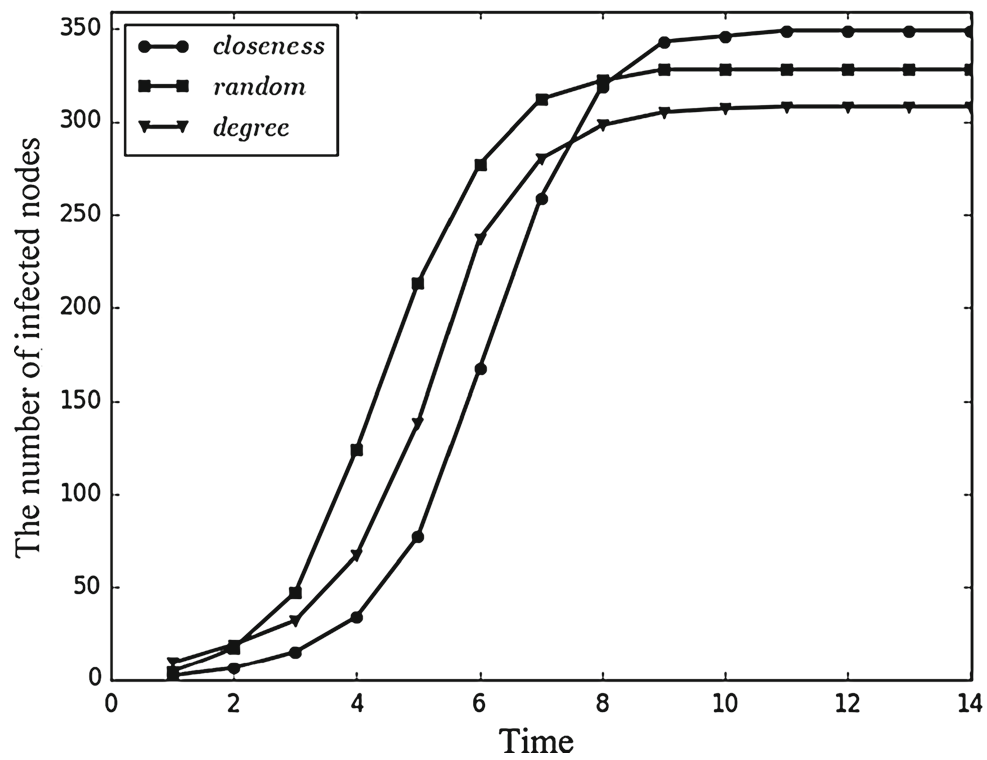 Figure 2: Performance comparison between Closeness, Random, and Degree selection across different node counts.
Critical Insight & Conclusion
The fundamental takeaway is that Opinion Leaders are not necessarily the most popular nodes. A "Hub" node with 1,000 weak connections might be less effective at spreading a message than a "Bridge" node with 100 close, high-frequency interactions.
Limitations & Future Work
The study relies on a simplified version of interactions (since private data is often inaccessible) and uses simulated networks. The authors acknowledge that moving to real-world datasets (Facebook, YouTube) and accounting for encrypted data environments (Cloud computing) will be the next frontier for this research.
In the era of viral misinformation, algorithms like this are essential tools for "guiding popular opinions" by identifying the true sentinels of our digital social fabric.