
Decoding Social Power: Using Transfer Entropy to Identify Peer Influence
Identifying Peer Influence in Online Social Networks Using Transfer Entropy
This paper introduces a model-free approach using Transfer Entropy (TE) to identify and quantify peer influence in online social networks. By treating user activity as stochastic point processes, the authors successfully reconstruct network structures and analyze influence patterns on the Tencent Weibo platform.
TL;DR
Quantifying who actually influences whom in social networks is notoriously difficult due to "noise" like shared interests (homophily). This paper moves away from simple follower counts to a sophisticated information-theoretic approach called Transfer Entropy (TE). By measuring how much one user's past behavior helps predict another's future actions, the researchers can map influence without needing a pre-defined model. Their findings suggest influence is surprisingly concentrated: most users exert power through a very narrow set of keywords and topics.
The Problem: The "Million Follower" Fallacy
In the world of social media analytics, we often mistake popularity for influence. Most prior works rely on structural measures (like PageRank or In-degree) or simple diffusion models. However:
- Structural measures are easily gamed (link farming) and don't reflect actual behavioral change.
- Dynamic models often assume linear relationships or require explicit "causal knowledge" that simply doesn't exist in raw social data.
- Confounding factors like homophily (people with similar tastes acting similarly) often lead to "upward bias," making us think someone is influential when they are simply part of a trend.
Methodology: High-Order Causal Inference
The authors propose using Transfer Entropy (TE). If knowing user X's history reduces the uncertainty about user Y's future behavior (beyond what Y's own history tells us), then X has a causal influence on Y.
1. Model-Free Intuition
Unlike Granger Causality, which is restricted to linear interactions, TE is sensitive to all-order correlations. This is crucial for social networks where human behavior is non-linear and "bursty."
2. The Estimator
To make TE work with real-world data, the authors discretized time into "bins" (e.g., 1 minute, 1 hour). They introduced a Simpson’s Rule-based estimator to handle the integration of entropy values, providing a data-driven way to minimize statistical deviation.
 The core transfer entropy formula (Eq 9) calculates the difference in conditional entropy to isolate the information "transferred" from X to Y.
Experiments: Validating Influence
Using a massive dataset from Tencent Weibo (KDD Cup 2012), the team tested if their TE-based influence scores could "reconstruct" the original follow-graph.
- Performance: The results were striking. The ROC curve showed that the framework could achieve a 1.0 True Positive Rate (TPR) while maintaining an extremely low False Positive Rate (FPR) of near zero.
- Keyword Concentration: As shown in the study, users are "specialists." 80% of influence is channeled through a mere 20% of the keywords they use.
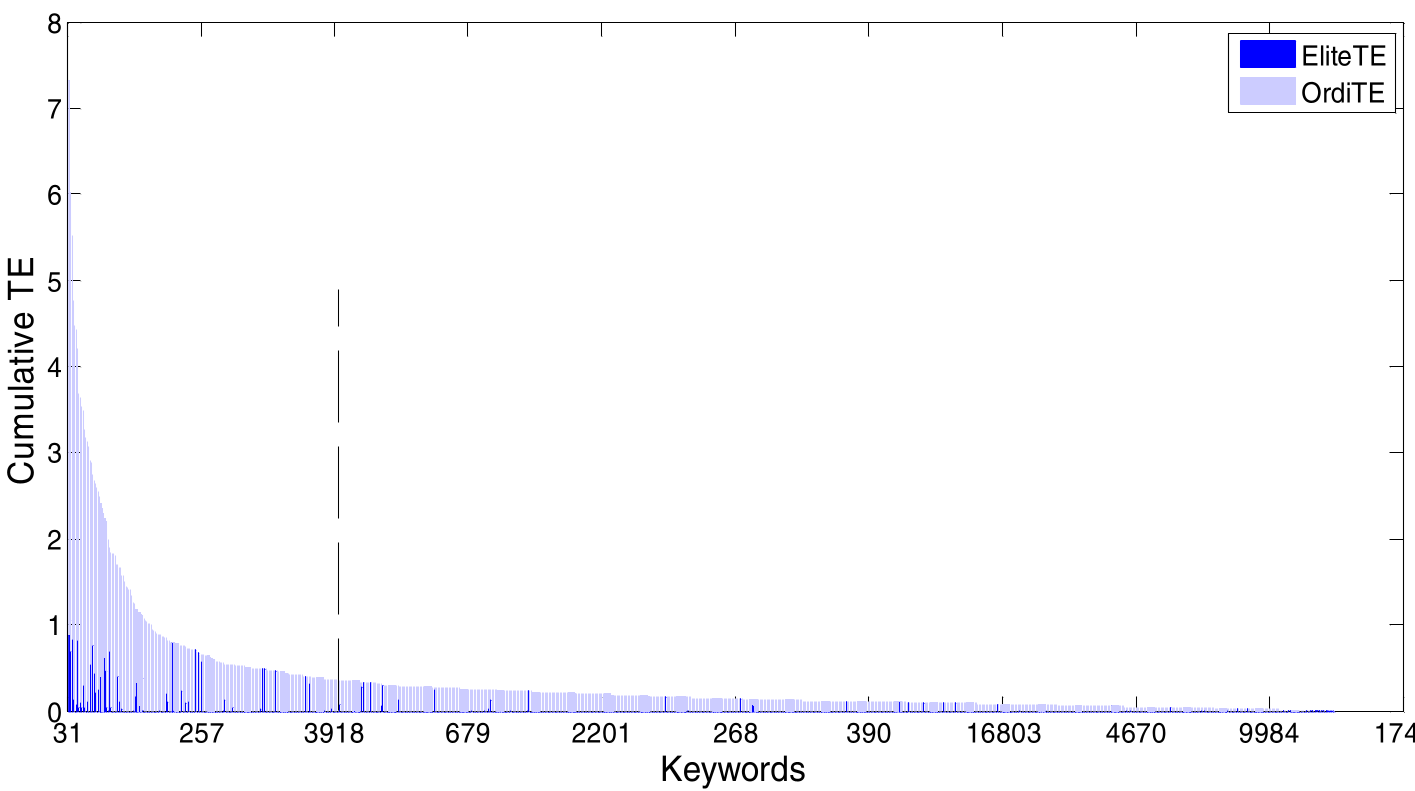 Fig 2: Influence concentration on keywords reveals a "long tail" where a few terms carry most of the social weight.
Case Study: Keywords vs. Topics
The authors compared how influence spreads via specific Keywords (micro-level) versus Topics/Tags (macro-level).
- Finding: Concentration is higher on keywords than on broader topics.
- Insight: Influential users don't just "talk about sports"; they wield power by using specific, high-impact terminology that triggers actions in their peers.
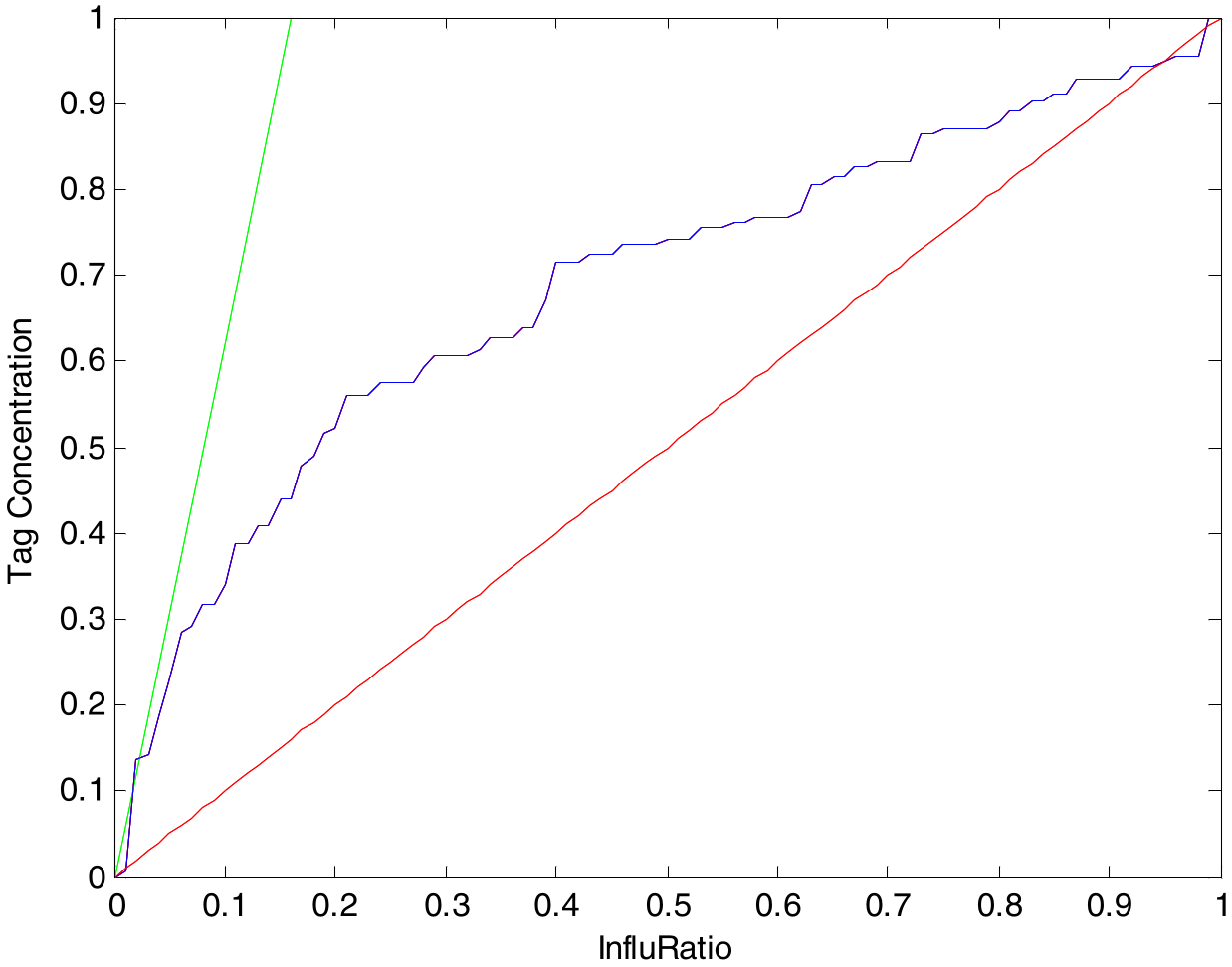 Fig 5: The blue curve shows how influence is distributed across tags, highlighting that even "influentials" only have impact in specific niches.
Critical Insight & Conclusion
The true value of this paper lies in its agnosticism. It doesn't care why a user is behaving a certain way; it mathematically isolates the "signal" of influence from the "noise" of general social trends.
Takeaway for Practitioners: If you are running a viral marketing campaign, don't just look for the user with the most followers. Look for the user who has the highest Transfer Entropy over the specific keywords relevant to your product.
Limitations:
- The computational cost of TE is high compared to simple graph metrics.
- The study uses recommendation adoption as the primary "activity," which may not capture emotional or sentiment-based influence perfectly.
Future Outlook: Integrating contextual information (NLP) into the TE framework could allow us to understand not just that influence occurred, but the linguistic nuance that made it happen.