
Tracking the Shifting Soul: Predicting Temporal Value Changes via Social Media
15051_Identifying and Predicting Temporal Change of Basic Human Values from Social Network Usage.
This paper introduces a novel approach for identifying and predicting the temporal change of basic human values—such as independence, success, and security—using Facebook usage data. By combining linear regression models with Hidden Markov Models (HMM), the authors track value shifts across five high-level dimensions (Schwartz’s value theory) over long-term social media activity.
TL;DR
Human values—the fundamental principles that guide our behavior—are often viewed as static. This paper challenges that notion by proving that basic human values evolve over time and that these shifts can be identified through our Facebook status updates. By leveraging a combination of linguistic analysis and Hidden Markov Models (HMM), the researchers successfully predicted value transitions over a 7.5-year span, outperforming standard baselines.
The Problem: Values are Not Carved in Stone
Current sentiment analysis and psychological profiling tools often treat a user’s "values" (like Hedonism, Security, or Self-Transcendence) as a fixed profile. However, life happens. A promotion might shift your focus toward Self-Enhancement, while starting a family might pivot you toward Conservation.
The technical challenge is twofold:
- Data Scarcity: How do we get ground-truth labels for how someone's values changed over a decade?
- Modeling Stochasticity: Value changes are influenced by "unforeseeable circumstances" (hidden states) that aren't always explicitly stated in a single post.
Methodology: From Words to States
The researchers developed a two-tier framework to capture the "rhythm" of human values.
Tier 1: The Linguistic Bridge
Using LIWC (Linguistic Inquiry and Word Count), the authors extracted psycholinguistic scores from Facebook statuses. They mapped these to the Portrait Value Questionnaire (PVQ), the gold standard in psychological value measurement. A linear regression model was built to translate "how people talk" into "what they value."
Tier 2: The HMM Engine
To handle the temporal aspect, the team treated value levels (Low, Medium, High) as states in a Hidden Markov Model (HMM). This is the "secret sauce": the HMM assumes that there are hidden variables (life events, social influence) that trigger transitions between value states.
 Note: The study utilized a dataset of 726 users, tracking some for up to 9 years—providing a rare longitudinal view of digital behavior.
Experiments and Results
The study evaluated five core value dimensions. The results confirmed that the HMM approach effectively captures the "state-switching" nature of human values.
Key Performance Metrics:
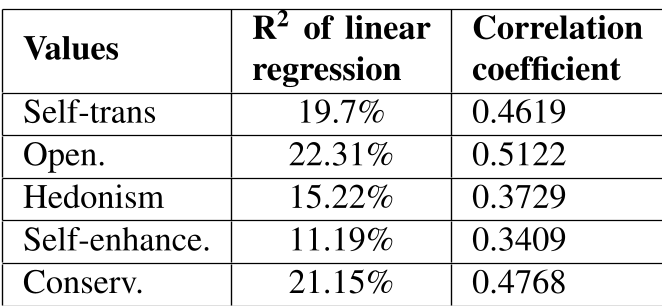
- Openness-to-Change: Showed the highest predictability with a Correlation Coefficient of 0.51 and the lowest RMSE (0.75).
- Self-Enhancement: Proved the most difficult to predict, likely due to the complex and often "performative" nature of success-oriented social media posts.
| Values | R² Strength | HMM RMSE |
|---|---|---|
| Self-Transcendence | 19.7% | 0.80 |
| Openness | 22.31% | 0.75 |
| Hedonism | 15.22% | 0.81 |
| Self-Enhancement | 11.19% | 0.84 |
| Conservation | 21.15% | 0.77 |
Critical Insight & Outlook
This work marks a shift from Static Profiling to Dynamic Journey Mapping.
Why it matters:
- Career Guidance: Imagine an AI that notices a shift in your values toward Independence and Self-Direction before you even realize you're ready for a career change.
- Marketing: Moving away from "what you bought" to "who you are becoming."
- Limitations: The study relies on Facebook data from 2017; current social media usage (TikTok, Instagram) is more visual/ephemeral, which might require multimodal analysis (Computer Vision + NLP) to replicate these results today.
By proving that our "values" have a detectable shelf-life and trajectory, Mukta et al. have provided the first mathematical evidence that social media is a mirror not just of who we are, but of how we are changing.