
Identifying Digital Opinion Leaders: Beyond Celebrity and Toward Representativeness
Identifying Representative Reviewers in Internet Social Media
The paper proposes a statistical algorithm to identify "Representative Reviewers" (opinion leaders) in social media networks, specifically within the music domain. By utilizing the Yahoo! Webscope dataset, it identifies users whose individual ratings closely align with the collective average, validating their representativeness through T-test analysis.
TL;DR
In the vast ocean of Web 2.0 data, identifying who actually represents the community is a significant challenge. This paper moves away from vanity metrics like follower counts and proposes a simple, mathematically sound method to find "Representative Reviewers"—users whose personal tastes consistently mirror the collective average. By isolating these individuals, the authors provide a potential solution to the notorious "Cold Start" problem in recommendation systems.
Background: Why Follower Count is a Lie
In social platforms like Twitter or Yahoo! Music, we often equate influence with popularity. However, the authors argue that a celebrity with millions of followers (like Ashton Kutcher or Britney Spears) might attract fans for reasons unrelated to the quality of their specific opinions.
The true Opinion Leader is a person who filters mass media information and provides a signal that the general public finds acceptable and resonant. In a technical sense, these are the "representatives" of a social network's latent consensus.
Methodology: The Math of Representativeness
The core insight of this research is that a representative user is one whose ratings are the "least surprising" relative to the community.
The authors use a straightforward but effective deviation formula to score each user:
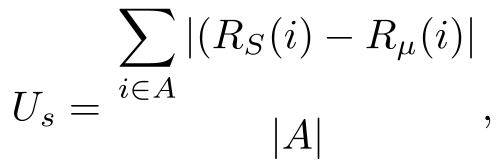
- : The rating given by user to song .
- : The average rating of song across the entire database.
- : The total number of songs rated by the user.
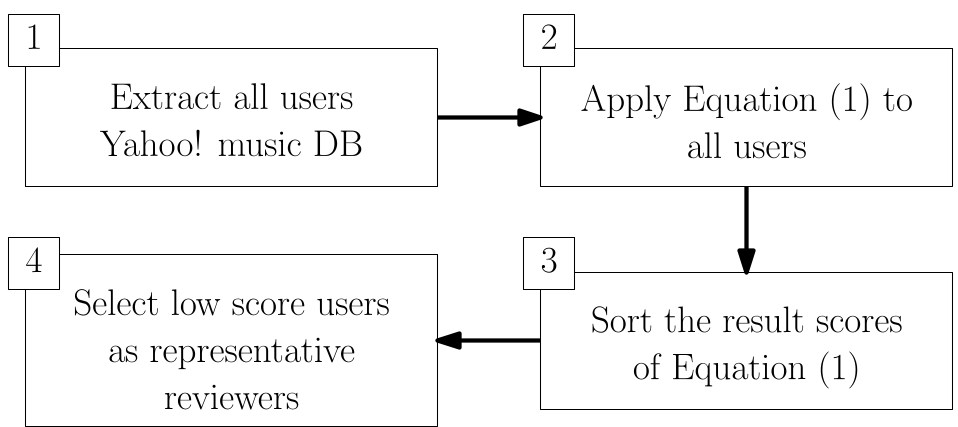
By calculating the mean absolute error between a user and the "crowd," the algorithm identifies those in the "sweet spot" of community sentiment.
Experimental Results: Validating the Signal
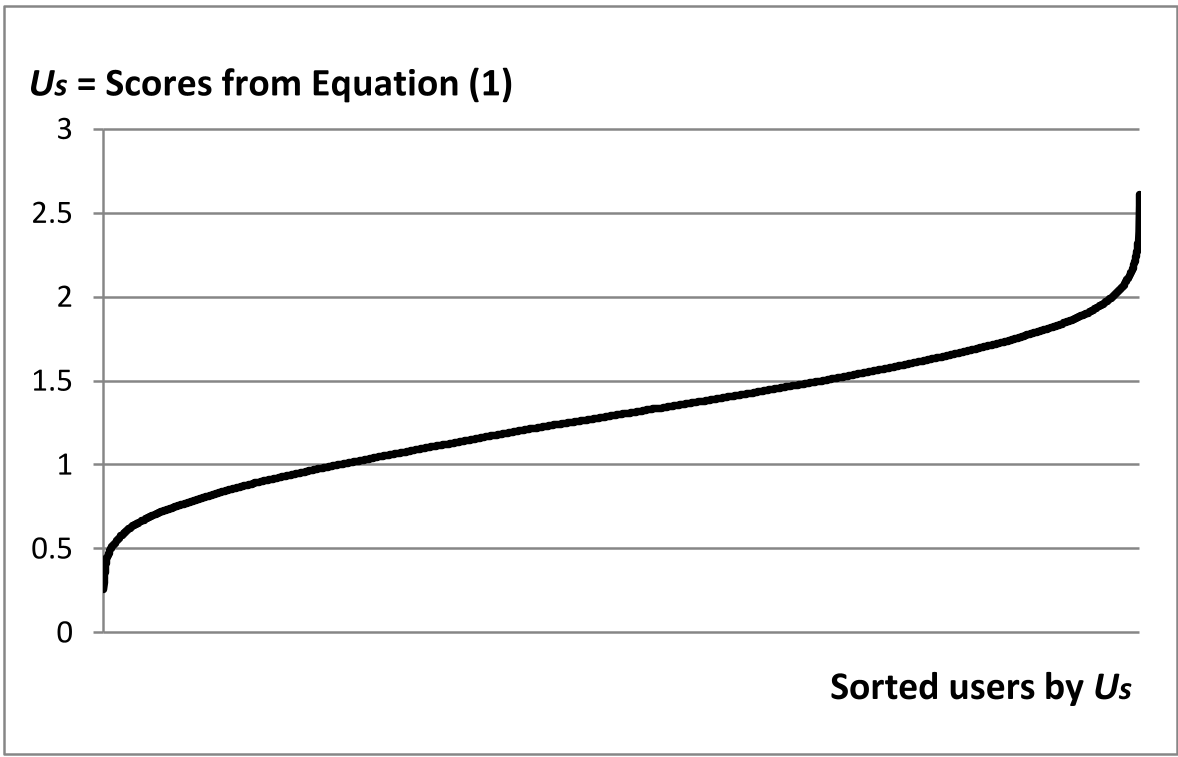
Using the Yahoo! Webscope Music dataset (15,400 users, 1,000 songs, 300,000 ratings), the authors compared the top-ranked "Representative Reviewers" against the bottom-ranked "Outliers."
The validation was performed using a T-test. At a significance level of 0.05:
- Top 100 Users: The null hypothesis (that their ratings represent the average) could not be rejected. They are statistically valid proxies for the crowd.
- Bottom 100 Users: The null hypothesis was rejected. These users' tastes are essentially "noise" relative to the community consensus.
Deep Insight: Solving the Cold Start Problem
The most valuable application of this research lies in Information Retrieval.
Standard Collaborative Filtering fails when a new song is added because there isn't enough data to calculate similarity. However, if we can identify 50 "Representative Reviewers," we only need their ratings to predict how the entire community of 15,000 people will eventually feel about the song. This transforms a massive data-gathering problem into a targeted expert-sampling task.
Conclusion and Future Directions
While the current approach is effective, it assumes an "average" represents the best opinion. In the future, the authors aim to apply this to recommendation systems for movies and explore how these representative users evolve over time. This work serves as a reminder that in the era of "Big Data," the "Right Data"—produced by the right people—is often more powerful than sheer volume.