
Beyond the Graph: Uncovering Social Communities via Frequent Pattern Mining
Identifying Social Communities by Frequent Pattern Mining
2009-07-01
Summary
Problem
Method
Results
Takeaways
Abstract
This paper introduces a generalized framework for identifying social communities by modeling entity relationships through frequent closed pattern mining. By leveraging frequent closed patterns and entropy-based feature selection, the authors construct weighted social graphs that accurately reveal latent community structures in transactional data.
## TL;DR
Most social networks are built from explicit interactions (follows, likes, emails). But what if the "social" link is hidden in shared behavior? This paper presents a framework that transforms raw transactional data into a social graph using **Frequent Closed Patterns**. By using entropy to select the most "telling" behaviors, the authors can accurately map out communities in both synthetic and real-world datasets like the Enron email corpus.
## The Problem: The "Application-Specific" Trap
In the realm of Social Network Analysis (SNA), building the network is often an afterthought. Researchers usually rely on obvious ties: "User A emailed User B." However, many organizational insights are buried in *shared data usage*. Existing methods to model these connections are usually tied to specific domains (like web link analysis) and suffer from the **curse of dimensionality** when dealing with thousands of possible features.
## The Insight: Data Usage as a Social Signature
The authors argue that if two entities (people, departments, or branches) interact with similar data in similar patterns, they belong to the same community, even if there is no direct "edge" between them.
To extract this signature efficiently, the paper focuses on **Frequent Closed Patterns**. Unlike basic frequent itemsets, closed patterns are more compact—they represent the maximal set of items appearing together with the same frequency. This reduces the search space without losing any information content.
## Methodology: The Entropy-Filtered Framework
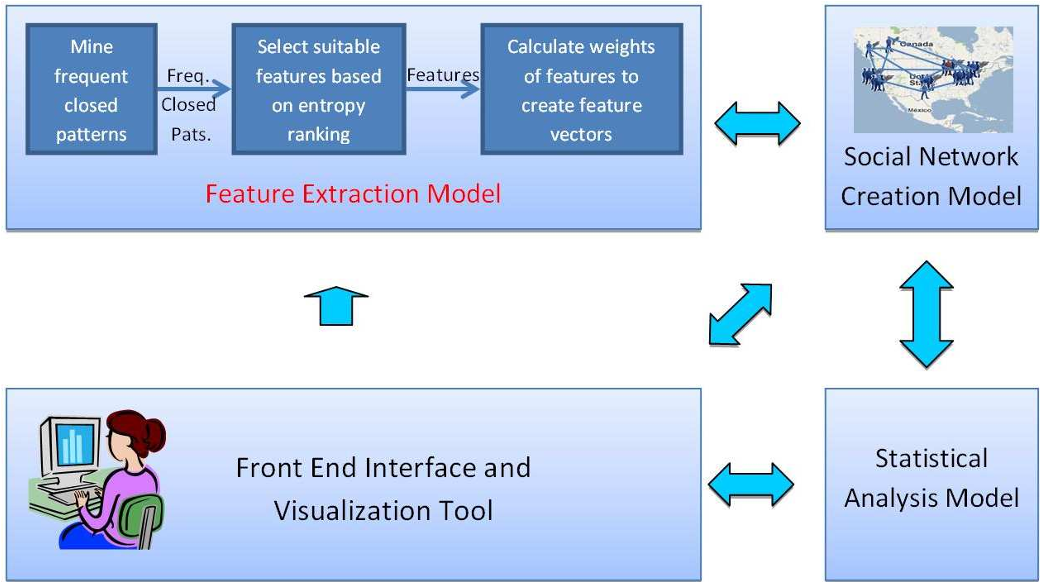
The proposed framework consists of four modular stages:
1. **Feature Extraction**: Using the **CHARM algorithm**, the system mines frequent closed patterns from transactional data.
2. **Entropy Ranking**: Not all patterns are equally informative. The authors apply an entropy measure to rank patterns; high-entropy patterns that appear across many entities in a non-trivial way are prioritized. This shrinks the feature vector to a "reasonable size."
3. **Network Creation**: Entities are represented as vectors of these selected patterns. The weights of the edges between entities are determined by the similarity (e.g., Euclidean distance) of these vectors.
4. **Visualization & Analysis**: Tools like UCINET or JUNG are used to identify headers, bridges, and clusters.
## Experimental Validation
### Synthetic Accuracy
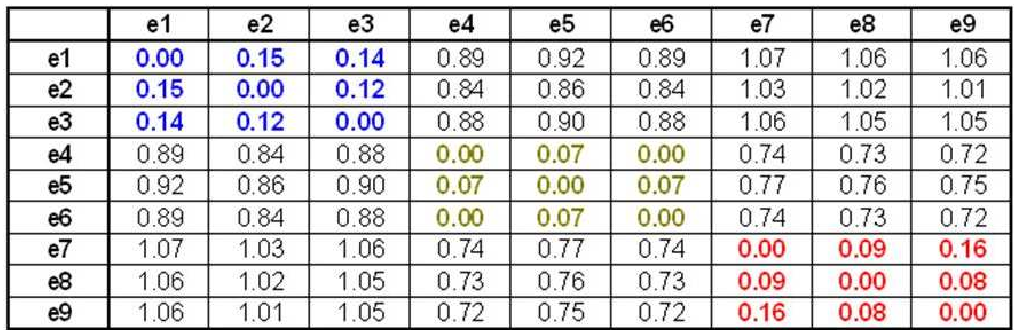
The authors tested the model on a 90k transaction dataset where three distinct groups were pre-programmed. By selecting only the top 11 features (patterns) based on entropy, the model perfectly reconstructed the three groups. As shown in the distance matrix below, the intra-group distances (highlighted) are significantly lower than inter-group distances.
### Real-World Case: The Enron Emails
Applying this to the Enron dataset, the model identified 100 closed itemsets (patterns of stems and email addresses) to differentiate 15 users. The resulting graph showed that users like **Kaminski** acted as central hubs with high connectivity, while others remained peripheral. This demonstrates that patterned behavior in text and contact lists is a powerful proxy for institutional roles.
## Critical Analysis & Future Outlook
The brilliance of this work lies in its **Inductive Bias**: it assumes that frequent, closed-loop behaviors are the "DNA" of a social group. By using entropy to prune the feature space, it solves the efficiency issues that plague older mining techniques.
**Limitations**: The framework currently requires a "user-specified threshold" for entropy and distance, which might vary wildly between different types of data. Future research could look into automated thresholding (heuristic-based) or applying this to temporal data to see how communities evolve over time.
## Summary
This research moves SNA from a simple "who talks to whom" model to a sophisticated "who acts like whom" model. By integrating frequent pattern mining with entropy-driven dimensionality reduction, it provides a scalable, generalized roadmap for discovering hidden organizational structures.