
DSHE: Deep Embedding Learning for Structural Hole Spanner Detection
Identifying Structural Hole Spanners in Social Networks via Graph Embedding
This paper introduces Deep Structural Hole Embedding (DSHE), a novel graph representation learning framework specifically designed to identify Structural Hole (SH) spanners in social networks. By leveraging a deep autoencoder architecture, the method maps network nodes into a low-dimensional latent space while preserving complex topological features to distinguish boundary-spanning nodes from community-centric ones.
TL;DR
Researchers from Heilongjiang University have introduced Deep Structural Hole Embedding (DSHE), the first framework to treat Structural Hole (SH) detection as a representation learning problem. By combining a deep autoencoder for global structure with a custom "Harmony" loss for local community boundaries, DSHE achieves up to a 10-15% improvement in accuracy over state-of-the-art graph-theoretic methods.
Motivation: The Bridge Between Worlds
In social network theory, Structural Holes are the gaps between clusters of people. The individuals who bridge these gaps—SH Spanners—hold immense power. They control the flow of information between segregated communities, gain access to diverse perspectives, and often act as catalysts for innovation or rumor propagation.
However, finding these individuals in a network of millions is computationally expensive. Existing methods like MaxD or 2-Step rely on calculating shortest paths or minimal cuts, which struggle with the massive scale of modern social data. The authors noticed that while Graph Embedding (like node2vec or SDNE) is great at identifying who belongs to the same group, it isn't designed to find the outliers who link different groups.
Methodology: Harmony and Dissonance
The core insight of DSHE is the tension between Harmony and Similarity.
1. Second-Order Similarity (Global Context)
Using a deep autoencoder, the model learns to reconstruct the adjacency matrix . This ensures that nodes with similar "friend circles" (neighborhoods) end up close together in the latent space.
2. First-Order Harmony (The SH Signature)
This is the "Secret Sauce." In a harmonious community, your "vector" should be very close to the average of your neighbors' vectors. However, an SH Spanner is connected to multiple, different communities. Their position is a compromise, creating a "disharmony" in the local latent structure.
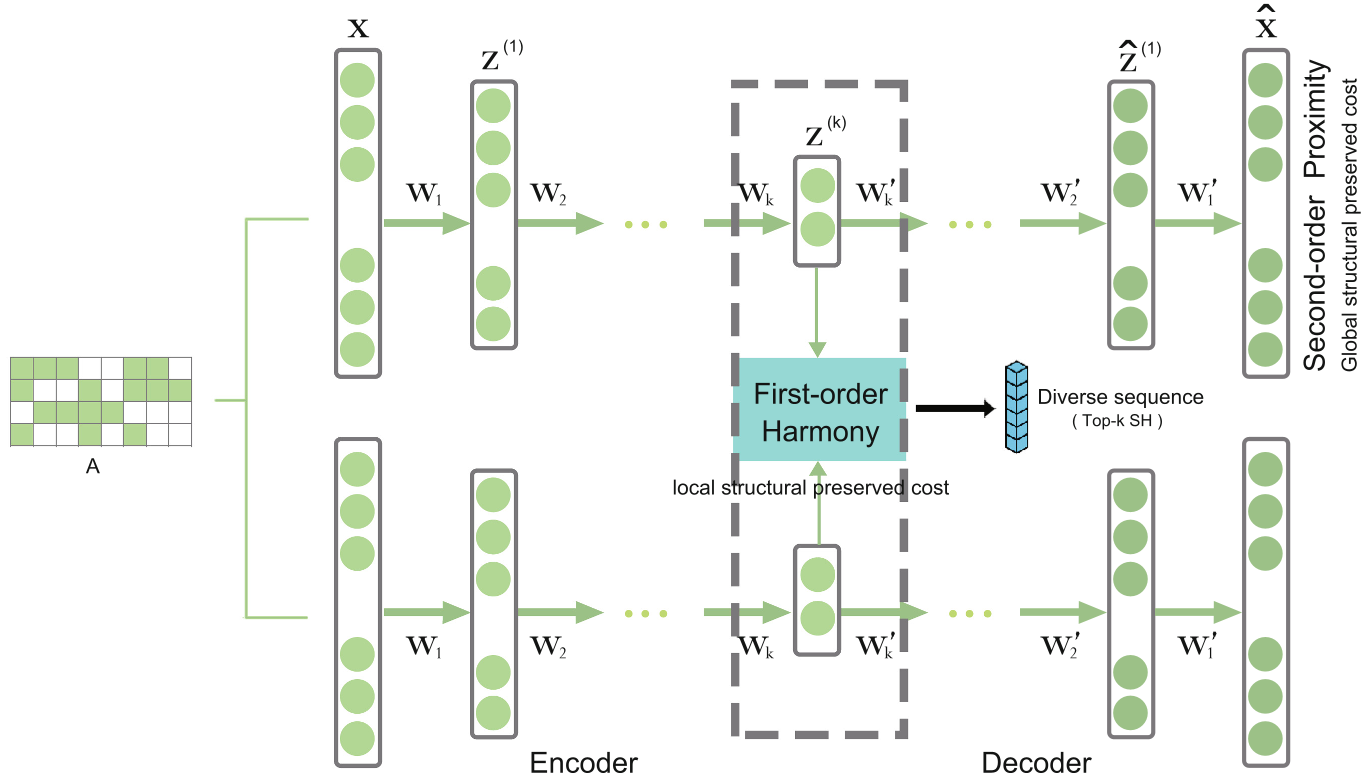
The model optimizes a joint loss function:
u L_{reg}$$ By maximizing the discrepancy (1st-order harmony) while maintaining structural integrity (2nd-order similarity), the model forces SH spanners to stand out in the embedding space. ## Experimental Breakthroughs The authors tested DSHE against five major baselines (MaxD, HIS, 2-Step, AP-BICC, and HAM) across three datasets: Karate Club, DBLP, and Coauthor. ### Performance Highlights: * **Accuracy:** On the Coauthor dataset, DSHE achieved **0.864**, vastly outperforming the previous SOTA, AP-BICC (0.765). * **Influence Factor (SHIF):** By simulating an Independent Cascade (IC) model, they proved that nodes found by DSHE are significantly more effective at spreading information across the entire network than those found by topological methods. 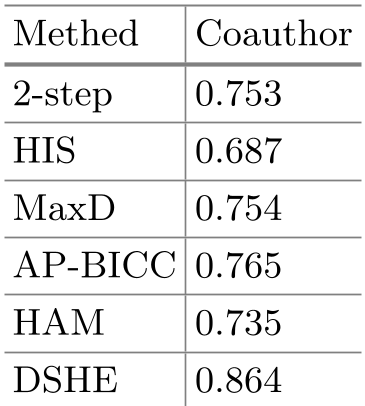 ## Critical Insights Why does it work? Traditional methods are often biased toward **high-degree nodes** (the "hubs" of a single community). DSHE is smarter; it looks for the topological "stress" of being pulled in two directions by different groups. Because it operates in a low-dimensional latent space, it filters out the noise of raw adjacency ties and captures the "evolutionary" structural role of the node. ## Conclusion & Future Work DSHE marks a shift from manual feature engineering to automated feature learning in social network analysis. While the current model excels in static snapshots, the authors suggest the next frontier is **Dynamic Networks**—identifying bridges as they form in real-time. For practitioners in rumor control, viral marketing, or organizational analysis, DSHE provides a powerful, scalable new tool for identifying key influence brokers.