
HotV: Revolutionizing Interest Similarity via Hot Vertex Clustering
Identifying Users' Interest Similarity Based on Clustering Hot Vertices in Social Networks
The paper introduces HotV (Hot Vertices), a novel method for identifying user interest similarity in directed social networks ("interest graphs") like Twitter or Sina Microblog. By clustering high-degree accounts (Hot Vertices) into diverse interest fields and mapping users to these clusters, the authors create an interest vector that significantly outperforms traditional topological methods in link prediction.
TL;DR
In the world of social networks, who you follow says more about what you like than who you actually know. This paper proposes HotV, a method that identifies user similarity not by looking at direct friend overlaps, but by clustering "Hot Vertices" (celebrities/influencers) to map users into a multi-dimensional interest space. It achieves nearly 2x the precision of traditional methods like Jaccard similarity.
Background & Motivation: Social vs. Interest Graphs
Social networks are generally split into two categories:
- Social Graphs (e.g., Facebook): Relationships are bidirectional and usually reflect real-life acquaintances.
- Interest Graphs (e.g., Twitter, Sina Microblog): Relationships are directed; one follows an account because of its content, not necessarily a personal connection.
The authors argue that traditional metrics like Common Neighbors (CN) fail in interest graphs because they treat every link equally. A link to a high-school friend is weighted the same as a link to a tech influencer, blurring the lines between social circles and topical interests.
Methodology: The HotV Pipeline
The core insight is that Hot Vertices—accounts with massive followings—serve as "anchors" for specific interest fields.
1. Extracting the Anchors
The system identifies "Hot Vertices" based on in-degree (number of fans) or VIP status. These accounts are assumed to represent specific niches (e.g., movies, technology, sports).
2. Dimensionality via Clustering
Instead of manually labeling these accounts, the authors use K-Means clustering to group hot vertices. Each cluster represents a dimension in an "Interest Space."
- Temperate Clustering: Smaller grains, more dimensions.
- High-Level Clustering: Larger grains, fewer dimensions.
3. Vector Representation
Each user is converted into a vector , where the value of each dimension is the normalized count of hot vertices they follow in that specific cluster.
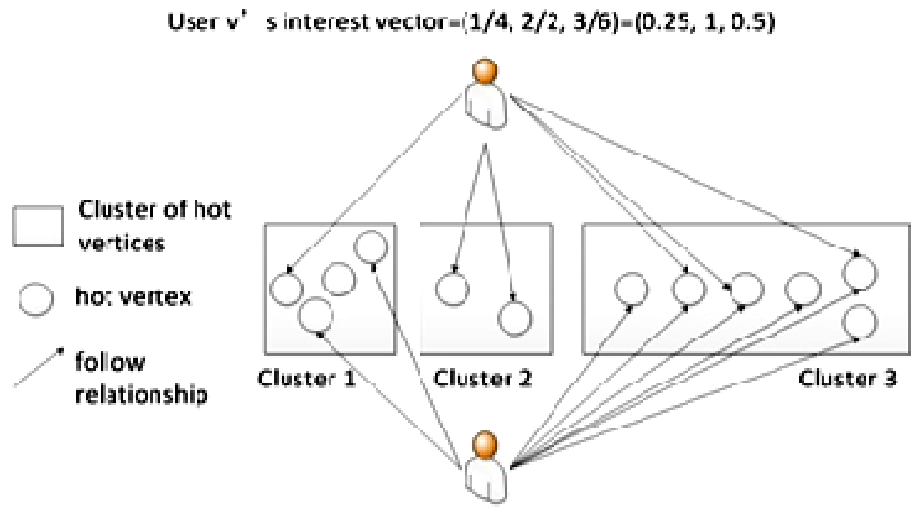
The similarity between two users is then calculated using the Cosine Similarity of these interest vectors:
Experiments and Performance
The authors tested HotV on a massive dataset from Sina Microblog. They used Link Prediction as the benchmark, assuming that if a system can accurately predict who a user will follow next, it has successfully captured their interests.
Key Findings:
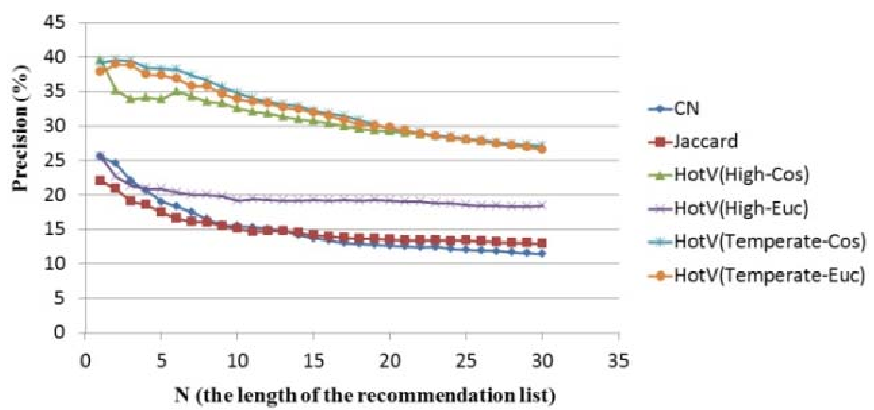
- Precision & Recall: HotV (Temperate-Cos) outperformed Jaccard and CN by nearly 100%.
- Grain Size Matters: "Temperate" clustering (mid-size clusters) performed better than "High-level" (large clusters). Large clusters tend to "wash out" specific interests by grouping too many different sub-topics together.
- The Distance Metric: Using Cosine similarity within the K-Means algorithm consistently beat Euclidean distance, likely because the "direction" of interest (topical alignment) is more important than the "magnitude" (number of follows).
Deep Insight: Why HotV Wins
HotV succeeds because it filters out the "noise" of personal relationships. By focusing only on high-degree nodes, it effectively isolates the Interest Graph from the Social Graph.
Furthermore, it addresses the Cold Start problem. Even for a new user, as soon as they follow a few popular accounts, the system can instantly project them into the interest space and begin making high-quality recommendations.
Critical Analysis & Future Work
While HotV is highly efficient (with a complexity comparable to simple memory-based methods), it has a few limitations:
- Temporal Decay: A user's interest in a hot vertex from 2020 might not reflect their interests in 2026. The authors suggest adding Time Weights in future versions.
- The "Niche" Problem: Very specific interests that aren't represented by "Hot Vertices" (nodes below the fan threshold) might be ignored by this model.
Conclusion
HotV demonstrates that in large-scale social data, "less is more." By focusing on the most influential nodes and using them as a coordinate system, we can achieve state-of-the-art recommendation accuracy without the need for heavy deep learning architectures.