
Identity Management: The Professional's Dilemma in a Social World
Identity Management: Multiple Presentations of Self in Facebook
This seminal HCI study explores how early career professionals navigate "Identity Management" on Facebook as they transition from college to the workplace. The authors identify a 3-tier behavioral framework—"Reliving the College Days," "Dressed to Impress," and "Living in the Business World"—to categorize how users manage self-presentation across heterogeneous social networks.
TL;DR
In 2007, as Facebook expanded beyond university dorms, a critical conflict emerged: How do you present yourself to your boss while still "partying like a rockstar" with your college buddies? This paper by DiMicco and Millen (IBM Research) analyzes how early Facebook adopters managed this "Context Collapse." They discovered that users fall into three tribes—those who ignore the professional shift, those who "cleanse" their digital footprint, and those who use social media specifically for corporate networking.
The Motivation: When Worlds Collide
The researchers observed a unique moment in internet history: the migration of the first Facebook generation into the corporate workforce. The core problem is Identity Management. On a platform designed for informal, high-disclosure social interaction, the appearance of coworkers and managers creates a high-stakes environment. Does a photo of you at a kegger in 2005 affect your promotion in 2007? The authors sought to understand the "Why" behind user behavior during this life-stage transition.
Methodology: Profiling the Corporate Facebook User
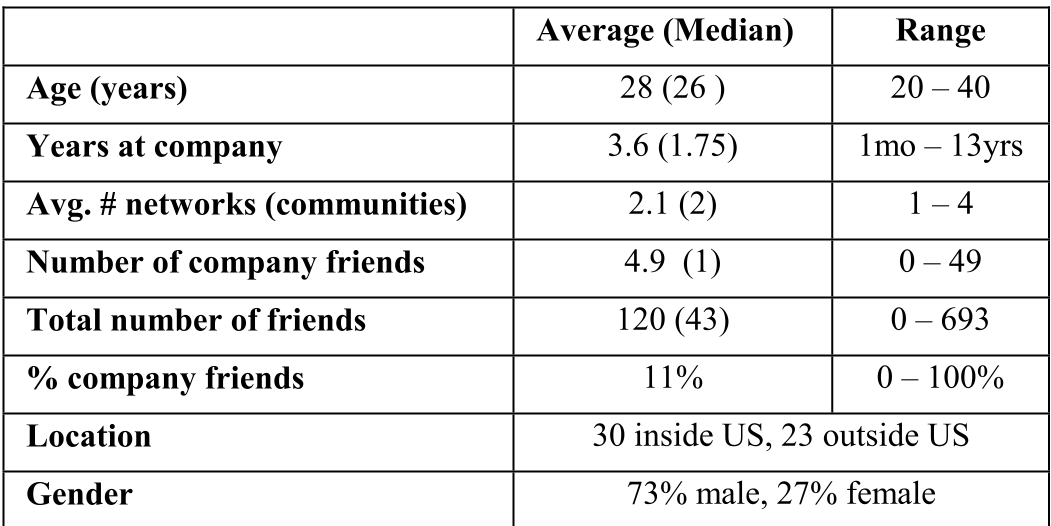
The team analyzed 68 IBM employees through their public-facing Facebook data and conducted deep-dive interviews. They looked at several metrics:
- Network Density: How many "company friends" vs. "total friends"?
- Professional Cues: Job titles, start dates, and professional photos.
- Interactional Polish: The tone of status messages and wall postings.
The Three Faces of Self-Presentation
The study's most significant contribution is the categorization of user behaviors:
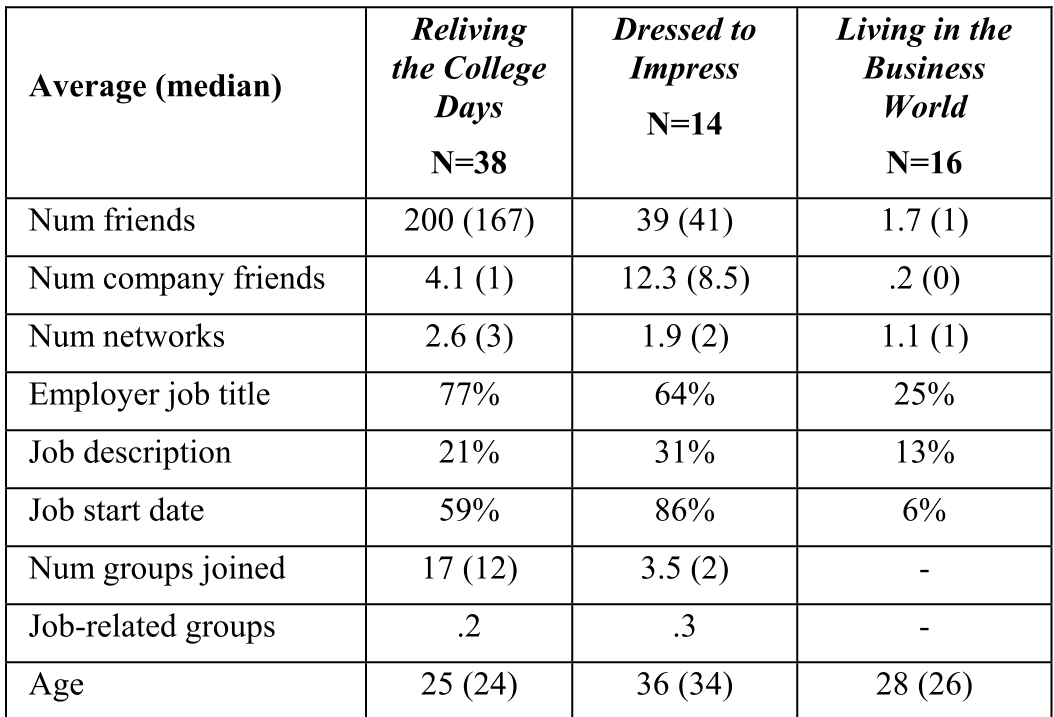
1. Reliving the College Days (The Largest Group)
These users treat Facebook as a "time capsule." They are typically younger (avg. age 25) and use the site almost exclusively for long-distance college friends. They don't care if their manager sees their profile. Their "Self" is anchored in their past social identity.
2. Dressed to Impress (The Strategic Handlers)
These users are the most cautious. They "cleanse" their profiles—removing alcohol-related photos or controversial groups. They bridge the gap between "fun" and "professional," consciously crafting an image that won't offend a recruiter or a mentor.
3. Living in the Business World (The Workplace Socializers)
These users use Facebook primarily to bond with coworkers. They don't have school networks attached. For them, Facebook is a tool for building "common ground" within the company, often leading to more frequent face-to-face interactions at the office.
SOTA Analysis: Why This Matters Today
While this paper used 2007 data, its insights are more relevant than ever. The authors correctly predicted that Organizational Benefits would arise from social networking—such as increased "people sensemaking" (finding colleagues with specific skills).
The Limitation? At the time, privacy controls were binary and clunky. The study highlights that most users found "multi-level access controls" too burdensome to use, a problem that persists in 2024 as we struggle to manage separate identities across LinkedIn (Professional), Instagram (Personal), and X (Public).
Conclusion & Future Outlook
DiMicco and Millen conclude that identity is not a monolith; it is a performance that changes based on the audience. The paper challenges designers to build better "authoring tools" that allow us to be both a "rockstar" and a "software engineer" without the two identities causing professional friction. This work laid the groundwork for modern features like "Close Friends" lists and LinkedIn's professional networking architecture.
Takeaway: Your digital identity is your most valuable professional asset. Whether you "cleanse" it or "compartmentalize" it determines how you navigate the modern workplace.