
Beyond Privacy Toggles: A Reference Framework for Social Identity Management (SIdM)
An Analysis of Implemented and Desirable Settings for Identity Management on Social Networking Sites
This paper presents a provider-independent reference framework for Social Identity Management (SIdM) on Social Networking Sites (SNS). By bridging identity theory with technical implementation, the authors categorize existing privacy settings and evaluate five major platforms (Facebook, Google+, Twitter, LinkedIn, and Diaspora) to identify gaps in managing multiple digital personas.
TL;DR
In our digital lives, we wear many hats—colleague, friend, child, activist. This paper argues that Social Networking Sites (SNS) are failing us by forcing a "single-faceted" identity. The authors propose a comprehensive reference framework to evaluate how well platforms allow us to manage these "Social Identities" and find that even giants like Facebook fall short of true identity flexibility.
Context Collapse: The Motivation
The core problem is Context Collapse. In the physical world, your boss rarely sees your "wild night out" persona because the audiences are physically segregated. Online, these boundaries dissolve. The authors leverage Erving Goffman’s 1959 theory of Impression Management, suggesting that privacy isn't just about hiding data—it's about the "deliberate and targeted disclosure" of specific traits to specific people.
The authors argue that current SNS settings are an ad-hoc "jungle" of buttons that lack a theoretical foundation, making it impossible for users to maintain a consistent self-image across different roles.
Methodology: The SIdM Framework
The researchers built a model that translates social science requirements into technical features. They define SIdM through four pillars:
- Identity Creation: Control over attributes (can you leave your birthday blank? can you add custom fields?).
- Multiple Representations: The ability to create "Personas"—subsets of your profile for different groups.
- Social Circles: The technical means to group contacts (e.g., Google+ Circles).
- Permission Assignment: The logic governing who sees what (The mapping of Attributes Targets).
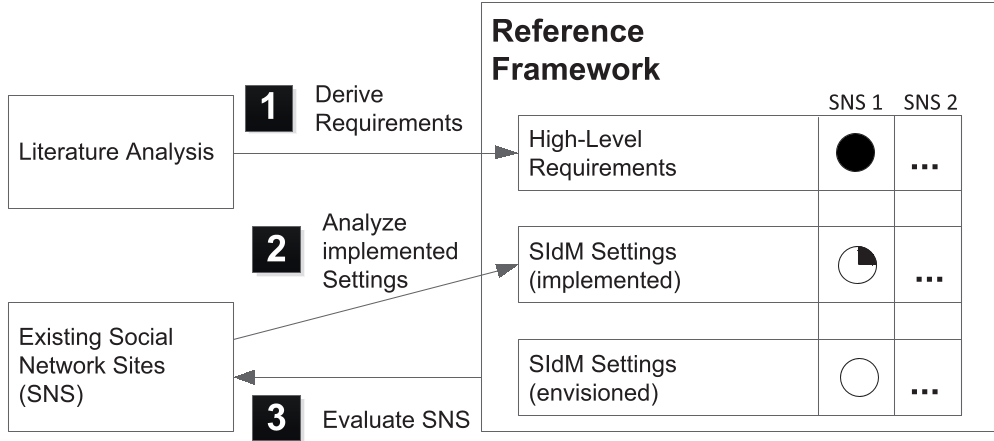
A unique insight is the Cartesian Product of Sharing (SD = A × T). The authors posit that true SIdM is achieved only when a user can make an independent sharing decision for every possible combination of an Attribute (A) and a Target (T). If a platform forces your profile picture to be public, it breaks this matrix.
The "Provider Jungle" Survey
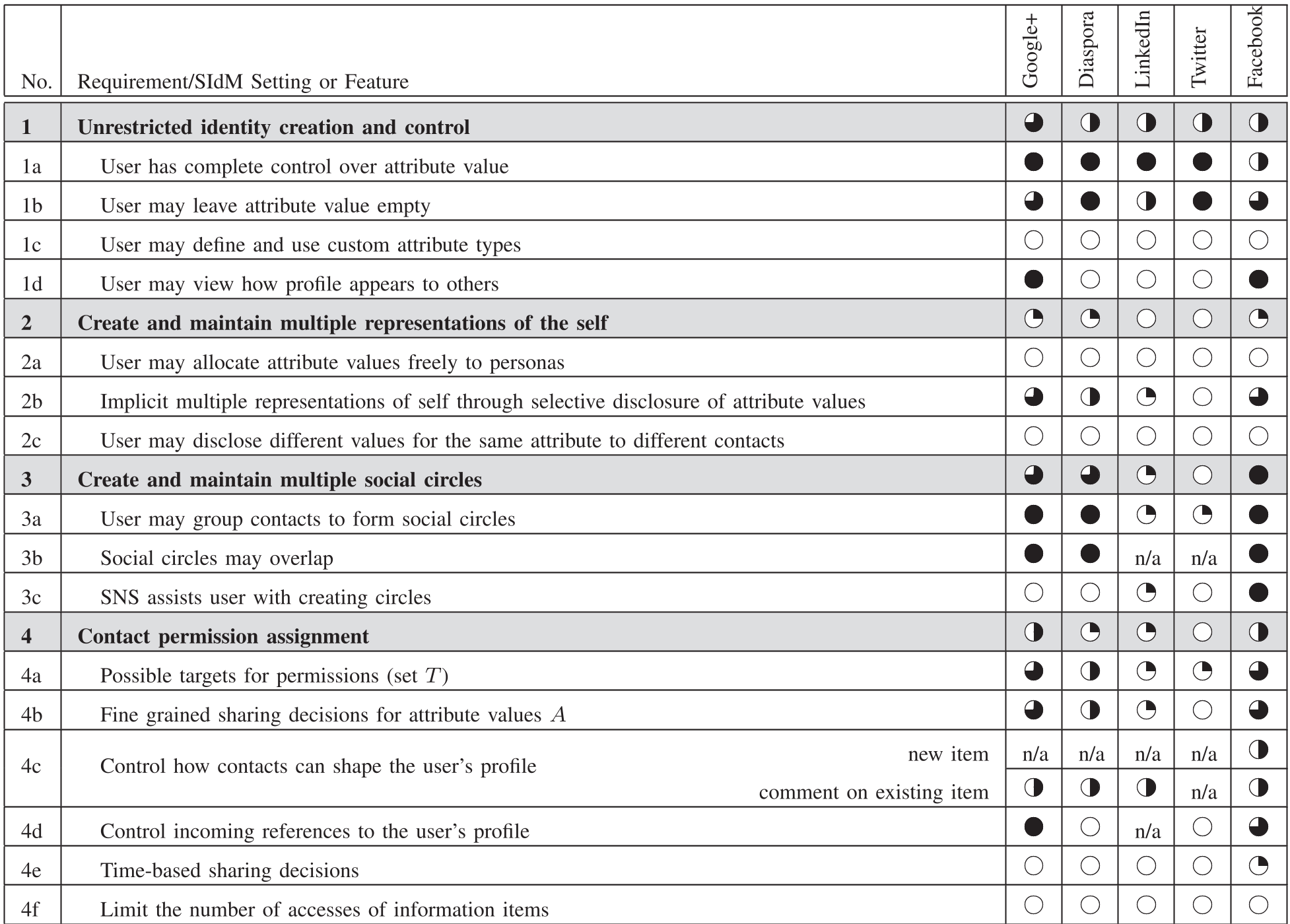
The authors audited five platforms. The results are a snapshot of the "Identity Maturity" of the web:
- Facebook & Google+: The "Power Users." They offer the most granular controls but still struggle with contradictory values. For instance, you cannot show your "Current City" as "London" to your coworkers and "New York" to your family simultaneously.
- Twitter: "The Public Square." Its SIdM is minimal because its utility relies on being a broadcast medium.
- LinkedIn: Suprisingly limited. Despite being a professional tool, it lacks the ability to distinguish between different subsets of professional contacts.
- Diaspora: Decentralization doesn't equal better identity management. While better for data ownership, its SIdM features were found to be prototypical.
Critical Insights: What's Missing?
The paper highlights two major "Desirable but Missing" features:
- Temporal Identity (Forgetting): Humans change. SNS attributes usually don't. The authors suggest "expiry dates" for profile attributes to allow our digital selves to evolve.
- The "Within Circle" Permission: A privacy leak occurs when a friend comments on your post. If that friend's post is visible to their friends, your persona has leaked to an unintended audience.
Final Takeaway
This work shifts the conversation from "Privacy" (is it hidden?) to "Identity" (is it appropriately presented?). As SNS move toward being "Multi-Purpose" platforms, the lack of robust SIdM will lead to "Least Common Denominator" sharing—where users stop sharing anything meaningful to avoid the risk of their different worlds colliding.
Future Outlook: The next decade of social tech will likely focus on Quantitative SIdM Metrics, allowing users to "score" how safe a platform is for their professional and personal personas before they ever hit "Sign Up."