
Behavioral Fingerprinting: Detecting Identity Theft via Semantic "Soulprints" in MSNs
Identity Theft Detection in Mobile Social Networks Using Behavioral Semantics
This paper introduces a probabilistic generative model for identity theft detection in Mobile Social Networks (MSNs) by integrating behavioral semantics with spatial and temporal features. By leveraging Latent Dirichlet Allocation (LDA) to extract implicit behavioral traits from user texts, the method achieves superior detection accuracy compared to traditional spatial-only models on Foursquare and Yelp datasets.
TL;DR
Identity theft in Mobile Social Networks (MSNs) usually involves account hijacking followed by fraudulent activity. This paper moves beyond passwords and GPS coordinates to analyze Behavioral Semantics—the latent patterns in the way you talk. By fusing spatial, temporal, and text-based features into a probabilistic generative model, the authors can distinguish a legitimate user from a thief with much higher precision than spatial-only tracking.
The Core Challenge: Stopping Hijackers in Their Tracks
Existing security measures are largely "gatekeepers" (passwords, fingerprints, iris scans). However, once those gates are breached, the system is blind. The authors argue that while a thief can steal your password, they cannot easily replicate your behavioral DNA.
Previous research focused heavily on spatial-temporal patterns (where you go and when). But humans are predictable in more than just geography; the topics we discuss and the communities we interact with form a unique semantic signature. The challenge is extracting these signals from the noisy, sparse data of short tweets and sporadic check-ins.
Methodology: The Fusion of Space, Time, and Text
The authors treat identity detection as a probabilistic inference problem. They model a user's check-in event as a tuple of —venue, time, and text.
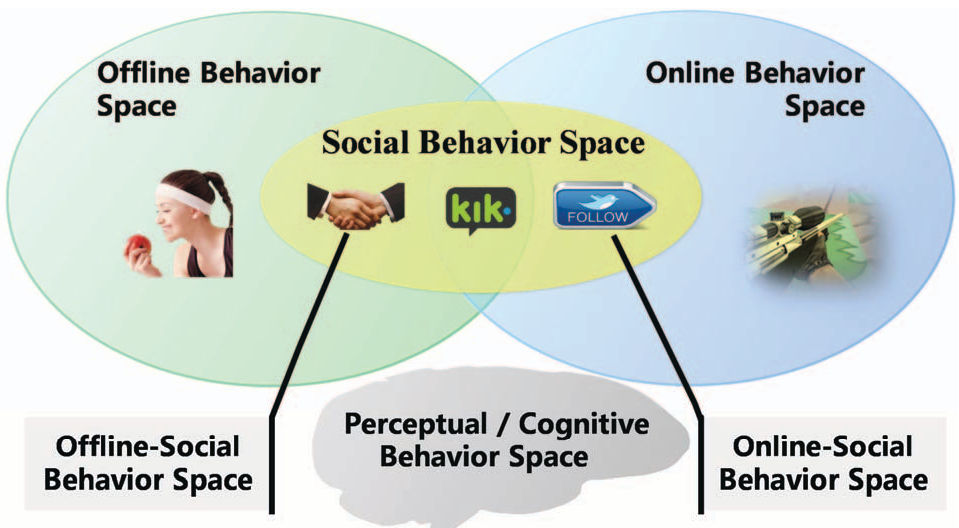
1. The Blended Space Architecture
The model assumes that a user's behavior is influenced by their Social Community. A community determines both the likelihood of visiting a specific venue and the "topics" of their conversations.
2. The Generative Process
The heart of the method is a joint distribution that captures dependencies between:
- Community Distribution (): Which social circles a user belongs to.
- Topic Distribution (): The interests of those circles.
- Spatial Items (): Common venues for those communities.
- Kernel Functions (): The temporal "rhythm" of activity.
By using Gibbs Sampling, the model learns the "normal" parameters for a user. When a new behavior occurs, the system calculates the probability . If the probability is low, an identity theft alert is triggered.
Experimental Showdown: Semantics vs. Spatial
The researchers tested their hypothesis on two massive real-life datasets: Foursquare and Yelp.
In a head-to-head comparison, they compared their semantic-based approach (using LDA) against MKDE (Mixture of Kernel Densities), which is the state-of-the-art for spatial modeling.
| Metric | Foursquare Dataset | Yelp Dataset |
|---|---|---|
| # of Users | 23,537 | 42,137 |
| # of Check-ins | 268,109 | 495,107 |
The "Clear Margin" Result
The most striking finding was the detectable difference. In the spatial distribution (Fig. 2), the overlap between legal users and anomalies is messy. However, when switching to semantic features (Fig. 3), the separation becomes much sharper. This proves that what we talk about is often more unique than where we stand.
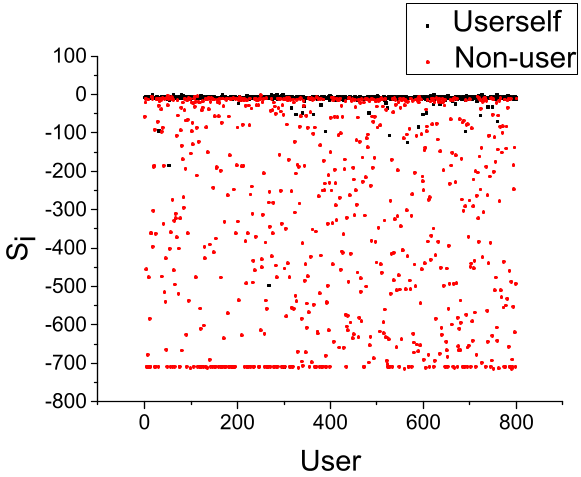 Fig 2: Spatial features often struggle to distinguish subtle identity changes.
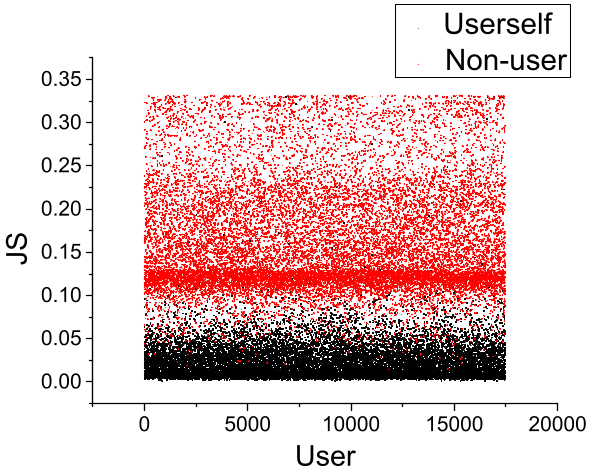 Fig 3: Semantic features provide a larger, more distinct margin for anomaly detection.
Final Verdict & Future Outlook
This work demonstrates that for modern security, data fusion is not optional; it is essential. By combining textual semantics with geo-temporal data, the model provides an interpretable and highly accurate shield against account hijacking.
Key Takeaways for the Industry:
- Beyond the Password: Continuous authentication via behavioral analysis is becoming mandatory for high-stakes social platforms.
- Interpretability: Because the model provides conditional probabilities for each dimension (time, place, text), security teams can see why an account was flagged (e.g., "The user is at a normal location, but their vocabulary has shifted drastically").
- Next Steps: Future work will likely look at how these models handle "adaptive attackers"—thieves who might try to mimic a user’s writing style using AI.
The project highlights a Shift from "What you know" (password) to "Who you are" (behavioral semantics).