
MEH-PS: Redefining Tractor Efficiency through Mechanic-Electronic-Hydraulic Integration
IEEE VEHICULAR TECHNOLOGY SOCIETY SECTION
This paper introduces a Novel Mechanic-Electronic-Hydraulic Powertrain System (MEH-PS) for agricultural tractors. It integrates an electro-mechanical hybrid system with a hydro-mechanical transmission (HMT), utilizing planetary gears to achieve multiple drive modes and step-less speed regulation (CVT) with an average HMT efficiency exceeding 86%.
TL;DR
Researchers have developed a Mechanic-Electronic-Hydraulic Powertrain System (MEH-PS) that merges the high torque of hydraulic systems with the flexible control of electric motors. By utilizing a sophisticated planetary gear arrangement, this system achieves a wide-range CVT effect for tractors, boosting acceleration performance by approximately 12% and maintaining transmission efficiency above 86%.
Background & Motivation: The Tractor's Dilemma
In the world of agricultural machinery, tractors are expected to be "jacks of all trades." They must provide massive traction for plowing at low speeds (5-10 km/h) yet maintain high efficiency for road transport (up to 50-60 km/h). Traditional stepped transmissions require dozens of gears to cover this range, leading to complex hardware and jerky operator experiences.
Existing Hydro-Mechanical Transmissions (HMT) provided a partial solution via continuously variable transmission (CVT), but they often struggle with limited speed ranges or low efficiency during specific power-split cycles. The authors identify a gap in the SOTA: the absence of a unified system that leverages electric hybridization to assist both the torque and speed regulation of an HMT.
Methodology: The "Tri-Power" Synergy
The core innovation lies in the MEH-PS Architecture, which coordinates power flow between an Internal Combustion Engine (ICE), a Motor-Generator (MG), and a Hydraulic system (Variable Displacement Pump and Fixed Displacement Motor).
1. Multi-Mode Drive Logic
The system utilizes four distinct drive modes to optimize the energy source based on load:
- Pure Electric: For low-load transit.
- Pure Engine: For standard farming operations.
- Torque Coupling (TC): Engine + Motor combine torques for heavy plowing or rapid acceleration.
- Speed Coupling (SC): Uses the motor's speed regulation via planetary gear K1 to extend the tractor's top speed without increasing engine RPM.
2. The Transmission Layout
The power merging mechanism (Planetary set K2) handles the complex task of blending mechanical and hydraulic power.
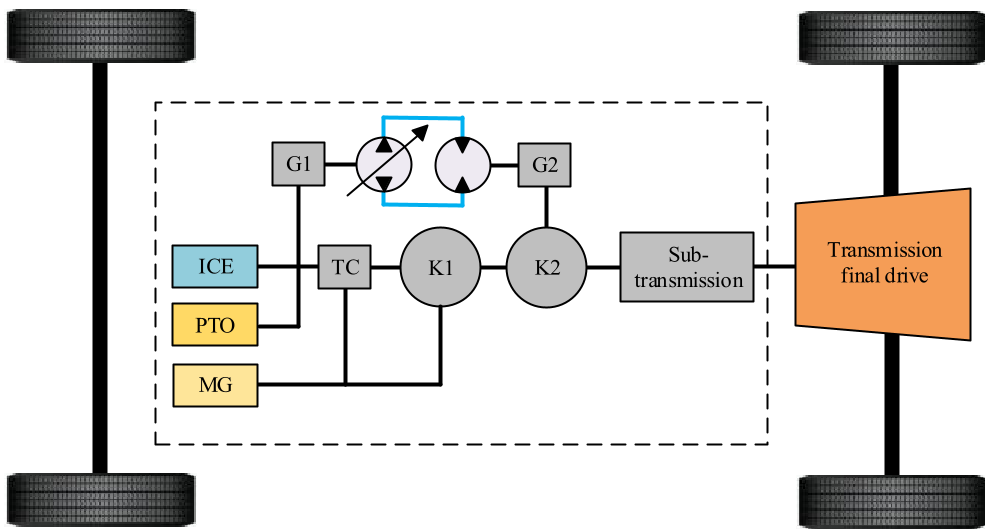 Figure 1: The schematic of MEH-PS showing the interaction between the ICE, MG, and the hydraulic circuit.
Experimental Results & Critical Analysis
The authors validated the design using SimulationX and a custom-built physical test bench.
SOTA Performance Comparison
In acceleration tests (0-40 km/h), the "Motor-Assisted" mode (Torque Coupling) reduced acceleration time from 58.6s to 51.5s. More importantly, the system reached 60 km/h using only four shifts, a feat usually requiring a much larger gearbox in conventional tractors.
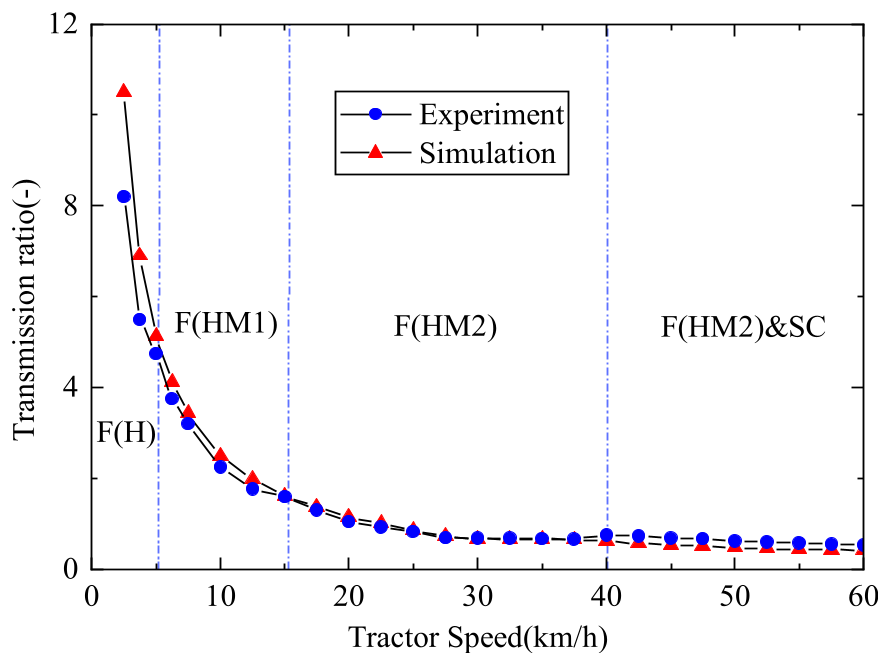 Figure 2: Comparison between simulation and experimental transmission efficiency, hitting peaks near mechanical transmission points.
Key Insights:
- Efficiency Sweet Spots: The highest efficiency occurs at the "mechanical points" (e=0), where the hydraulic path carries no power, minimizing conversion losses.
- Power Split Optimization: The power split ratio is kept low across most operating ranges, which is the primary reason the average efficiency stays above 86%.
Conclusion & Future Outlook
The MEH-PS stands as a significant advancement in tractor powertrain design. By integrating an electric motor into the hydro-mechanical loop, the authors have created a system that is not only more dynamic but also "future-proofed" for the electrification of agriculture.
Limitations: The complexity of managing five clutches/brakes (C1-C5, B1-B5) poses a challenge for real-time control robustness and manufacturing costs. Future research will likely focus on simplifying the switching logic and improving the energy management strategy for the battery pack during prolonged heavy-duty operations.
Main Source: "Design and Analysis of a Novel Mechanic-Electronic-Hydraulic Powertrain System for Agriculture Tractors", IEEE Access, 2021.