
iFriendU: Weapons-Grade Social Engineering via 3-Cliques
iFriendU: leveraging 3-cliques to enhance infiltration attacks in online social networks
This paper introduces iFriendU, a novel infiltration attack for Online Social Networks (OSNs) that exploits 3-cliques to systematically gain access to private communities. It also presents MORPH-x, a mitigation system that uses inferred trust thresholds and a probation period for new friends to block over 90% of such automated infiltration attempts.
TL;DR
The paper iFriendU exposes a critical vulnerability in how we trust people on Online Social Networks (OSNs). By leveraging the mathematical structure of 3-cliques (triangles), attackers can systematically trick users into accepting friend requests from fake accounts. The study shows that building "social momentum" through mutual friends can boost infiltration efficiency by 75%, but introduces MORPH-x, a defense mechanism that effectively walls off these attackers.
Background: The Trust Paradox
In a tightly-knit community, members are naturally skeptical. If a random account (a "Naïve" attacker) sends you a request, you ignore it. However, if that account shares 10 mutual friends with you, human psychology—and OSN algorithms—suggest they are "safe." The authors identify this Social Closeness () as the primary exploit vector.
Methodology: The iFriendU Attack Path
The attack isn't a blunt instrument; it's a multi-stage infiltration.
1. Identifying the Weak Link
The attacker crawls the target community to find users with the highest number of 3-cliques (). A user involved in many triangles is a "social hub." Befriending them provides the "keys to the city" for their entire sub-network.
2. Recursive Friend Building
The attacker doesn't go for the target immediately. Instead, they follow a depth-2 recursive strategy:
- Step 1: Befriend the friends of the target's friends.
- Step 2: Use those newly established links to befriend the direct friends of the target.
- Step 3: Finally, invite the target.
At this stage, the target sees a request from someone with a massive pool of mutual friends, making acceptance highly likely.
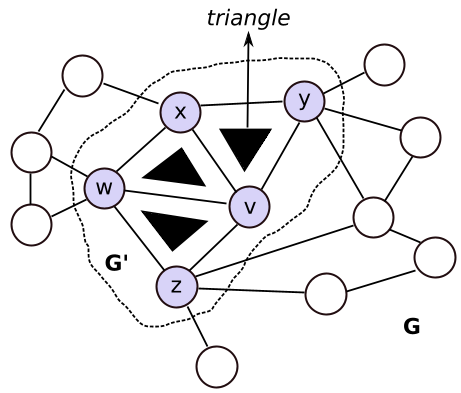 Figure 1: The recursive logic of building mutual friends before hitting the final target.
Experimental Proof: Facebook in the Crosshairs
The authors tested this on a real-world Facebook dataset consisting of 178K nodes and 339K edges.
- Naïve Success: 45% (Randomly hitting 150 users).
- iFriendU Success: 79% (Systematically building the 3-clique path).
The efficiency gain is calculated at 75%. This proves that structural knowledge of the social graph allows an attacker to bypass traditional human intuition.
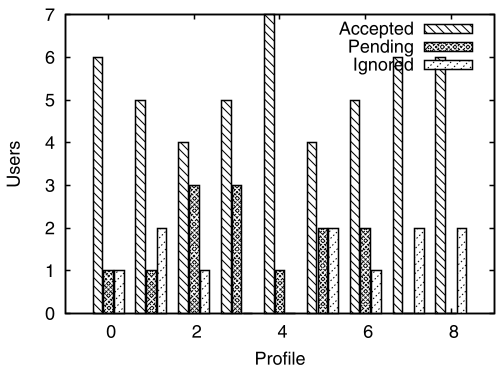 Figure 2: Distribution of 3-cliques in the OSN dataset, showing the "Small World" connectivity that attackers exploit.
The Defense: MORPH-x
To counter this, the authors proposed MORPH-x. This system shifts the burden of proof from the user to the network.
- Probation Period: New friends are "confined." They cannot see your private profile data initially.
- Trust Inference: The system calculates a trust score based on structural overlap ().
- Automated Promotion: Only when the system "sees" that the friend is genuinely embedded in your trusted circles does it promote them to "Full Friend" status.
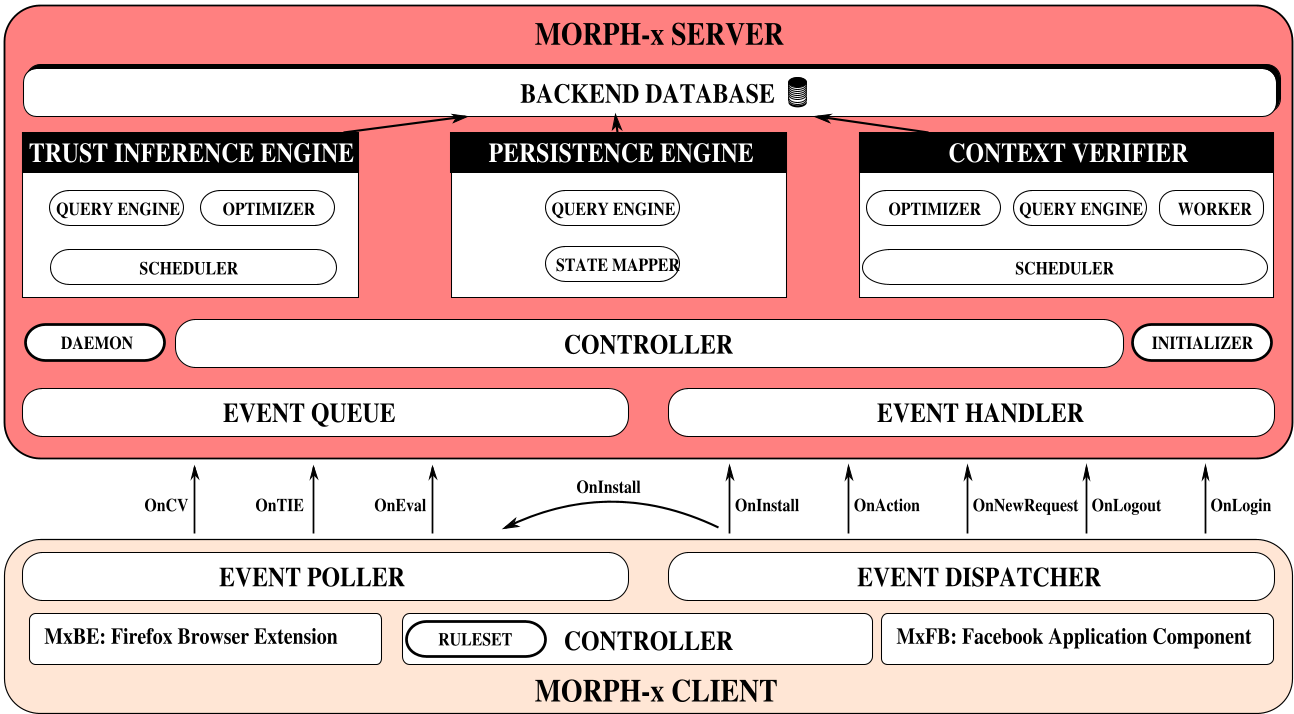 Figure 3: Architecture of the MORPH-x system combining client-side monitoring and server-side trust calculation.
Critical Analysis & Conclusion
Takeaway
iFriendU demonstrates that social network security is a graph problem, not just a UI problem. By understanding "triadic closure," attackers can manufacture social proof.
Limitations
The study was conducted in 2010. Modern platforms like Facebook and LinkedIn have since implemented "Likely Fake Account" flags and rate-limiting on requests. However, the core logic—building mutual friend clusters—remains the gold standard for high-value spear-phishing and state-sponsored social engineering today.
Future Outlook
As we move toward decentralized social networks (like Mastodon or Farcaster), decentralized trust scores (like EigenTrust or Karma) will become the modern-day equivalents of MORPH-x, protecting users from automated graph-based infiltration.