
Beyond Concrete: Scaling Sustainable Wood and Brick in Nigeria’s Institutional Architecture
International Journal of Spectrum Research in Environmental & Energy Studies (IJSREES) 2 (1), January-March, 2026, Pages 144-152
This study evaluates the sustainable integration of wood and brick in Nigeria's institutional buildings through a systematic literature review (SLR). It concludes that engineered timber and stabilized earth bricks offer superior carbon sequestration and thermal performance, positioning them as viable SOTA alternatives to carbon-intensive concrete and steel.
TL;DR
The construction sector is a primary driver of environmental degradation. In Nigeria, the dominance of "modern" materials like concrete and steel contributes to high carbon footprints and poor thermal comfort. This study advocates for a return to engineered wood and stabilized earth bricks, proving they are not just "materials for the poor" but high-performance, cost-effective solutions for large-scale institutional infrastructure.
The "Prestige Gap" and the Carbon Crisis
In the Nigerian built environment, material selection is often driven by a perceived hierarchy of modernity. Concrete and sandcrete blocks are viewed as symbols of prestige, despite their massive carbon debt (cement alone accounts for ~8% of global CO2) and their tendency to exacerbate the Urban Heat Island (UHI) effect.
The author's core insight is that this reliance is an architectural misalignment. In a hot-humid climate, the high thermal mass of earth-based materials and the carbon-sequestration capacity of timber offer a dual solution: environmental mitigation and passive cooling.
Methodology: A Multi-Dimensional Synthesis
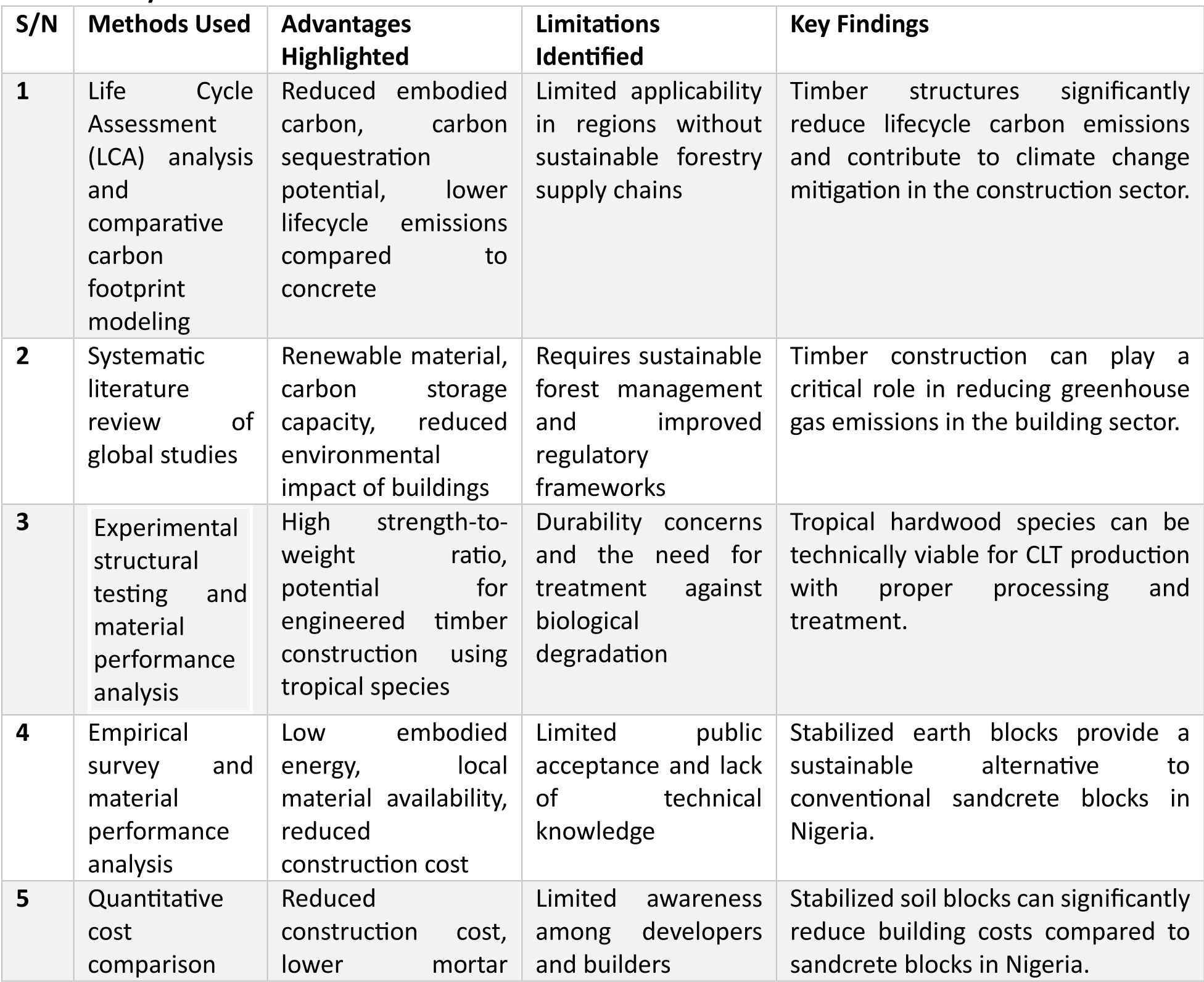
The research employs a systematic review to bridge the gap between material science and socio-economic reality. By analyzing Life Cycle Assessments (LCA) and structural test results, the study evaluates two primary pathways:
- Engineered Wood (CLT/Glulam): Moving beyond primitive timber to high-strength, fire-resistant multi-story applications using fast-growing tropical species.
- Stabilized Earth (ISSB): Utilizing local laterite soil stabilized with minimal cement to create interlocking blocks that outperform sandcrete in both cost and thermal regulation.
 Note: The study synthesizes data across the Nigerian climatic and regulatory framework.
Performance Breakdown: Why It Works
1. Structural & Environmental Superiority
Contrary to the myth that timber is unsuitable for large-scale projects in the tropics, the research cites evidence that engineered tropical hardwoods meet the mechanical requirements for multi-story construction. Timber acts as a carbon sink, storing atmospheric carbon throughout its lifecycle.
2. The Economic Edge
The study highlights that Interlocking Stabilized Soil Blocks (ISSB) offer a data-proven cost advantage. By eliminating the need for expensive external plastering and reducing mortar requirements, sustainable materials provide a faster, cheaper path to public infrastructure development.
Critical Barriers: The Roadblocks to Adoption
Despite the technical wins, the study identifies three critical "inhibitors":
- Regulatory Vacuum: There is a lack of standardized building codes for timber and earth-based materials, leaving architects in a legal limbo.
- Technical Knowledge Gap: Many professionals lack the training to specify or oversee engineered wood and stabilized earth construction.
- Socio-Cultural Perception: The "material for the poor" stigma prevents high-stakes institutional projects (universities, hospitals) from adopting these SOTA solutions.
Conclusion & Future Outlook
The transition to sustainable construction in Nigeria is not a technical impossibility but a policy challenge. The study calls for Demonstration Projects—high-profile public buildings that utilize these materials to prove the "prestige" of sustainable architecture.
For Nigeria to meet its climate targets while building for a rapidly growing population, the future must be built on a foundation of local, renewable, and thermally efficient materials.
Final Takeaway
Shift the focus from fragmented residential research to high-impact institutional policy action.