
iMac: Aligning Self-Interest with Social Good in Mobile Crowdsourcing
iMac: Strategy-Proof Incentive Mechanism for Mobile Crowdsourcing
The paper introduces iMac, a strategy-proof incentive mechanism for mobile crowdsourcing based on the Vickrey-Clarke-Groves (VCG) framework. It ensures truthful cost reporting by strategic smartphone users while minimizing the global social cost of sensing tasks.
TL;DR
Mobile crowdsourcing turns our smartphones into a global sensing network, but users aren't volunteers—they are rational agents who want to be paid more than it costs them to participate. The iMac mechanism solves the "cheating problem" by making truth-telling the most profitable strategy for every user, ensuring the entire system operates at the lowest possible social cost.
The "Liar's Paradox" in Crowdsourcing
In a typical crowdsourcing scenario (e.g., monitoring air quality), a platform needs to recruit users to collect data. Each user has a private cost (battery drain, data usage). If the platform asks, "How much does this cost you?", a rational user will lie and say "It's very expensive!" to negotiate a higher payment.
This creates two massive failures:
- Inefficiency: The platform might pick the "loudest" liars instead of the most efficient workers.
- Market Collapse: If everyone overcharges, the requester can't afford the sensing task, and the system dies.
Methodology: The iMac Framework
The researchers proposed iMac (Strategy-Proof Incentive Mechanism for Mobile Crowdsourcing). Based on the Vickrey-Clarke-Groves (VCG) theory, it breaks the link between what you say it costs and what you are paid.
1. Winner Selection (The Greedy Approach)
To minimize the social cost, iMac sorts all participating smartphones by their claimed costs in non-descending order. It picks the cheapest users first until the total sensing demand is met.
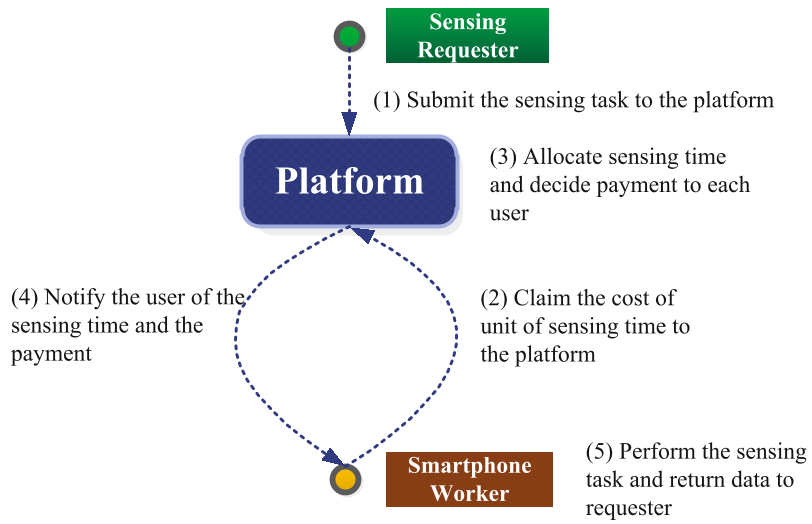 Figure 1: The interaction loop between Requesters, the Platform, and Smartphones.
2. The Payment Rule (The Clarke Pivot)
The "magic" of iMac lies in the payment formula: In plain English: Your payment is the difference between how much the system would have cost without you versus the cost of everyone else with you. You are essentially paid for the value you add to the collective efficiency. If you lie about your cost, you risk either not being picked or reducing your own utility.
Performance: Truth pays off
The authors validated iMac against a "Baseline" where users can cheat without repercussions.
Overpayment Efficiency
A common fear of VCG-style mechanisms is that the platform has to pay too much to keep people honest. iMac proves this fear is overblown. As the number of smartphones increases, the "Overpayment" ratio drops significantly because competition drives the "marginal value" of any single user down.
(Note: Refer to Fig. 2 in the paper showing overpayment approaching 1.0 as competition increases)
Social Cost Savings
When users are strategic, the baseline mechanism's cost explodes because it lacks the mathematical rigor to filter out cheaters. iMac keeps the social cost at the theoretical minimum.
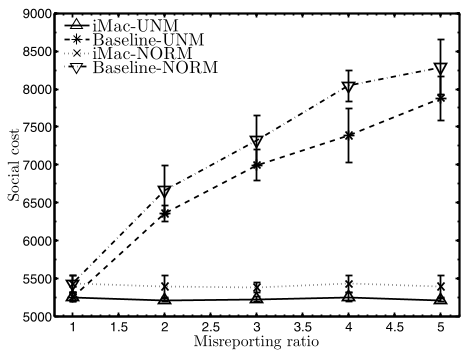 Figure 5: iMac vs Baseline. iMac maintains the lowest social cost even as the user pool grows.
Critical Insight & Conclusion
The genius of iMac is its Strategy-Proofness. By establishing a Nash Equilibrium where (claimed cost equals real cost), the platform gains perfect information about a distributed, private system.
Limitations: While iMac is brilliant for static tasks, real-world crowdsourcing is often dynamic. Future work would need to address "online" scenarios where users join and leave in real-time, requiring a dynamic version of the VCG mechanism.
Final takeaway: iMac proves that in the world of mobile sensing, honesty isn't just a virtue—in a well-designed system, it's the most profitable business strategy.