
Efficient Dietary Assessment: Bridging the Gap Between Computer Vision and Pediatric Health
Image-based Dietary Assessment System for Chinese Children
This paper presents a comprehensive image-based dietary assessment system tailored for Chinese children, integrating food weight estimation via smartphone photos, machine learning-driven error elimination, and a personalized food recommendation engine based on Chinese Dietary Reference Intakes (DRIs). The system achieves a weight estimation precision exceeding 80% with a significant reduction in processing time compared to traditional 3D reconstruction methods.
TL;DR
Researchers from the Beijing University of Posts and Telecommunications have developed a smartphone-based system that allows parents to estimate a child's nutrient intake simply by taking a photo. By using a clever physical shaping tool and a linear regression error-correction model, the system achieves over 80% accuracy in food weight estimation while processing results in under 5 seconds—significantly faster than existing 3D reconstruction methods.
Background & Motivation: The Silent Struggle of Nutritional Tracking
Nutritional health in children is a critical predictor of long-term wellness. However, current assessment methods are either too primitive (manual journals) or too complex (lab-grade 3D imaging). Parents often only realize nutritional deficiencies after physical symptoms appear. The challenge lies in the Inductive Bias of 2D images: a photo lacks depth information, making it nearly impossible to calculate the volume of a "pile" of food accurately without a reference for height.
Methodology: Engineering Precision from 2D Constraints
The system, commissioned by the Chinese Capital Institute of Pediatrics, avoids the heavy computational overhead of 3D reconstruction by introducing three core innovations:
1. The Height Problem: The "Stair" Solution
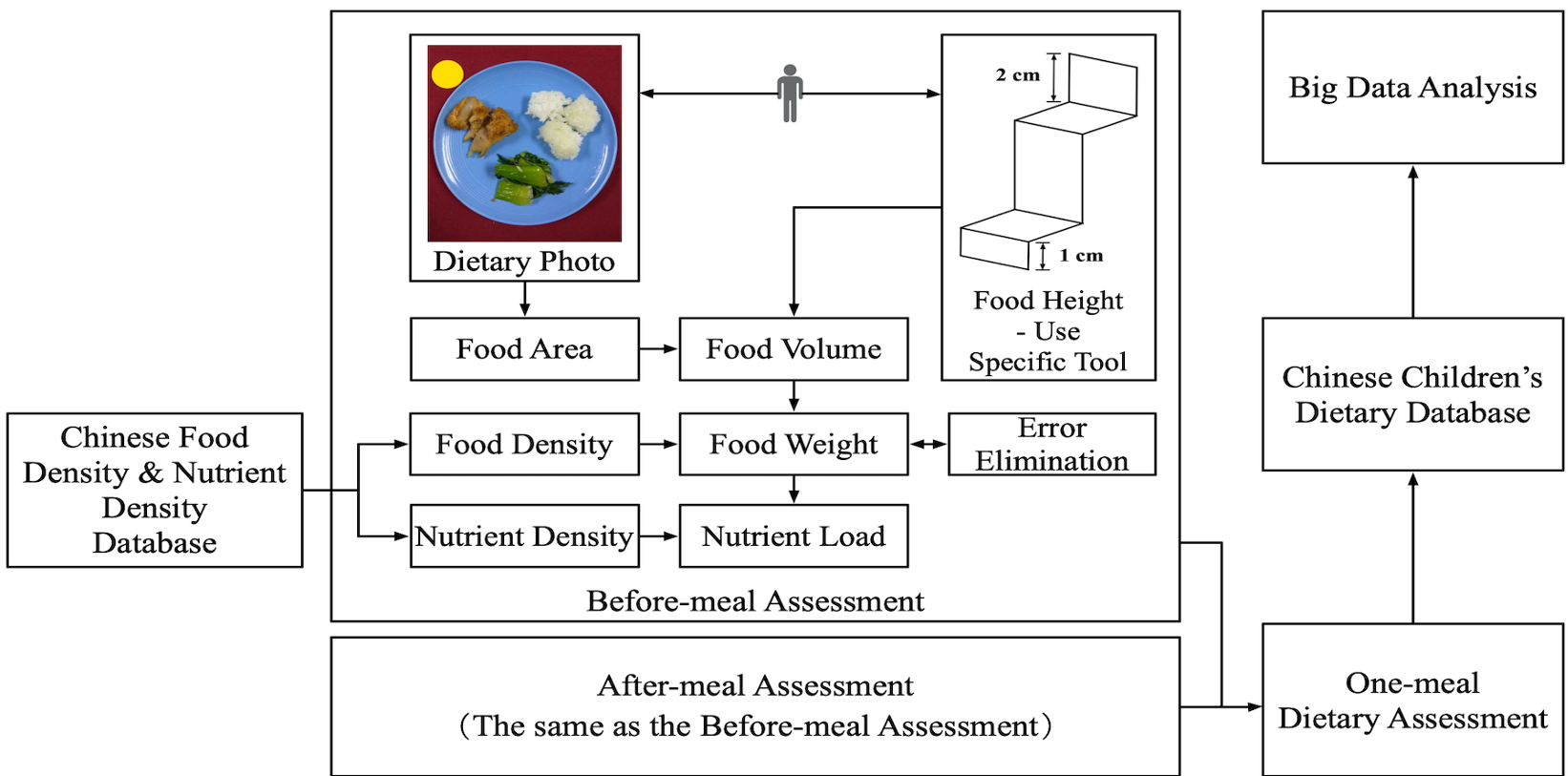
To solve the depth ambiguity, researchers introduced a "special shaping tool"—a multi-step stair. By shaping a food pile against this tool, the user can provide a discrete height value to the system. This transforms a complex 3D modeling problem into a much simpler area-multiplied-by-height calculation.
2. Architecture of the Assessment Pipeline
The workflow involves region segmentation using a modified Canny algorithm and expansion coefficients to isolate the food and a reference object (with a known area).
3. Error Elimination via Linear Regression
A raw "Area × Height" calculation is often prone to noise. The authors implemented a corrective model: This model takes a feature vector containing pixel counts, preliminary volume, and density data to output a refined weight , effectively filtering out the systematic errors inherent in smartphone photography.
Experiments: Speed Meets Accuracy
The system was tested against various common foods. Unlike previous SOTA methods that took upwards of 24 seconds to calculate volume, this system performs the task in under 5 seconds.
Key Performance Data:
| Food Item | Actual Weight (g) | Estimated Weight (g) | Precision |
|---|---|---|---|
| Rice | 54.2 | 57.85 | 93.3% |
| Tofu Cube | 113.5 | 120.85 | 93.5% |
| Chicken Cubes | 41.3 | 48.29 | 83.1% |
The results demonstrate that while irregular shapes (like chicken cubes) present more of a challenge, the system maintains a high baseline of accuracy sufficient for clinical reference.
Closing the Loop: Data-Driven Recommendations
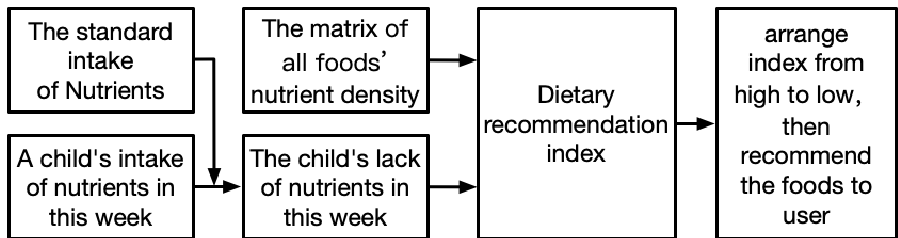
Beyond just "counting calories," the system compares a child's weekly intake against the Chinese Dietary Reference Intakes (DRIs). It calculates a "Dietary Recommendation Index" for various foods: Where represents the lack of specific nutrients and is the nutrient density matrix. This ensures the data collected doesn't just sit in a database but actively informs the child's next meal.
Critical Insight & Limitations
The beauty of this system lies in its pragmatism. By using a physical tool to "standardize" food height, the researchers bypassed the need for expensive LiDAR sensors or GPU-heavy photogrammetry.
However, a clear limitation is the user friction introduced by the "shaping tool." While it increases accuracy, it requires the user to physically manipulate their food before eating, which may affect adoption in casual settings. Future work might leverage "Depth-from-Something" deep learning models to eliminate the need for this physical tool entirely.
Final Summary
This system represents a major step forward in making pediatric nutritional health proactive rather than reactive. By combining simple computer vision techniques with robust nutritional databases, it provides a viable, low-latency solution for real-world dietary management.