
Digital Fingerprints: Identifying Image Provenance in the Age of Social Media
18164_Image Origin Classification Based on Social Network Provenance.
This paper introduces a forensic methodology to identify the social network (SN) origin (Facebook, Twitter, Flickr) of digital images and estimate their original JPEG quality factor. The method utilizes 8x8 DCT coefficient histograms as distinctive features processed by a Bagged Tree Random Forest classifier, achieving high accuracy in provenance attribution.
TL;DR
In a world where millions of photos are uploaded daily to platforms like Facebook and Twitter, reconstructing the history of an image is a forensic necessity. This paper proposes a method to identify which social network an image originated from by analyzing the invisible "scars" left by platform-specific compression. By looking at DCT coefficient histograms and using Random Forest classifiers, the authors can pinpoint the source platform and even guess the image's quality before it was uploaded.
Perspective: Why Metadata is Not Enough
When an image is uploaded to a social network, it typically undergoes a "black-box" transformation: it is resized, stripped of EXIF metadata, and re-compressed to save bandwidth. For forensic experts, this is a nightmare—metadata is easily forged or erased.
The authors' core insight is that each platform (Facebook, Twitter, Flickr) uses a slightly different re-compression algorithm. These algorithms leave specific statistical traces—fingerprints—in the pixel values and transform coefficients that are nearly impossible to see with the naked eye but easy for a machine to detect.
Methodology: Peeking into the DCT Domain
The proposed method focuses on the Discrete Cosine Transform (DCT) domain. Since almost every social network uses JPEG compression, the 8x8 block DCT coefficients are the most sensitive area to track distortions.
The Feature Extraction Pipeline
- Block Analysis: The image is divided into 8x8 blocks.
- AC Modes: The authors select the first DCT coefficients (following a zig-zag scan, excluding DC).
- Histogram Binning: For each mode, a histogram of values is created (within a range of ).
- Normalization: Histograms are normalized by the number of blocks to ensure image size doesn't skew the results.
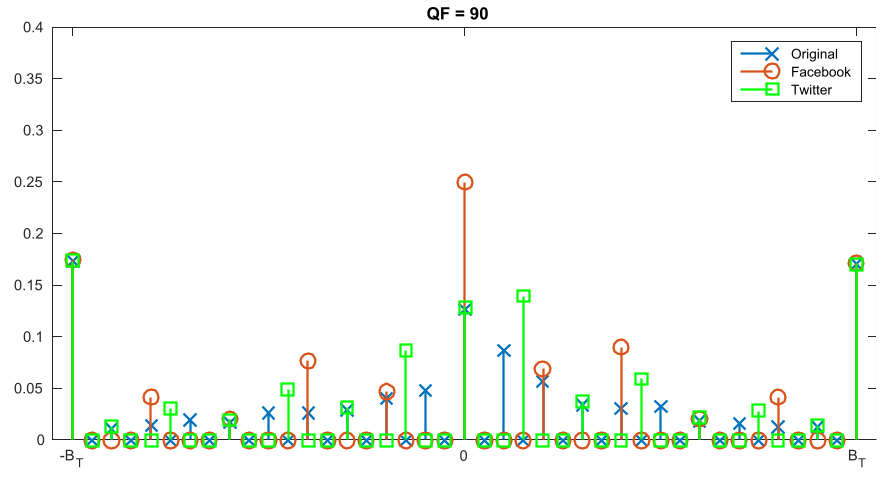 Fig 1. Comparison of DCT-coefficient histograms for a sample image before and after Facebook processing. The shifts in magnitude and position are the "fingerprints" the model learns.
Experiments and Logic: The "Twitter Gap"
One of the most fascinating findings in the paper relates to Twitter's optimization strategy. The authors noticed that for images with an original Quality Factor (QF) 85, Twitter often does not re-process the image. This creates a "confusion" in the classifier because an image downloaded from Twitter looks identical to a standard compressed JPEG. However, for high-quality images (), Twitter does apply processing, making them perfectly distinguishable.
Performance Highlights
The researchers tested the system under various scenarios:
- Controlled Environment: Using the UCID database, they achieved remarkably high diagonal accuracy for provenance.
- Open Scenario: Tested on real, "uncontrolled" public images from the web, the system maintained an 88.75% accuracy rate.
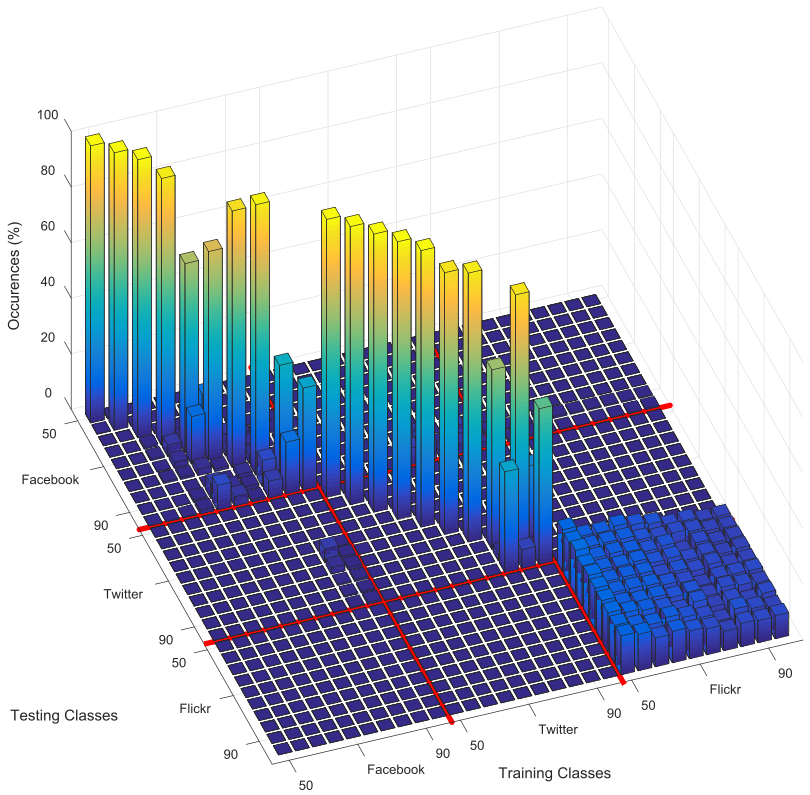 Fig 2. Matrix showing the system's ability to distinguish between Facebook, Twitter, and Flickr across different quality factors.
Critical Insight: Cross-Platform Chains
What happens if an image is uploaded to Facebook, downloaded, and then uploaded to Flickr? This "cross-upload" scenario is common in digital investigations. The authors found that the last social network in the chain usually leaves the dominant mark. However, Flickr's processing is so heavy that its traces often survive even if the image is later passed through Facebook—a phenomenon termed "important distortions" that remain detectable.
Conclusion & Future Outlook
This work provides a robust framework for Image Phylogeny, helping investigators trace the "family tree" of a digital asset.
Limitations:
- The current method is reliant on JPEG format; its effectiveness on newer formats like WebP or HEIC (used by modern iPhones) remains to be tested.
- Platforms frequently update their compression backends, meaning classifiers must be periodically "retrained" to stay relevant.
As social platforms become more sophisticated, forensic techniques like this—which look past the visual surface into the mathematical structure of the data—will be essential for maintaining truth in digital media.