
Digital Fingerprinting: Deciphering the Hidden Traces of Social Media Platforms on Your Photos
Image origin identification for online social networks (OSNs)
This paper introduces a robust framework for identifying the provenance of images shared over Online Social Networks (OSNs) like Facebook, Twitter, Flickr, and WeChat. The authors leverage a multi-class SVM classifier trained on a custom feature vector that captures unique digital traces—such as quantization tables and color subsampling—left by platform-specific image processing pipelines.
TL;DR
Researchers from the University of Macau have developed a forensics-ready method to identify which social media platform (Facebook, Twitter, WeChat, or Flickr) an image originated from. By analyzing subtle "traces" left by each platform's unique compression and resizing algorithms, their SVM-based classifier achieves nearly 100% accuracy, even on high-quality images where previous methods failed.
Contextual Positioning
In the landscape of digital forensics, this work moves beyond traditional camera identification (which looks for sensor noise) and focuses on "platform provenance." It addresses the growing need for legal and privacy enforcement in an era where billions of images are shared daily on OSNs, often stripped of their original metadata.
The Problem: The "Black Box" of OSN Uploads
When you upload a photo to Facebook or WeChat, it doesn't stay the same. Platforms perform a "black box" series of operations:
- Resizing: Shrinking images to save bandwidth.
- JPEG Compression: Re-encoding images using proprietary quantization tables.
- Enhancement Filtering: Sharpening or color-adjusting to make images look better.
Existing methods, like those by Caldelli et al., relied on basic DCT domain analysis but struggled significantly with high-quality uploads because the "traces" are much thinner. Furthermore, most previous work ignored color space information, which is a missed opportunity for differentiation.
Methodology: Engineering the Perfect Feature Vector
The core innovation lies in the feature vector , which acts as a multi-dimensional thumbprint. The authors broke down the platform behavior into four quantifiable metrics:
1. Color Subsampling ()
Platforms use different YUV modes (e.g., 4:4:4 for Flickr vs. 4:2:0 for Facebook). The authors converted these into a normalized scalar, providing a primary "filter" for classification.
2. The Quantization Table Gap ( and )
Every OSN has a favorite way of compressing JPEGs. The authors calculated the distance between a platform's custom quantization table () and the standard JPEG table ().
- Insight: Flickr uses tables that deviate slightly from the standard, making it instantly recognizable through variable .
3. Refined DCT Histograms ()
To catch the traces of enhancement filters, the authors analyzed 9 frequency bands in the DCT domain. They simplified the feature set by removing coefficient signs and truncating histograms, focusing only on the distribution of energy which contains the "echo" of filtering.
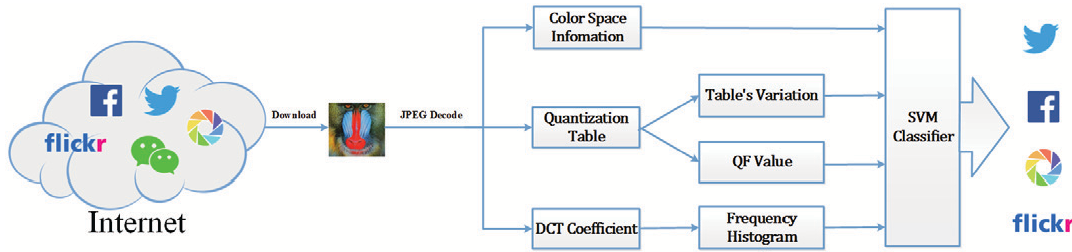 Figure 1: The schematic flow from image upload to origin identification via SVM.
Experimental Performance vs. SOTA
The researchers tested their model against 660 images across various quality factors. The results were dominant:
- WeChat & Flickr: 100% accuracy across all tests.
- Facebook vs. Twitter: Historically difficult to distinguish due to similar QF (Quality Factor) strategies. However, the proposed method achieved 99.85% accuracy.
The High-Quality Breakthrough
The most telling result is shown in the comparison with the previous SOTA ([10]). For Facebook images uploaded with a QF of 90:
- Prior Work: Accuracy dropped to 83.92%.
- This Paper: Retained 100% accuracy.
 Table 1: Detailed contrast showing the proposed method's stability across different upload Qualities.
Critical Analysis & Future Outlook
Takeaway: This research proves that the "aggression" of OSN processing is actually a forensic gift. The more a platform tries to optimize an image, the more unique its signature becomes.
Limitations:
- The study is limited to four platforms. While the methodology is scalable, modern platforms like Instagram apply much more aggressive, non-linear filters (AI-upscaling, etc.) that may require deep learning to disentangle.
- The current approach assumes the image has only passed through one OSN. A "double-sharing" scenario (downloading from Twitter and uploading to Facebook) remains a complex challenge for future work.
Conclusion: Sun and Zhou have provided a highly efficient, mathematically grounded bridge between raw signal processing and digital forensics. As "deepfake" and misappropriation issues rise, these platform fingerprints will be essential for tracing the propagation paths of misinformation.