
Beyond the Human Eye: A Systematic Review of Image Recognition in Precision Agriculture
Use of Technologies of Image Recognition in Agriculture: Systematic Review of Literature
This paper presents a systematic review of image recognition technologies in precision agriculture, specifically focusing on machine learning methods for classification. It synthesizes findings on Artificial Vision Systems (SMV), Artificial Neural Networks (ANN), and Fuzzy Classifiers used for disease diagnosis, nutrient deficiency detection, and fruit quality assessment.
Executive Summary
TL;DR: This systematic review explores the digital transformation of the "Agronomist’s intuition" into algorithmic precision. By analyzing 36 key studies, the authors break down how Computer Vision and Machine Learning (SVM, ANN, Fuzzy Logic) are currently outperforming manual efforts in disease detection, nutrient mapping, and fruit grading.
Positioning: This work serves as an academic map, categorizing a decade of fragmented research into a coherent operational framework. It transitions the field from "experimental curiosities" to "industrial necessities," highlighting that while the algorithms are ready, the data infrastructure still lags behind.
Problem & Motivation
Agriculture has historically been a labor-saturated industry. Traditional diagnosis—determining if a leaf is yellow due to a lack of Nitrogen or a fungal infection—is a "difficult manual task" influenced by erratic environmental factors.
The authors' biological insight is that agricultural health is encoded in visual stimuli (color, texture, morphology). The bottleneck isn't just the lack of workers, but the lack of objective consistency. Human decision-making is subjective; a machine's perception of "RGB 255, 200, 0" is absolute.
Methodology: The Three-Level Hierarchy
The paper adopts a structured vision of image analysis, dividing the workflow into three critical levels:
- Low Level: Focuses on image acquisition and noise reduction (preprocessing).
- Intermediate Level: The stage of semantic extraction—segmentation (isolating the fruit from the leaf) and feature description (quantifying the shape).
- High Level: The "Cognitive" phase where recognition, interpretation, and classification happen.
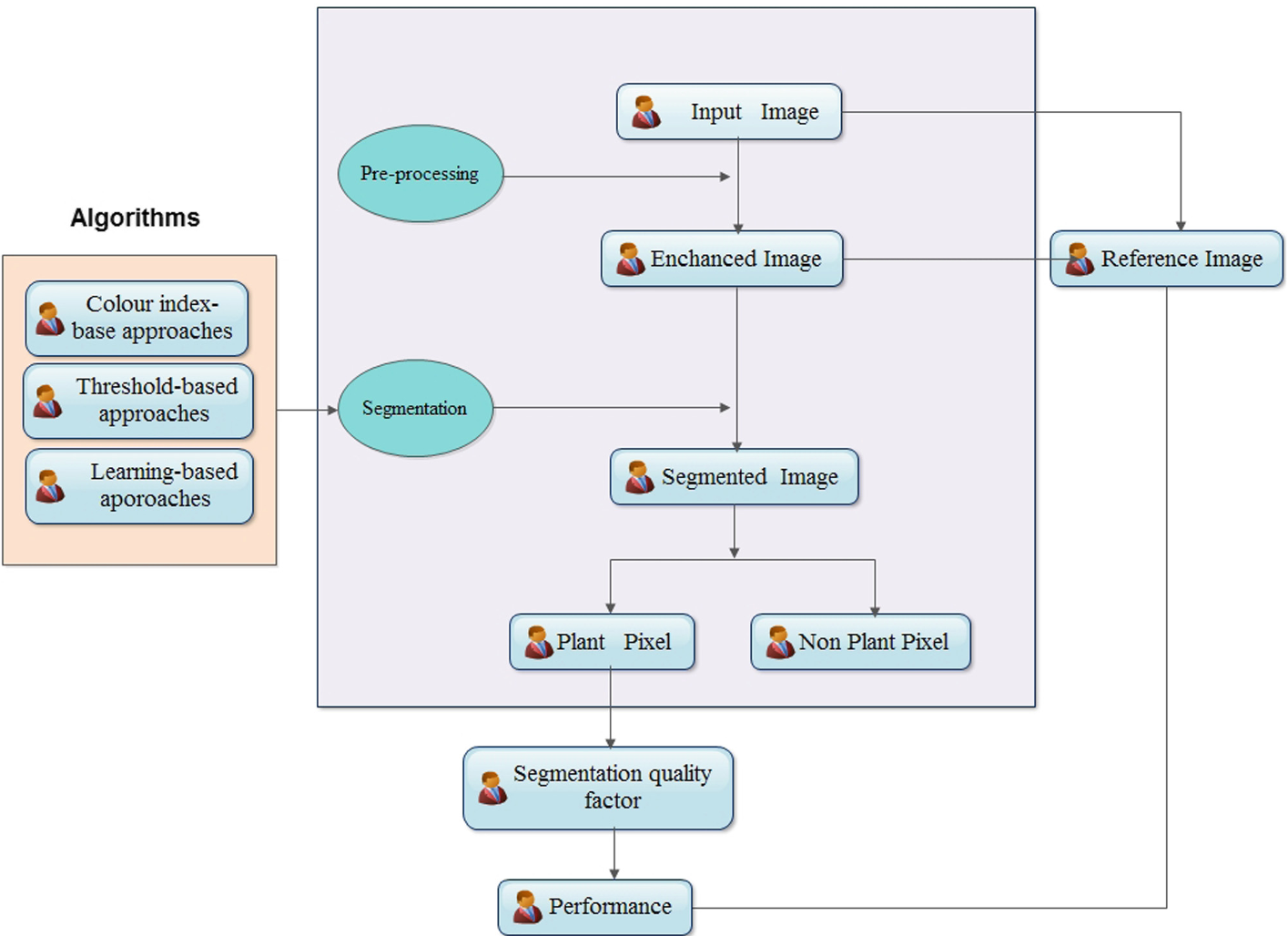
Key Algorithmic Pillars
- Artificial Vision Systems (SMV/Computer Vision): Utilizing libraries like OpenCV and techniques like SVM or KNN. These are often used for geometric tasks like sorting apples (handling ~15 per second).
- Artificial Neural Networks (ANN): Targeted at complex, non-linear patterns like identifying iron or zinc deficiencies based on subtle leaf texture variations.
- Fuzzy Classifiers: These excel at handling "uncertainty"—situations where a fruit is "slightly ripe" rather than "ripe." By using Mamdani-style inference, systems can mimic the fuzzy logic of a human expert.
Experiments & Results: Quantifying Success
The review presents evidence that machines are matching or exceeding expert performance across various crops:
| Crop | Method | Accuracy | Context |
|---|---|---|---|
| Avocado | MLP (Neural Network) | 98.0% | Early-stage disease detection |
| Apple | Machine Vision | 73–96% | Real-time sorting (15 apples/sec) |
| Cotton | ANN | 89.56% | Nutrient deficiency diagnosis |
| Plant Leaves | ACO + SVM | 95.53% | Automatic species recognition |
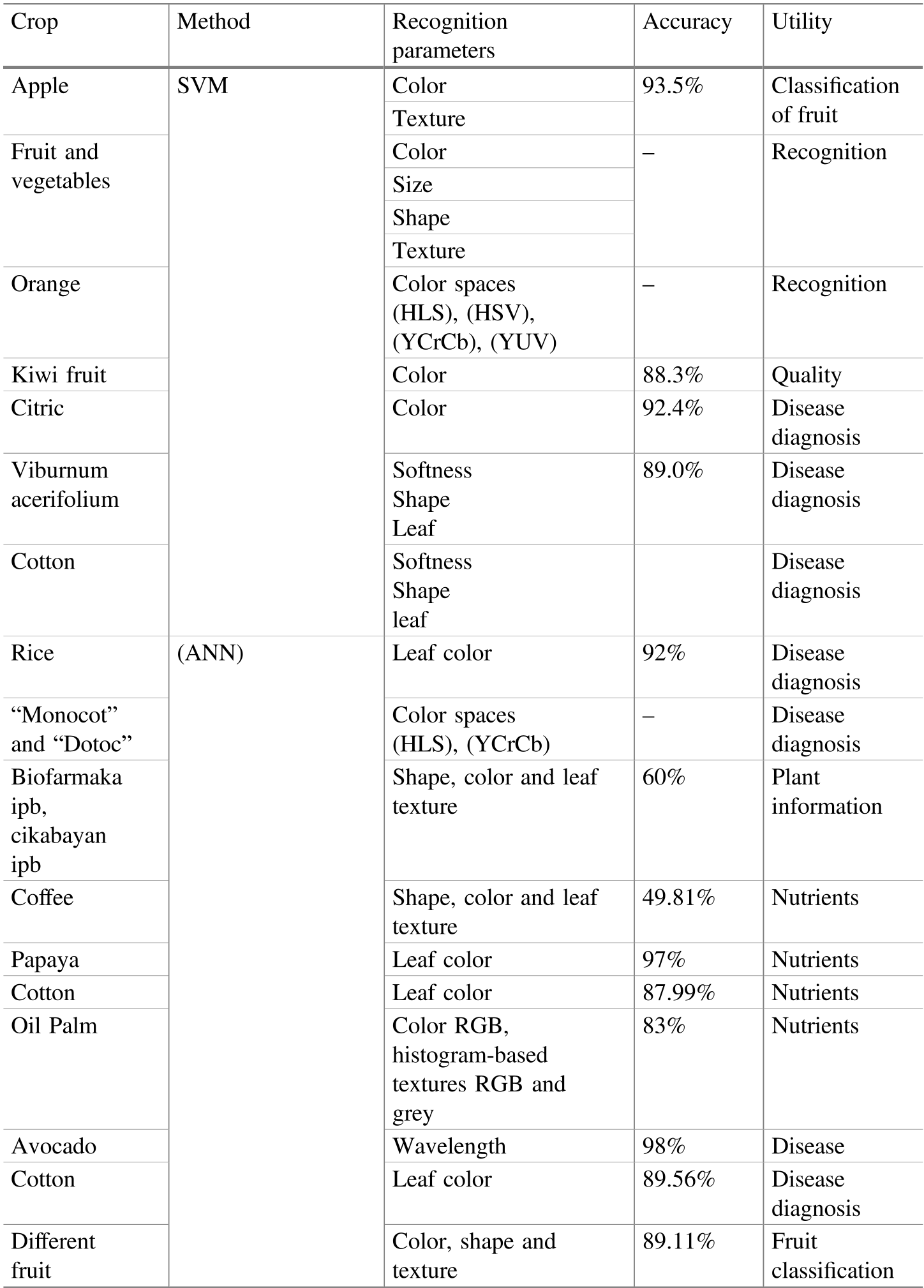
The results demonstrate that while color remains the most significant parameter for nutrient and maturity detection, texture is the decisive factor for disease stratification.
Critical Analysis & Conclusion
Takeaway
The shift toward "Smart Farming" is no longer a theoretical pursuit. Precision agriculture now leverages robust mathematical classifiers to replace human visual stimuli with quantitative data models.
Limitations
Despite the high accuracy rates, the paper identifies a critical "Infrastructure Gap":
- Computational Cost: Increasing the number of features (color + texture + shape) leads to higher latency, which is problematic for real-time robotic harvesters.
- The Data Desert: There is a glaring absence of standardized, online, open-access datasets for food quality. Most researchers still rely on private, laboratory-standardized datasets which may not generalize to unpredictable field conditions.
Future Outlook
The next frontier lies in Mobile Integration (Android-based pathology tools) and the democratization of these algorithms. The industry's evolution depends on moving from "controlled laboratory experiments" to "distributed edge computing" on the farm.