
Turning Smartphones into X-Ray Vision: Democratizing NLOS Imaging via MAS
Imaging Hidden Objects with Consumer LiDAR via Motion Induced Sampling
This paper introduces a multi-frame fusion strategy and the Motion-Induced Aperture Sampling (MAS) model to enable Non-Line-of-Sight (NLOS) imaging on consumer-grade smartphone LiDAR. The method achieves real-time 3D reconstruction, multi-object tracking, and camera localization using off-the-shelf hardware costing less than $100.
TL;DR
Researchers have unlocked the ability to "see around corners" using the cheap LiDAR sensors found in modern smartphones. By introducing the Motion-Induced Aperture Sampling (MAS) model and a particle-filtering fusion strategy, they've turned low-resolution, noisy consumer hardware into a powerful tool for 3D tracking and camera localization. No specialized labs, no 100 sensor and some clever math.
Background: Navigating the "Shadow" World
Non-Line-of-Sight (NLOS) imaging is the "holy grail" of computer vision: reconstruct a hidden scene by analyzing how light bounces off a "relay wall" (essentially a diffuse mirror). While the physics is well-understood, it has historically required high-powered lasers and picosecond-accurate detectors.
Consumer LiDAR (like those on iPhones or AR headsets) is the polar opposite:
- Low Power: Restricted by eye-safety regulations.
- Low Resolution: Often fewer than 100 pixels.
- Dynamic Complexity: Handheld cameras and moving targets create a "motion blur" nightmare for standard reconstruction algorithms.
The Core Breakthrough: The MAS Model
The authors realized that instead of fighting motion, they could exploit it. Their Motion-Induced Aperture Sampling (MAS) model treats the handheld movement of a phone as a way to create a Synthetic Aperture.
The Intuition
Think of a single-frame measurement from a smartphone LiDAR as a tiny, noisy crop of a larger "Space-Time Impulse Response" (STIR). As you move the phone, you are essentially "scanning" different parts of this hidden response.
The MAS model uses the Light-Cone Transform (LCT) to make a crucial observation: a rigid-body translation of a hidden object corresponds to a simple shift in the LCT-transformed measurement space.
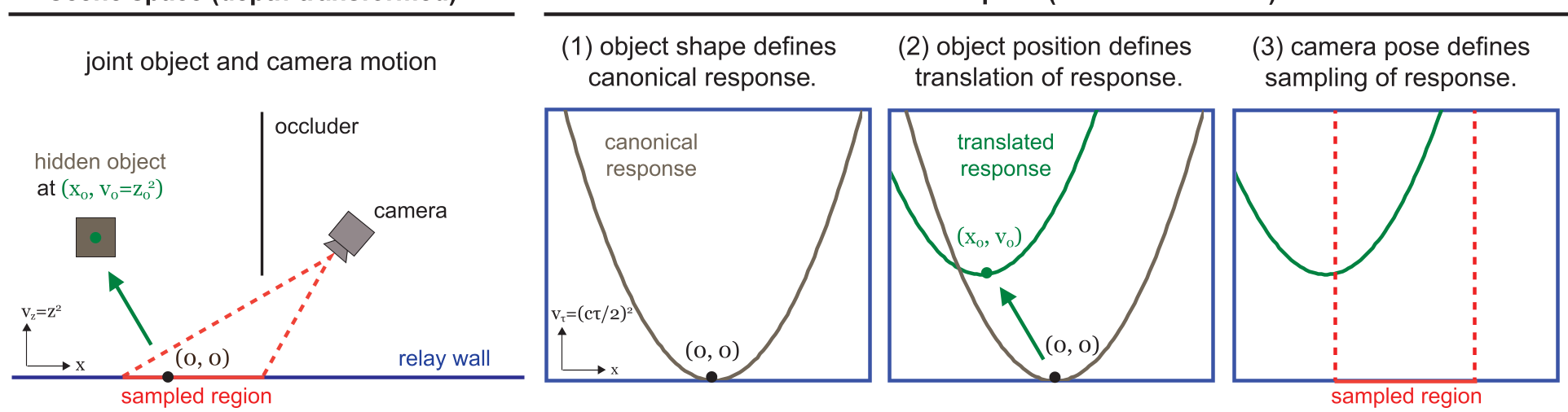 Figure 2: The MAS model decouples object shape (canonical STIR) from time-dependent motion and camera pose, allowing the system to handle 6D camera motion.
Methodology: From Chaos to Certainty with Particle Filters
Because the problem is highly non-convex (too many unknowns), the authors simplify the task by solving for one variable at a time using Particle Filtering.
- Object Tracking: If the shape is known (e.g., a person or a box), the filter tracks the 3D position by comparing live measurements against rendered simulations.
- Camera Localization: If the hidden environment is known, the "shadows" act as landmarks. This allows a device to localize itself even when facing a blank, featureless white wall—a scenario where traditional Visual Odometry (VO) fails.
 Figure 3: High-level overview of the particle propagation and evaluation steps used for real-time tracking.
Experiments & Results: The $100 Powerhouse
The team tested their approach using the ST VL53L8CX, a common $100 SPAD sensor.
- Quantifiable Accuracy: They achieved a tracking error of ~4.7 cm.
- Multi-Object Capabilities: The system could distinguish between multiple hidden targets (e.g., tracking a user's left and right hands individually).
- Beyond Retroreflectors: While earlier NLOS work often required highly reflective tape, this model demonstrates feasibility even with diffuse (matte) objects, albeit with lower SNR.
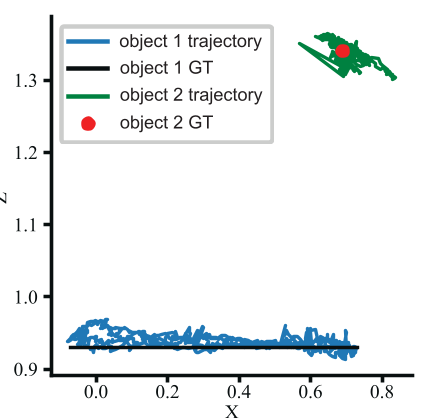 Figure 4: Real-time tracking of multiple hidden objects and hand gesture recognition through a relay wall.
Critical Insight: Why Does This Matter?
The real value of this paper isn't just "seeing around corners"—it's the democratization of the technology.
By moving NLOS from "lab-only" to "plug-and-play," we open the door for:
- Safety: Robots detecting humans around blind corners in warehouses.
- AR/VR: Robust body-pose tracking even when parts of the body are occluded.
- Minimalist Sensing: Using multi-bounce light as an "anti-aliasing" filter to help low-res sensors see better.
Limitations & Future Work
The model currently assumes rigid-body translation. Future iterations will need to handle non-rigid deformation (like a person walking) by integrating deformable neural fields (like D-NeRF). Additionally, using Machine Learning to learn a "robustness" score function could replace the current handcrafted math to better handle complex, real-world BRDFs (surface reflections).
Conclusion
This work proves that we don't need million-dollar hardware to achieve "superhuman" vision. By cleverly modeling the physics of motion and light-cones, we can turn the noise of a $100 smartphone sensor into a signal that reveals the hidden world.