
Imaging Hidden Objects with Consumer LiDAR: The Dawn of Plug-and-Play NLOS
Imaging Hidden Objects with Consumer LiDAR via Motion Induced Sampling
The paper introduces a "Motion-Induced Aperture Sampling" (MAS) model to enable 3D Non-Line-of-Sight (NLOS) imaging using $100 consumer-grade LiDAR sensors. By integrating multi-frame fusion and particle filtering, the method achieves real-time 3D reconstruction, multi-object tracking, and camera localization on handheld smartphone-grade hardware.
TL;DR
Researchers from MIT and Dartmouth have unlocked the ability to see around corners using the $100 LiDAR sensors found in modern smartphones and vacuum robots. By treating camera motion not as a source of noise, but as a "synthetic aperture," their new Motion-Induced Aperture Sampling (MAS) model enables real-time 3D tracking and reconstruction of hidden objects with standard consumer hardware.
The Problem: Why Your Phone Can't "See" Through Walls (Yet)
Non-Line-of-Sight (NLOS) imaging—using a wall as a "virtual mirror" to see hidden objects—is not new. However, until now, it required a "laboratory-grade" setup:
- Prohibitive Cost: Equipment often exceeds $100,000.
- Fragility: Requires precise calibration; the slightest vibration ruins the measurement.
- Power & SNR: Consumer LiDARs use eye-safe, low-power lasers. The "third-bounce" signal (Laser → Wall → Object → Wall → Sensor) is exponentially weaker than direct reflections, often buried under sensor noise.
The Insight: Motion as a Feature, Not a Bug
The core innovation lies in the Motion-Induced Aperture Sampling (MAS) model. Instead of trying to get a perfect image from a single snapshot (which is impossible given the low SNR), the authors leverage the natural motion of a handheld device.
1. The Light-Cone Transform (LCT) Reimagined
The authors use the LCT to transform space-time measurements into a domain where the relationship between object shape and measurements is a simple 3D convolution.
2. De-coupling Motion
By modeling the movement of the object () and the camera () separately, they can "sum up" multiple noisy frames to create one high-quality synthetic aperture. This is analogous to "Burst Photography" on your iPhone, but for 3D light-of-flight data.
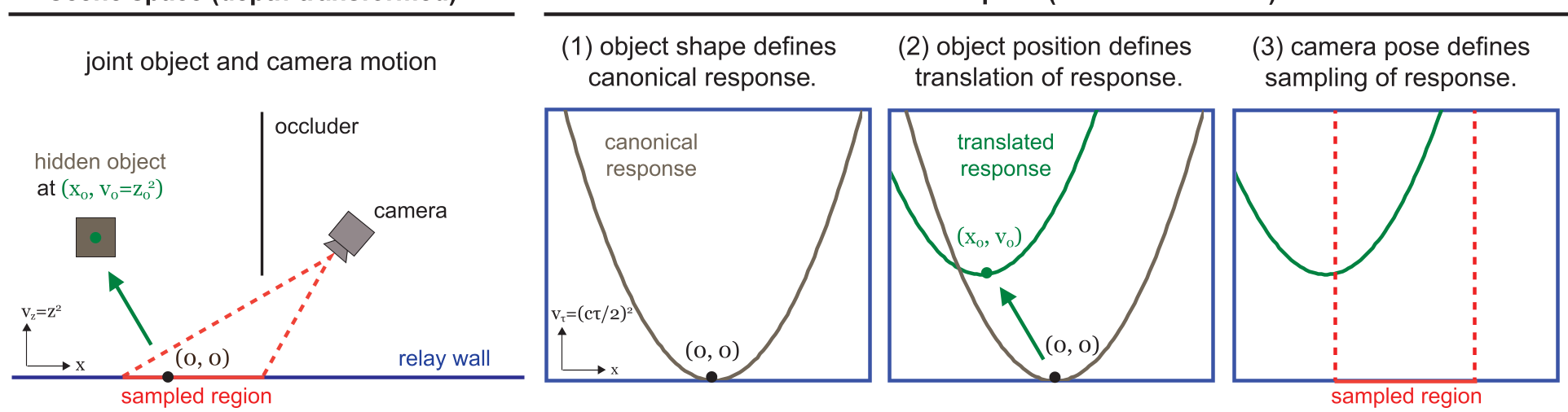 Caption: The MAS model unifies object shape, object motion, and camera pose into a single measurement framework using the Light-Cone Transform.
Real-Time Tracking with Particle Filtering
To solve the complex inverse problem of tracking a hidden object in real-time, the team employed a Particle Filter.
- Propagation: Moves "particles" (hypothesized object locations) based on a motion prior.
- Evaluation: Each particle "renders" a predicted LiDAR signal and compares it to the actual noisy raw data.
- Resampling: Particles that match the data survive; others are discarded.
This Bayesian approach allows the system to maintain a "probability cloud" of where the hidden object might be, effectively handling the high uncertainty of consumer-grade sensors.
Experimental Breakthroughs
The team demonstrated three key capabilities using a smartphone-grade sensor:
- 3D Reconstruction: Building a mesh of a hidden mannequin.
- Multi-Object Tracking: Simultaneously tracking two moving objects behind a corner.
- NLOS Localization: Using a hidden object as a "visual anchor" to navigate a robot through a featureless, white-walled room where standard cameras get lost.
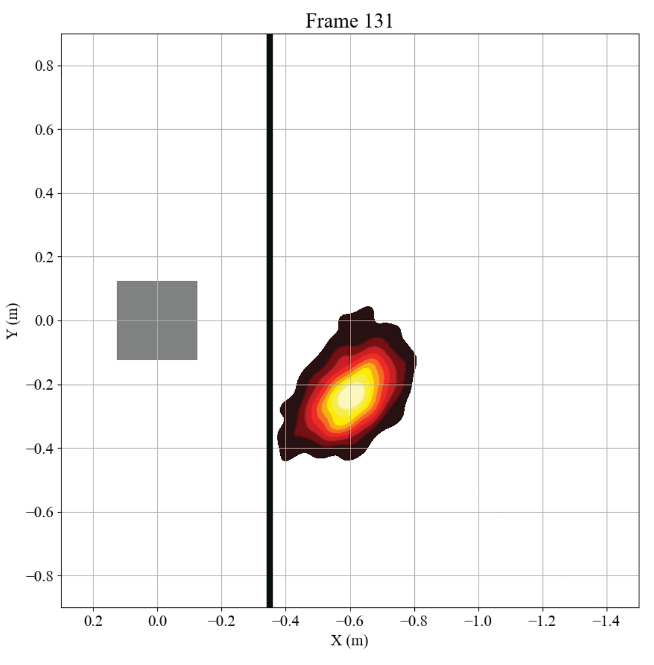 Caption: Comparison of camera localization. While traditional methods fail in textureless environments, NLOS-based anchors provide robust pose estimation.
The Industry Impact: Democratizing NLOS
The shift from 100 sensor (like the ST VL53L8CX) is a massive leap for "plug-and-play" computer vision.
Key Takeaways for the Future:
- Safety: Autonomous vehicles could "see" a child running into the street from behind a parked car using only consumer-grade sensors.
- AR/VR: Headsets could track a user's body pose or room geometry even when parts of the scene are occluded.
- Robotics: Low-cost warehouse robots can avoid collisions around sharp corners without expensive sensor suites.
Limitations
Currently, the model works best with retroreflective materials (which bounce light directly back), though it does show promise with diffuse surfaces at a lower SNR. Future work involving machine learning to "learn" the reflectance score function could potentially eliminate the need for specialized materials entirely.
Conclusion
This research proves that the hardware to see around corners is already in our pockets. The bottleneck was the math—and with the MAS model, that door is now wide open.