
IMaxer: A Unified Framework for Decoding Influence in Location-Based Social Networks
IMaxer: A Unified System for Evaluating Influence Maximization in Location-based Social Networks
IMaxer is a unified system designed for evaluating and comparing Influence Maximization (IM) mechanisms specifically within Location-based Social Networks (LBSNs). It integrates a complete pipeline—from raw data selection and spatial clustering to influence mining and visualization—supporting diverse interaction models such as user-to-user and location-to-location propagation.
TL;DR
IMaxer is an end-to-end analytical system that unifies various Influence Maximization (IM) techniques for Location-based Social Networks (LBSNs). By modeling interactions between users and geographic locations, it allows users to determine who (or what place) is most influential, simulate the spread of information, and visualize trajectories on Google Maps, ultimately aiding in strategic decision-making for viral and out-of-home marketing.
Problem & Motivation: The Silo Effect in Influence Research
The explosion of geo-tagged social media data (LBSN) has led to a flurry of specialized Influence Maximization (IM) algorithms. Some focus on social followers (User-User), while others focus on geographical promotion (Location-Location).
However, practitioners face a fragmentation problem:
- No Unified Benchmark: It is difficult to compare a user-centric strategy against a location-centric one within the same context.
- Data Noise: Raw LBSN data is notoriously messy, with multiple IDs for single coordinates and varying spatial granularities.
- Complexity: Setting up a pipeline from raw check-in data to a visualized "spread map" requires significant engineering overhead.
IMaxer addresses this by providing an extensible "plug-and-play" architecture that handles everything from data cleaning to final visualization.
Methodology: The Unified IM Model
The core innovation is the Unified IM Model, which abstracts the propagation process into three layers. This allows the system to support diverse interaction types, such as a user influencing another user via a friend's recommendation or a location influencing a user by attracting their visit.
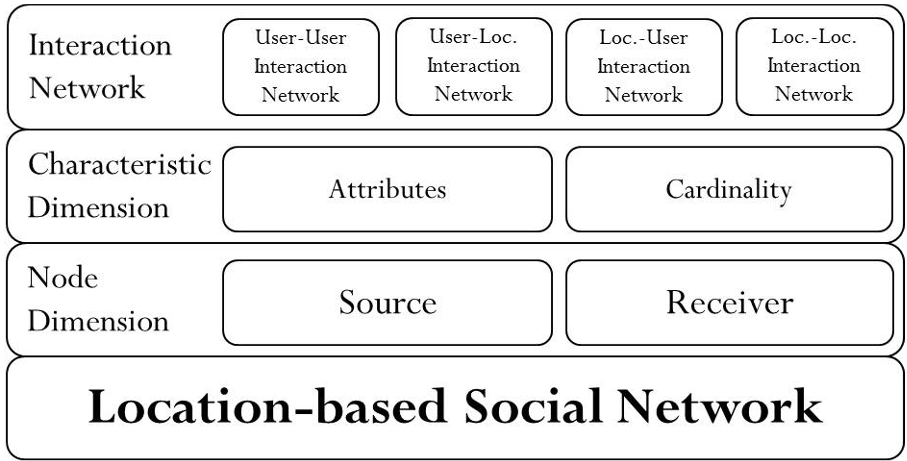
The Interaction Layers:
- User-User (U-U): Traditional social influence (word-of-mouth).
- Location-Location (L-L): Influence based on visitor "carry-over" (if a person visits Place A then Place B, A has a potential influence on B).
- User-Location (U-L): Identifying users whose visits cover the most unique regions.
- Location-User (L-U): Finding hubs that attract the most unique visitors for ad placement.
The system uses a grid-based or density-based spatial clustering module during preprocessing to resolve GPS anomalies and group coordinates into meaningful Points of Interest (POIs).
Experiments & Technical Insights
The authors demonstrate IMaxer using real datasets from Foursquare, BrightKite, and Gowalla. A standout feature is the ability to compare Effective Reach vs. Cost.
In their NYC use case, they compared:
- Strategy A: Placing ads at top-5 influential locations (Location-Location influence).
- Strategy B: Distributing promotional gear (t-shirts) to top-5 influential users (User-Location influence).
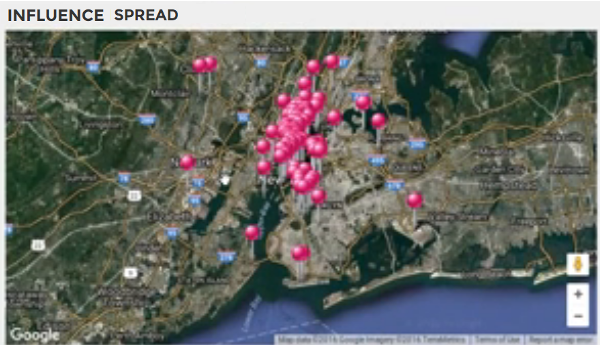
The experiment revealed that Strategy A (Locations) reached ~22% more geographic nodes than Strategy B. This insight is crucial for a marketer who might find it cheaper to target a few key venues than to coordinate a group of "influencers."
The results are rendered through integrated APIs:
- Google Maps: For geographical heatmaps and location-based spread.
- Gephi: For social graph visualization and user-to-user influence paths.
Critical Analysis & Conclusion
Takeaway
IMaxer successfully moves Influence Maximization from a theoretical algorithmic challenge to a comparative system science. Its primary contribution is not a single "better" algorithm, but a system architecture that allows for the rigorous testing of existing ones (like Linear Threshold or Independent Cascade) in a geospatial context.
Limitations & Future Work
While IMaxer is robust, its current reliance on discrete check-in data might miss the continuous "path influence" found in real-time GPS trajectories. Furthermore, the "Inclusion of cost" is discussed conceptually but could be formalized into an automated optimization objective. Future iterations could integrate Reinforcement Learning to adapt the "Top-K" selection dynamically as the influence spread evolves in real-time.
Final Verdict: For researchers looking to benchmark LBSN algorithms or marketers seeking evidence-based ad placement, IMaxer provides the essential "lab equipment" for the social-geography age.