
Intelligent Academic Credit Systems: Tackling Multi-Class Imbalance with Random Forest
Imbalanced educational data classification: An effective approach with resampling and random forest
This paper introduces a specialized Educational Data Mining (EDM) framework for multi-class student performance prediction within an academic credit system. It combines a hybrid resampling scheme (oversampling and undersampling) with a Random Forest classifier to navigate severe class imbalances and missing data.
TL;DR
Predicting student success in an "Academic Credit System" is notoriously difficult due to flexible curricula and skewed data distributions. This paper proposes an effective hybrid strategy: combining hybrid resampling (balancing datasets) with Random Forest (robust ensemble learning). The results show a significant jump of +13.5% in accuracy, providing a reliable backbone for educational decision support systems.
The "Flexibility" Trap: Why Educational Data is Different
In a standard credit system, students have autonomy over their pace and subject choice. This freedom creates three technical nightmares for data scientists:
- High Multi-class Imbalance: "At-risk" students (those warned or asked to stop) are rare compared to the graduating majority.
- Structural Heterogeneity: Subject requirements change over time, making models trained on 2005 data potentially irrelevant for 2026.
- Ubiquitous Missing Data: Since students take subjects at different times, "missing values" aren't just errors—they represent the "incomplete" status of their degree.
Methodology: The Hybrid Resilience
The authors argue that simply throwing an algorithm at the problem isn't enough. The solution must happen at the data level first.
1. The Strategy Map
The paper utilizes a structured three-step pipeline. Crucially, it maps different curriculum versions to a target standard to ensure historical data remains useful.
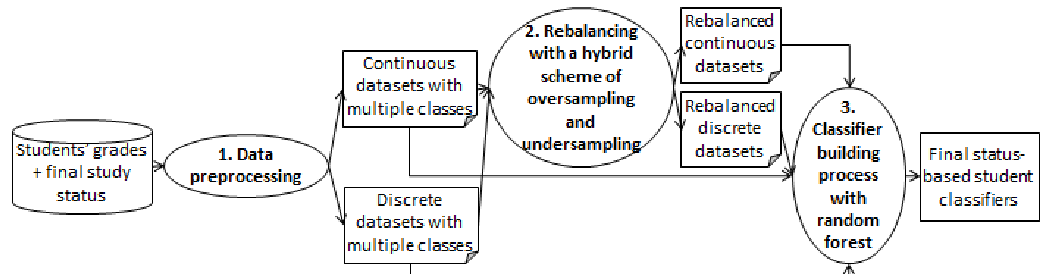 Figure 1: The proposed EDM workflow integrating pre-processing and hybrid resampling.
2. Hybrid Resampling vs. Pure Approaches
The authors found that pure oversampling leads to overfitting (and high cost), while pure undersampling loses vital information. By using a uniform distribution hybrid scheme, they rebalance the five classes ("Studying", "Graduating", "Study_Stop", "1st Warned", "2nd Warned") to roughly equal proportions while keeping the total sample size constant at 1334 students.
3. Why Random Forest?
The choice of Random Forest over deep learning or SVM is intentional. Random Forest’s ability to select feature subspaces (subsets of attributes) at each node is a natural defense against the "unknown positions" of missing grades in a student's record.
Experimental Showdown: Results that Matter
The study compared nine algorithmic variants (including Naïve Bayes, SVM, and BP-Neural Networks) across four different student cohorts (Year 2 to Year 5).
Key Findings:
- The Power of Rebalancing: Across all models, rebalancing the data led to a dramatic surge in ROC and Accuracy.
- The Dominance of Ensembles: Random Forest achieved the highest ROC (0.994) in Year 4 data, significantly outperforming Bagging or Boosting with SVM.
- Timing of Prediction: Accuracy increases as students progress from Year 2 to Year 5, but the model remains surprisingly robust even in Year 2 (AUC > 0.99 with Random Forest).
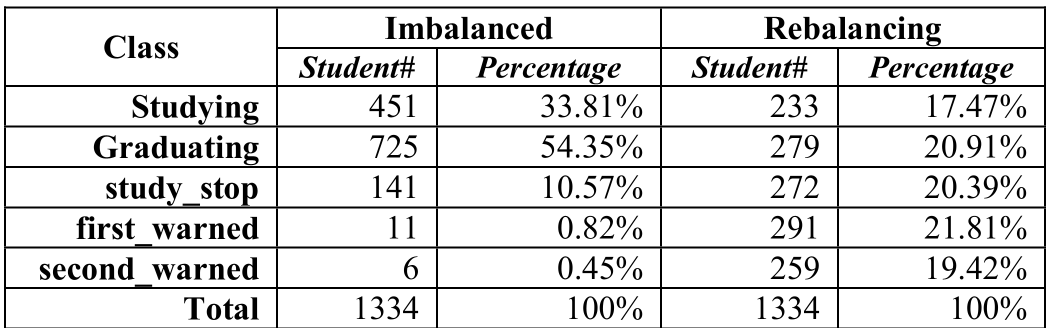 Table 1: The dramatic shift in class distribution after internal rebalancing.
Critical Analysis & Conclusion
This work demonstrates that data preprocessing and rebalancing are just as influential as the choice of the classifier. In the context of the academic credit system, treating missing values as "zeros" (representing a lack of knowledge gained) proved more effective than complex discretization.
Takeaways for Researchers:
- Feature Subspacing is Key: When data is sparse/missing, Random Forest’s random feature selection provides an inherent inductive bias that outperforms global models like SVM.
- Hybrid Resilience: To detect the "rare" student who might drop out, you must artificially amplify their presence in the training data without bloating the dataset.
Future Outlook: The authors suggest moving toward "explainable AI" (XAI) to uncover the "black-box" of these forests, turning predictions into actionable pedagogical rules for teachers.