
Modular Contagion: Why Community Structure is the "Off-Switch" for Epidemic Outbreaks
The Impact of Community Structure of Social Contact Network on Epidemic Outbreak and Effectiveness of Non-pharmaceutical Interventions
This paper investigates the 2009 H1N1 outbreak at a Chinese university to model how hierarchical community structures in social networks drive epidemic dynamics. Using a stochastic SEIR model mapped onto empirical contact data, it demonstrates that community modularity (dormitories and classes) creates localized infection hotspots and dictates the effectiveness of non-pharmaceutical interventions (NPIs).
TL;DR
Epidemics don't spread uniformly; they "hop" through social clusters. This study analyzes a 2009 H1N1 outbreak in a university dormitory to prove that human social organization—spatial clusters like roommates and academic classes—creates structural bottlenecks for viruses. By modeling these "communities," the researchers show that the timing and granularity of quarantine (especially focusing on the smallest social units) are more decisive than the total volume of social distancing.
Background: Beyond Homogeneous Mixing
In classical epidemiology, the "well-mixed" assumption suggests anyone can infect anyone. However, real life is modular. We spend 90% of our time with 1% of our contacts. This paper situates itself at the intersection of Complex Network Theory and Public Health, arguing that the topology of our daily interactions is the most significant predictor of how an outbreak evolves and how we can stop it.
The "Community" Insight: Rooms, Classes, and Corridors
The researchers tracked a specific H1N1 hotspot: a six-story apartment building housing 206 infected students. They discovered a clear hierarchy of contact:
- Roommates (Densely Connected): Highest transmission risk.
- Classmates (Moderately Connected): Bridging nodes between rooms.
- Department/Building (Sparsely Connected): Occasional "long-range" transmission.
Methodology & Architecture
The authors built a Stochastic SEIR Model mapped onto a hierarchical graph. Unlike standard models, they adjusted the "Spreading Rate" () based on the edge type (roommate link vs. building link).
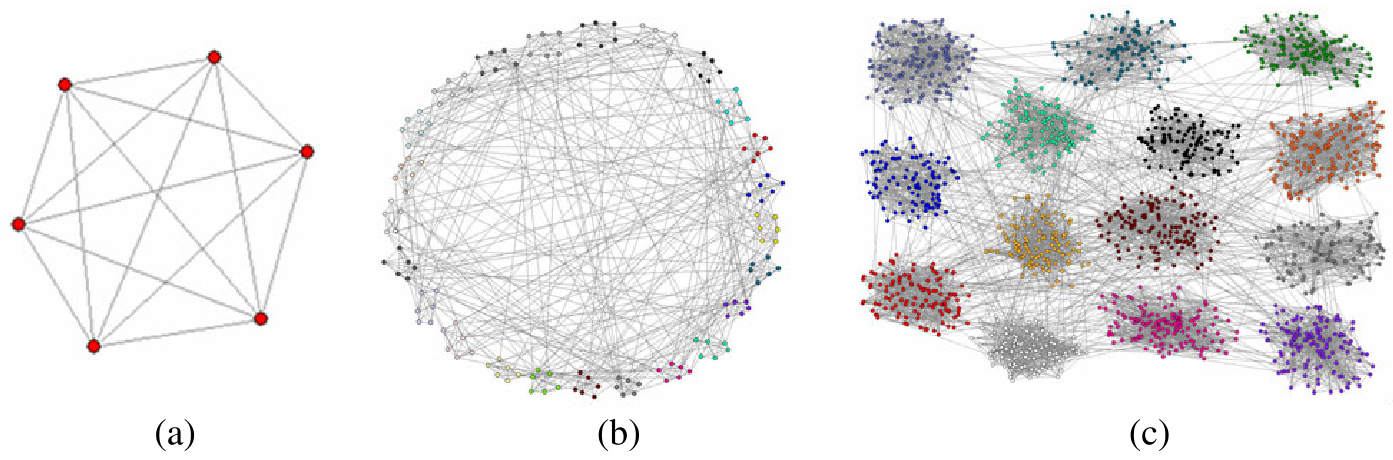 The model transforms students into nodes and relationships into edges, categorized by the modularity of campus life.
Key Findings: The Power of Targeted Quarantine
1. The "Clustered Outbreak" Phenomenon
The simulation revealed that infection often saturated individual rooms or classes while leaving others untouched. This is the Inductive Bias of modular networks: the virus gets "trapped" in a community until a rare inter-community contact allows it to jump.
 Visualization of a typical run: Notice how colors (rooms) clump together in the transmission tree, signifying that the virus follows the community structure.
2. Timeliness vs. Cost
The study quantified the "Price of Delay." Isolating the building on Day 1 rather than Day 7 isn't just marginally better—it is an order of magnitude more effective, reducing total infections by up to 92%.
3. The "Roommate Rule"
A critical discovery was that quarantining roommates of a confirmed case is the most cost-effective Non-Pharmaceutical Intervention (NPI). Since the room acts as a "highly-risk environment," preemptively isolating roommates—even before they show symptoms—cuts off the most common transmission pathway.
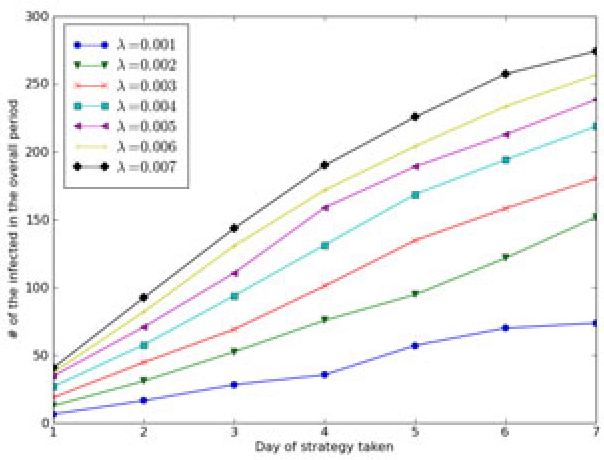 Graph showing that earlier building isolation (lower λ) and higher contact tracing efficiency (θ) dramatically flatten the curve.
Critical Analysis & Conclusion
The value of this work lies in its empirical grounding. It uses real data from a localized outbreak to validate the theoretical modularity of social networks.
Takeaway for Future Policy:
- Micro-Quarantines: Policy should focus on "functional units" (rooms, families, teams) rather than just individuals.
- Viral Dynamics: Community structure acts as both a fuel (accelerating local spread) and a firebreak (slowing global spread).
Limitations: The paper lacks a secondary economic cost-benefit analysis. While "total isolation" is mathematically effective, its socio-economic sustainability remains a challenge. Future research should look at "Adaptive Modularity"—how people change their habits in response to perceived risk, further altering the network topology in real-time.
Final Insight: In the architecture of an epidemic, the walls of our social groups are just as important as the medicine in our cabinets.