
Decoding Virality: How Content Popularity Dictates Information Coverage in Social Networks
17294_Impact of Content Popularity on Information Coverage in Online Social Networks.
This paper investigates the quantitative relationship between content popularity (represented by forwarding probability ) and information coverage in Online Social Networks (OSNs). Using a geography-aware rank-based social model, the authors derive a critical lower bound for to ensure content reaches a constant fraction of the network.
Executive Summary
TL;DR: This research provides a rigorous mathematical answer to a fundamental question in social media: Exactly how popular must a post be to go viral? By modeling users' "first-copy forwarding" behavior within a geography-aware social network, the authors identify a phase transition. If the forwarding probability exceeds a specific threshold defined by the number of friends , the information achieves "complete coverage," reaching a constant portion of the entire network regardless of its total size.
Background Positioning: This work bridges the gap between empirical social network observations (like the small-world phenomenon) and formal information theory. It moves beyond simple "epidemic" models by incorporating the spatial and rank-based constraints typical of modern OSNs like Facebook and Weibo.
The Problem: The Complexity of First-Copy Forwarding
In a real social network, you might see the same meme five times from different friends. However, you only make the decision to "Share" or "Ignore" it the first time you see it. This is the First-copy Forwarding Behavior.
From a mathematical perspective, this creates massive dependencies. Traditional models often assume each encounter is an independent coin flip, but in reality, your decision at dictates whether the information stops or spreads through your branch of the network. Prior works struggled to calculate the exact global coverage because of these inter-connected "social circles" where friends of friends are also your friends.
Methodology: The Geometry of Social Ties
The authors adopt a Rank-based Model. In this model, the probability that you are friends with someone isn't just about physical distance; it's about how many people live closer to you than they do (their "Rank").
1. Network Partitioning
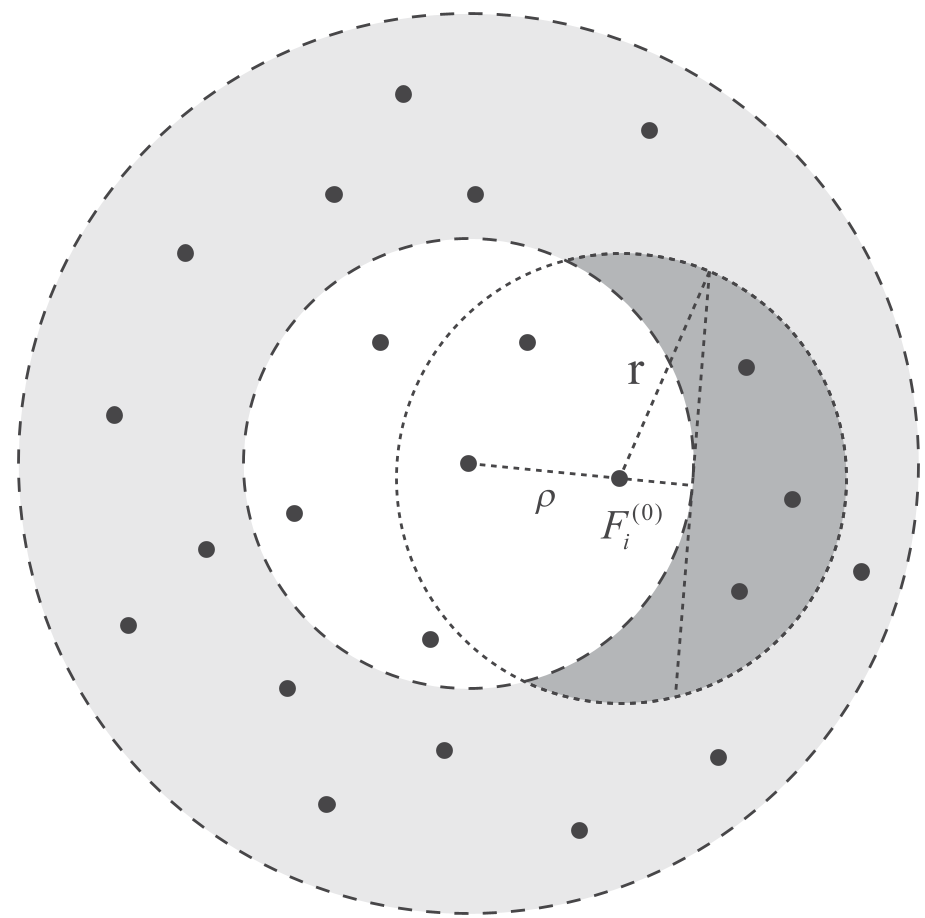
To solve the dependency problem, the authors "sliced" the social network into a series of concentric rings (Torus Partition).
2. The Virality Threshold
By analyzing how information jumps from Ring to Ring , the authors derived Theorem 4.1. They found that for information to achieve "complete coverage" (reaching a constant fraction of ), the forwarding probability must be:
Essentially, . This means the "Expected Number of Forwarding Friends" must reach a specific value (determined by the network's spatial locality ) for the content to survive the "extinction" phase.
Experiments & Real-World Validation
The researchers tested their theory against both synthetic data and a real-world dataset from Weibo (87,321 nodes).
Key Findings:
- Scale Invariance: The coverage rate is largely independent of the network size (). Whether a network has 10,000 or 100,000 nodes, the required for 50% coverage remains the same.
- Heterogeneity Matters: In real-world networks (like Weibo), the distribution of friends follows a Power Law.
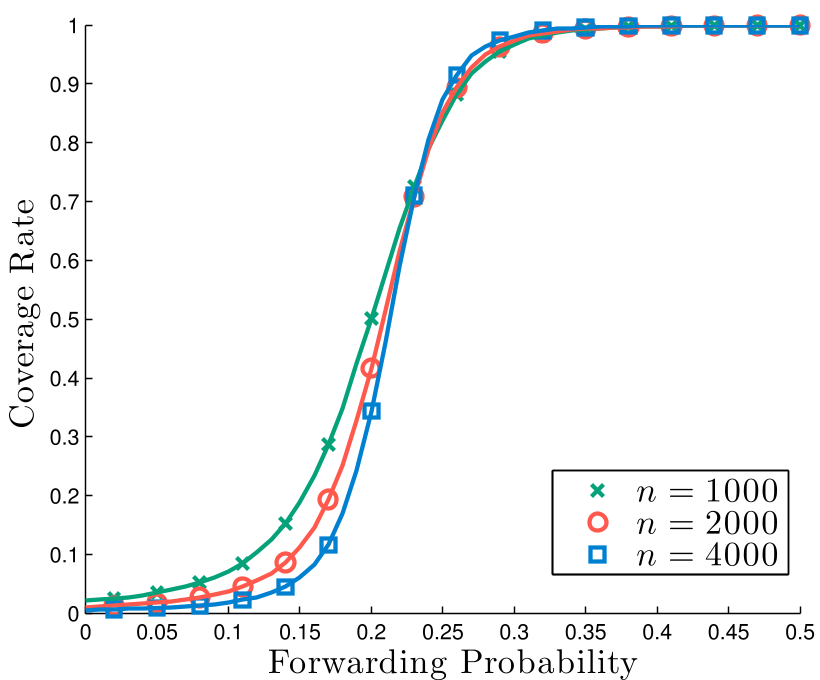
As shown in the charts, real social networks (the red line in the right graph) actually spread information better than uniform networks when is low. This is because "Influencers" (nodes with massive ) act as super-spreaders, bridging gaps that would stop a meme in a more uniform population.
Critical Insight & Conclusion
Takeaway: The study proves that virality is a property of local engagement. If you can ensure that, on average, at least one friend of every receiver forwards your content (), the mathematics of OSNs practically guarantees global reach.
Limitations:
- The model assumes a relatively uniform geographical distribution of nodes, which doesn't account for "community clusters" (e.g., professional vs. personal circles).
- It assumes is constant for all users, whereas in reality, an influencer might have a different forwarding threshold than a casual user.
Future Work: This framework opens the door for "Content Popularity Prediction." By measuring the early (forwarding rate) in a small sample, marketers can predict if a piece of content will eventually saturate the network or fizzle out.