
Beyond the Well-Mixed Assumption: How Network Topology Triggers Epidemic Resurgence
Impact of the topology of metapopulations on the resurgence of epidemics rendered by a new multiscale hybrid modeling approach
This paper introduces a novel multiscale hybrid modeling approach, SD–IB, which combines System Dynamics (SD) and Individual-Based Modeling (IBM) to simulate epidemic resurgence in metapopulations. By integrating local compartmental dynamics with spatially-explicit inter-site migrations, the model successfully reproduces complex resurgent behaviors and SOTA-level spatial accuracy that traditional models fail to capture.
TL;DR
Epidemiologists have long struggled with a "scale dilemma": simple models are too fast and inaccurate, while detailed models are too slow to run. This paper breaks the deadlock by introducing a hybrid SD–IB approach. By nesting System Dynamics (for local outbreaks) inside Individual-Based agents (for global movements), the researchers prove that the physical "shape" of a population network is the primary reason why diseases like influenza or rabies disappear only to strike back in violent waves.
The "Well-Mixed" Trap: Why Simple Models Fail
For nearly a century, we have relied on compartmental models (like SIR) that assume everyone in a population has an equal chance of meeting everyone else. While this works for a small village, it is a mathematical fiction for a country.
In reality, populations are "patchy"—dense cities connected by sparse transport links. The authors argue that by ignoring this metapopulation topology, traditional models overestimate the "Force of Infection" and fail to explain resurgence: the phenomenon where a disease seems to die out but survives in a hidden geographic pocket before reigning a second wave.
Methodology: The Fusion of Two Worlds
The genius of this work lies in its multiscale architecture. Instead of choosing between the speed of math and the detail of agents, it uses both.
- Local Scale (System Dynamics): Each "site" (node) uses stocks and flows to calculate infection rates. It’s fast, deterministic, and mirrors classic ODEs.
- Global Scale (Individual-Based): Sites are treated as agents in a 2D space. They interact by "shipping" infected individuals to neighbors based on distance-weighted functions.
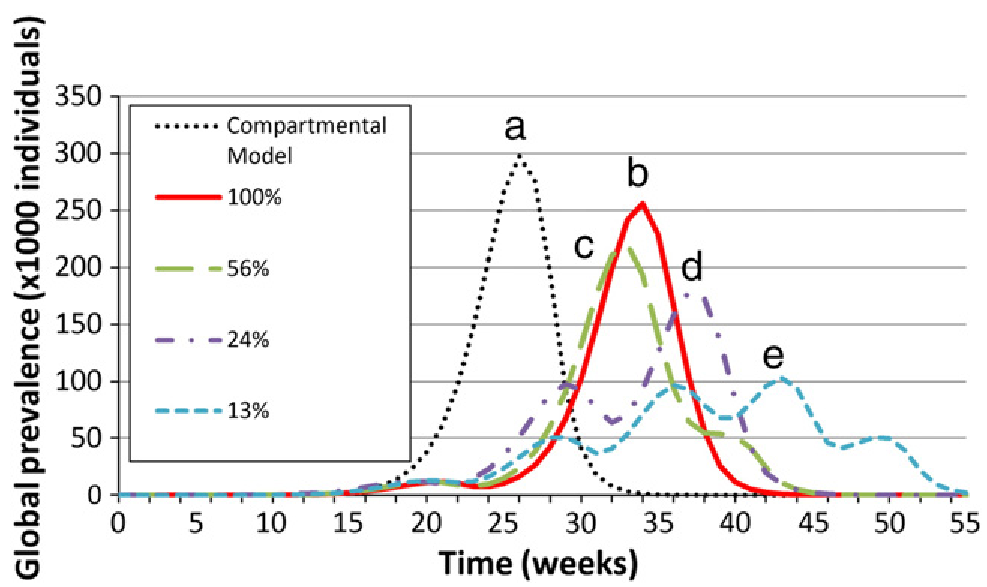 Figure 1: The hybrid architecture where IBM agents (clouds) represent sites, each containing an internal SD model (bottom right) for local dynamics.
Key Insights: Geography as a Controller
The experiments yielded several counter-intuitive findings that challenge the current SOTA in public health:
- The Power of Starting Points: Starting an outbreak in a "hub" site vs. a "peripheral" site yields completely different results, even with identical biological parameters. A hub can trigger a massive resurgence, while a periphery might lead to a quick extinction.
- The Connectivity Buffer: As network connectivity decreases, the instantaneous prevalence of a disease drops, but the duration of the epidemic lengthens.
- Resurgence without Randomness: Unlike previous models that required "stochastic noise" to explain hidden waves, this hybrid model shows that the structure of the network alone can cause oscillatory, multi-peak behaviors.
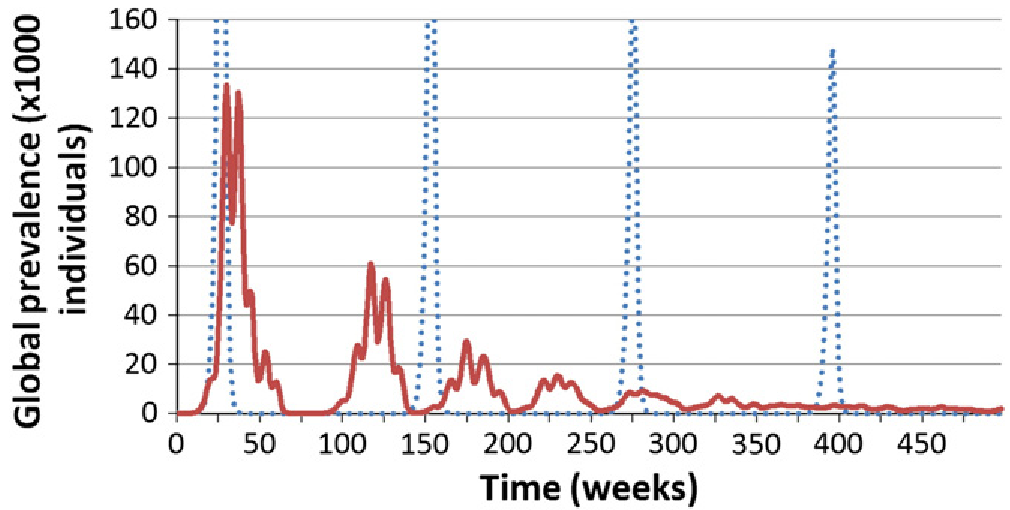 Figure 2: Traditional compartmental models (single peak) vs. the Hybrid model (complex, resurgent peaks) using the same parameters.
Engineering the Future of Epidemiology
One of the most profound takeaways is the "Threshold Effect" at the metapopulation scale. The authors show that even if a disease has a high (Basic Reproduction Number), it might fail to turn into a pandemic if the connectivity between sites is too low or if a "population bottleneck" exists.
Limitations & Future Work
While the model is deterministic, the authors admit that incorporating stochasticity (randomness) could improve accuracy for very low infection counts. Furthermore, the choice of "site size" is critical—if a site is too large, the "well-mixed" error simply reappears at a smaller scale.
Conclusion
"The pathogen is nothing, the environment is everything." This paper breathes new life into Claude Bernard’s old adage. By providing a tractable way to model space, the SD–IB framework offers a powerful tool for policymakers to simulate how closing specific travel routes (targeted migration cutting) can be far more effective—and less disruptive—than blanket lockdowns.
Takeaway: In the battle against the next pandemic, the map is just as important as the microbe.