
Beyond Access Control: Mastering Privacy through Implicit Contextual Integrity
Implicit Contextual Integrity in Online Social Networks
The paper proposes the first computational model for Implicit Contextual Integrity (ICI) in Online Social Networks (OSNs). It introduces an Information Assistant Agent (IAA) that automatically learns evolving social contexts, relationships, and implicit information-sharing norms to alert users about inappropriate exchanges or sensitive data leaks.
TL;DR
Online Social Networks (OSNs) are messy. Unlike a corporate office or a hospital, OSN "contexts" (family, work, gym buddies) are invisible and overlapping. This paper introduces the Information Assistant Agent (IAA), a smart proxy that learns your social norms on the fly. By analyzing your message history, it detects when a post is "out of character" for a specific group or if a secret is about to leak into the wrong circle, reducing privacy blunders by nearly 90%.
The Problem: The Collapse of Social Spheres
In the physical world, we instinctively change our behavior: you don't share "wild Saturday night" photos with your boss. In OSNs, these spheres collapse. Current privacy tools rely on Access Control Lists (ACLs)—static "Who can see this" rules.
The authors argue that ACLs fail because:
- Contexts are Implicit: You don't always label your friend groups.
- Norms are Dynamic: What’s okay to joke about today might be taboo tomorrow.
- Relationships Evolve: A close friend can become a distant acquaintance (or a boss), changing the "appropriateness" of sharing.
Methodology: How the Agent Learns Your Life
The proposed model focuses on two pillars: Appropriateness (Is this topic okay here?) and Dissemination (Will this receiver leak this sensitive info elsewhere?).
1. Context Discovery
Instead of asking the user to define groups, the IAA uses Infomap, a community-finding algorithm, to analyze the user's ego-network. It identifies "dense clusters" as individual contexts (e.g., Work vs. Photography Class).
2. Probabilistic Norm Inference
The agent treats "appropriateness" as a frequentist probability.
- Increase: If many people in a context talk about "Politics," the appropriateness score for that topic goes up.
- Decay: If a topic isn't mentioned for months, its score drops, reflecting shifting social interests.
3. The "Social Buffer" (Agent Workflow)
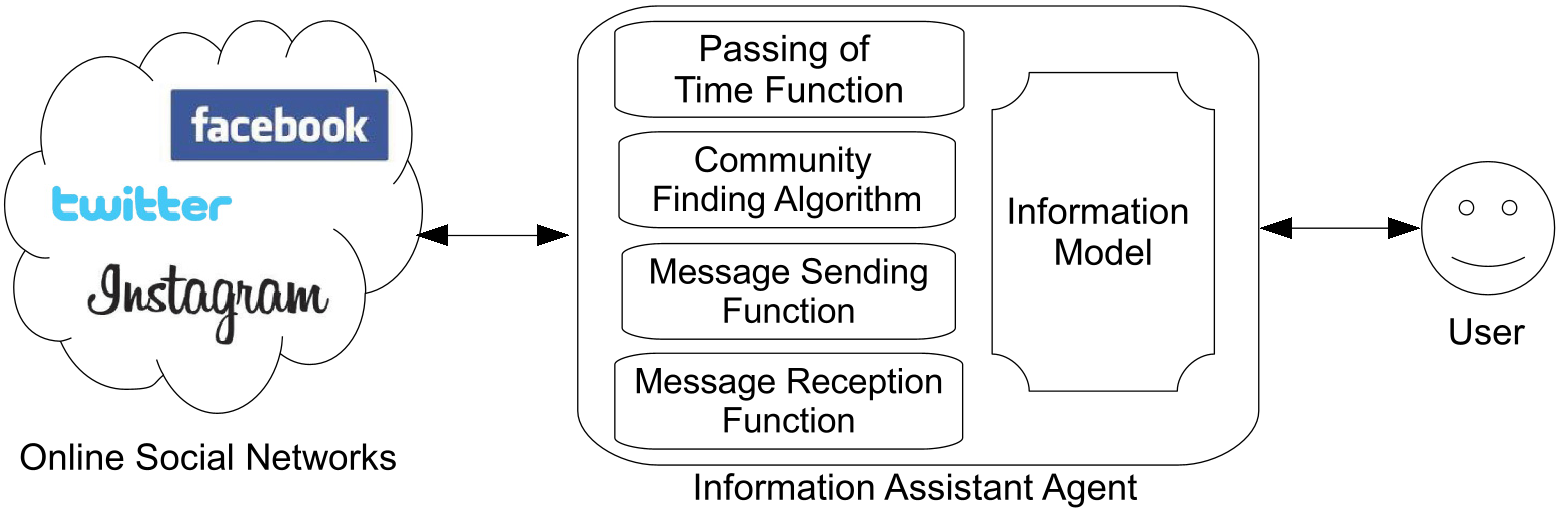 Figure 1: The IAA sits between the user and the OSN, intercepting outgoing messages to calculate risks.
The IAA maintains Exchange Lists. If you and Bob have a history of sharing "Dark Humor," the agent won't alert you when you send him a vulgar joke, even if that joke is inappropriate for the broader "Work" context. It respects the Reciprocity of your specific relationship.
Experiments & Validation
The authors simulated a society of 100 agents with different attitudes (Compliant, Obedient, Random).
Key Result: Drastic Risk Reduction
The study found that even with only 40% of users acting "normally," the IAAs could accurately map out the social minefields.
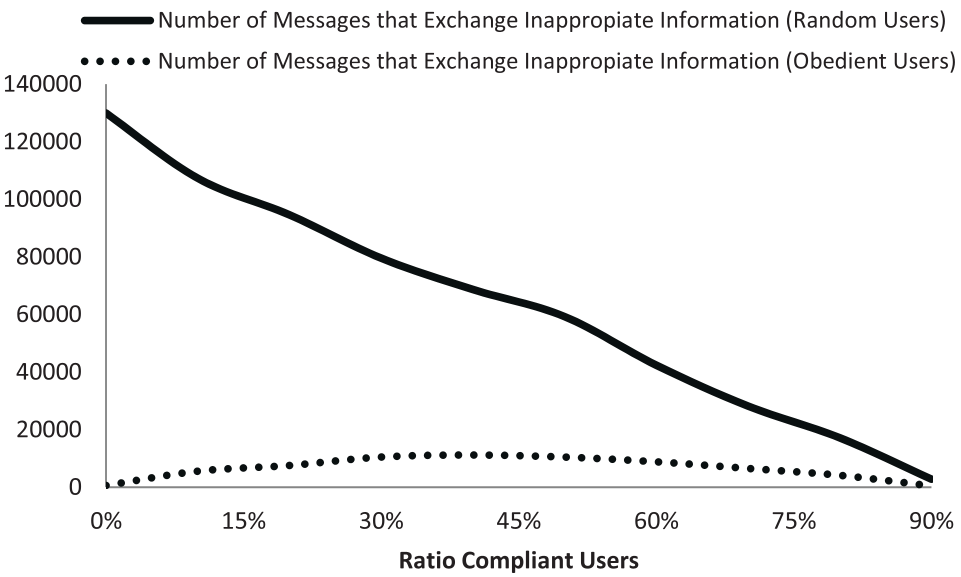 Figure 2: Comparison showing Obedient users (with IAAs) suffer significantly fewer privacy breaches than Random users.
Distinguishing "Unusual" from "Inappropriate"
A critical feature of the IAA is its ability to handle novelty. If you post about your wedding for the first time, it might trigger a "Topic Unusual" alert. However, if your friends "Like" or "Comment" positively on it, the IAA immediately increases the appropriateness score for "Marriage," and won't bug you again. In contrast, "Obscene" jokes that get ignored stay flagged as high-risk.
Critical Insight: The "Implicit" Advantage
The hallmark of this paper is the transition from Explicit to Implicit modeling. By moving away from rigid rules (which users hate to set up) to an agent that "watches and learns," the authors address the "Privacy Paradox"—where users say they care about privacy but do nothing to protect it because the tools are too difficult to use.
Limitations & Future Work
While robust, the model faces challenges in Sybil Attacks. If a large group of malicious users joins your circle and starts talking about a sensitive topic, they could trick the IAA into thinking that topic is now "appropriate." The authors suggest integrating Sybil defense mechanisms to mitigate this in future iterations.
Conclusion
This research provides a foundational blueprint for the next generation of "Privacy Assistants." By embedding the social theory of Contextual Integrity into a probabilistic agent, we can finally move toward a digital world that understands the nuance of human relationships.
Key Takeaway: Don't lock the door; hire a digital butler who knows who is supposed to hear what.