
Guardian of the Feed: Detecting Hidden Location Leaks in Turkish Tweets
Implicit Location Sharing Detection in Social Media Turkish Text Messaging
This paper introduces a machine learning-based framework for detecting implicit location sharing in Turkish social media posts (Twitter). The authors developed a custom classifier and a Google Chrome extension that proactively warns users when a tweet subtly reveals their physical location without explicit geotagging.
TL;DR
Social media users often accidentally reveal their whereabouts through "implicit" mentions (e.g., "I'm so bored at home"). This paper tackles this privacy loophole for the Turkish language by combining manual corpus labeling with machine learning. The result is a high-accuracy classifier (88.82%) embedded in a Chrome extension that acts as a real-time privacy watchdog.
Context & Motivation: The Danger of the "Silent" Leak
Most users understand that "checking in" on Foursquare or enabling GPS on Twitter shares their location. However, a significant portion of users unknowingly leak their private addresses or current locations through natural language.
The authors highlight a chilling reality: attackers use "ambient" location data to determine if a house is vacant or to track individuals. While tools like GeoSocial Footprint exist for English, the Turkish social media landscape lacked a dedicated semantic defense mechanism.
Methodology: Engineering Turkish Linguistic "Triggers"
The core innovation lies in the extraction of six feature sets that map directly to how location is expressed in the Turkish language:
- Direct Suffixes: "deyim/dayım" (meaning "I am at...").
- Locative Case: The "de/da" suffixes that indicate position.
- Common Nouns: Generic places like ev (home) or okul (school).
- Toponyms: Names of all 81 Turkish cities.
- Points of Interest (POI): A massive list of 6,560 specific venues (cafes, malls) scraped from historical data.
- Motion Verbs: Verbs like geldim (I arrived) which imply a current arrival at a destination.
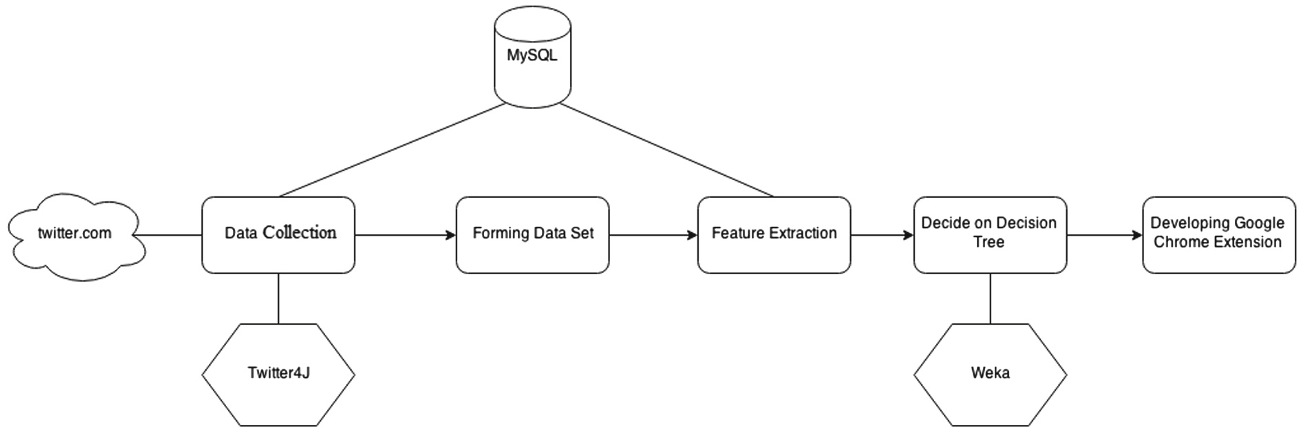 Figure 1: The workflow from data collection via Twitter4j to classifier induction and tool deployment.
Experiments & Results: Decision Trees as Privacy Filters
The researchers tested 73 different classifiers using the Weka workbench. They found that J48graft (an extension of the C4.5 decision tree) outperformed more complex ensemble methods for this specific task.
Key Performance Metrics:
- Top Accuracy: 88.82% (J48graft with 66% split).
- Robustness: Even with 10-fold cross-validation, the accuracy remained steady at ~87.4%.
- Insight: Feature 3 (Common place names) and Feature 5 (POIs) were the strongest predictors of location sharing.
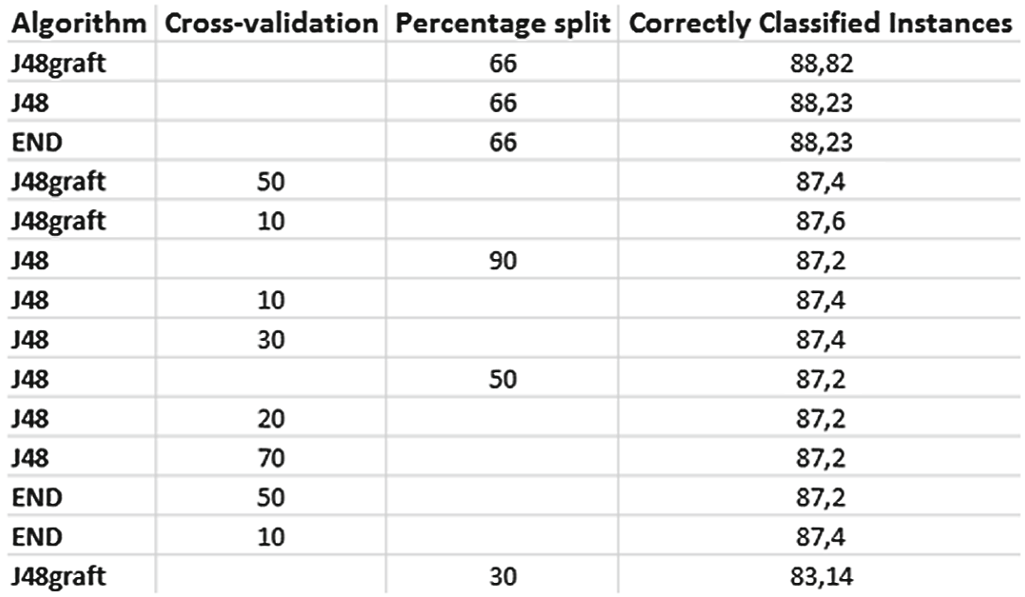 Figure 2: Accuracy comparison across different machine learning algorithms and testing configurations.
The "Privacy Shield" Extension
Moving beyond theory, the authors implemented the J48graft logic into a Google Chrome extension. It works by:
- Hooking into the "Tweet" button.
- Parsing the text for the 6 features.
- Running the decision tree logic.
- Displaying a "Konum paylaşıyor olabilirsiniz!" (You might be sharing your location!) warning if the threshold is met.
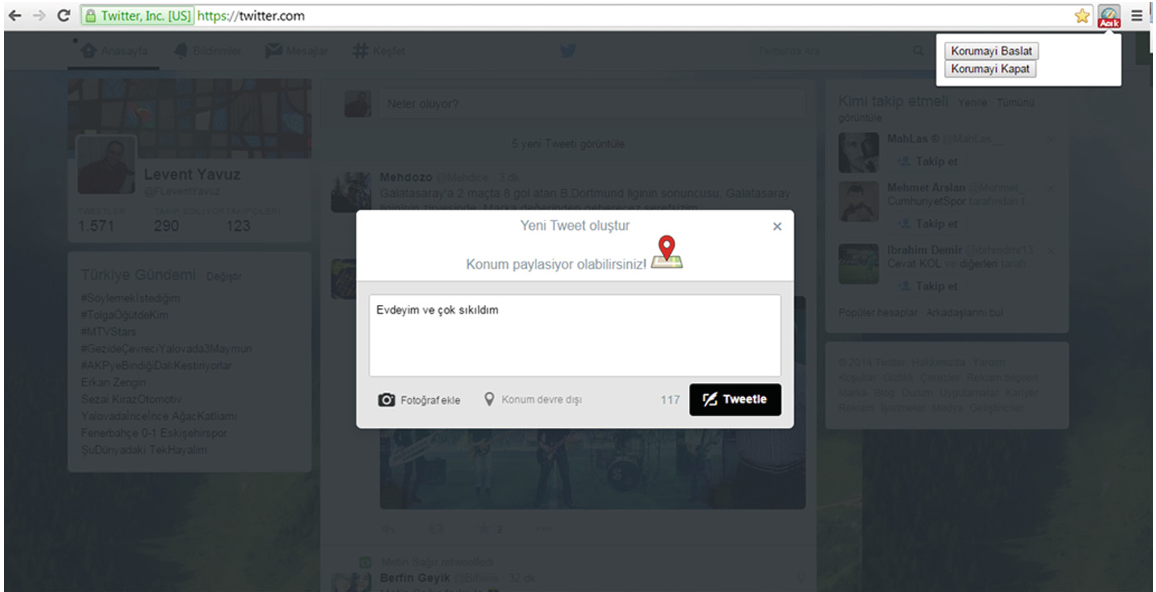 Figure 3: The extension in action, providing a real-time warning to the user before they post.
Critical Insight & Conclusion
This work represents a vital step toward Language-Specific Privacy (LSP). While global platforms often ignore the nuances of non-English languages, the authors demonstrate that relatively lightweight machine learning models (Decision Trees) can be highly effective when combined with expert linguistic feature engineering.
Limitations: The current system relies on a static list of POIs and keywords. In the age of LLMs (Large Language Models), moving toward dynamic embedding-based detection could further reduce false negatives (e.g., detecting location through sarcasm or highly metaphorical language).
Future Outlook: Extending this logic to Facebook and MySpace (or modern equivalents like Threads/Instagram) is straightforward, provided the feature set is adjusted for platform-specific slang.