
Resilience Over Lean: Managing Disruptions in Build-to-Order Supply Chains
The Importance of Managing Events in a Build-to-Order Supply Chain: A Case Study at a Manufacturer of Agricultural Machinery
This paper presents a case study of an agricultural machinery manufacturer utilizing a Build-to-Order Supply Chain (BOSC) and a System Dynamics model to analyze Supply Chain Event Management (SCEM). The study identifies how disruptions like strikes and supplier shortages destabilize performance and evaluates capacity flexibility as a mitigation strategy.
TL;DR
In the volatile world of agricultural machinery manufacturing, the efficiency of Build-to-Order (BTO) is a double-edged sword. This study uses System Dynamics to demonstrate how minor strikes or supplier delays can permanently cripple service rates if the system lacks capacity buffers. The takeaway is clear: in an era of turbulence, "idle" capacity isn't waste—it's an insurance policy for customer loyalty.
Background: The Build-to-Order Fragility
Build-to-Order (BTO) has long been the gold standard for high-variety, low-volume industries like automotive and agricultural machinery. By triggering production only upon a confirmed order, firms reduce finished goods inventory. However, this study highlights a critical flaw: BOSC systems are "event-prone." When a disruption occurs, the lack of inventory buffers means the system has no "momentum" to carry it through, leading to a "Lose-Lose-Situation" where customers face delays and firms lose profitability.
The Problem: The Vicious Cycle of Fixed Capacity
The authors identify a specific phenomenon in the agricultural machinery sector: the endogenous instability caused by exogenous events.
- The Strike Effect: A one-week strike at a plant doesn't just delay one week of work; it pushes the entire sequence of future orders back.
- The Capacity Ceiling: Because production usually operates at its maximum limit, there is no "catch-up" mechanism. New orders arrive at the same rate, but the system is stuck processing "old" arrivals, leading to a permanent shift in delivery delays.
Methodology: Simulating Complexity via System Dynamics
To analyze this, the researchers built a generic model capturing the interplay between the order backlog, material flows, and market targets.
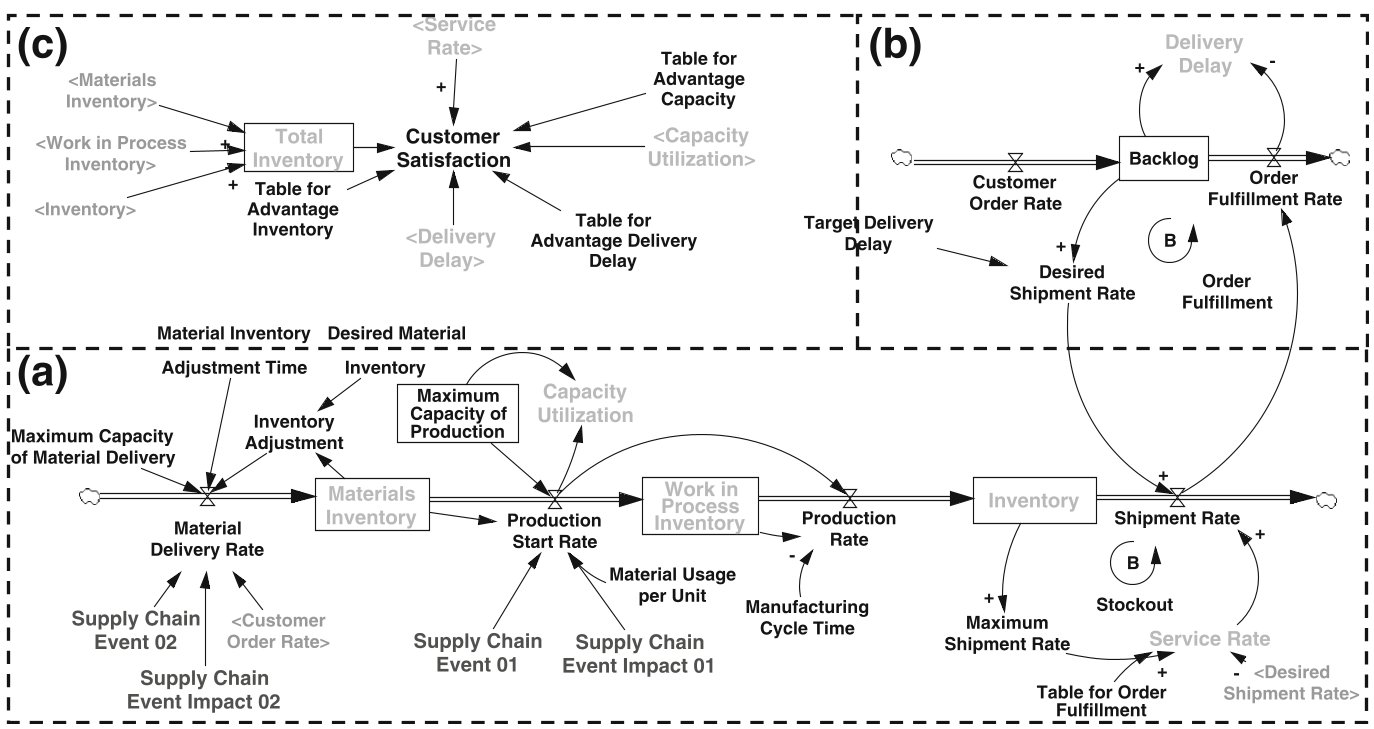
The model focuses on the Polylemma of Production Controlling, balancing four conflicting KPIs:
- Market Targets: Delivery Time and Service Rate.
- Operational Targets: Capacity Utilization and Inventory Level.
Experimental Insights: The Cost of Flexibility
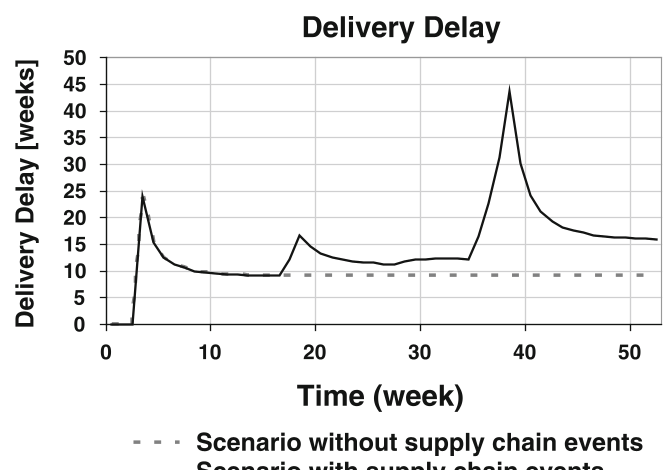
The researchers simulated two major events: a plant strike and a Just-in-Sequence (JIS) supplier shortage.
As shown in Figure 4, the initial strike (Week 15) caused the service rate to plummet. Without intervention, recovery is slow and incomplete. However, by introducing Capacity Flexibility (increasing max capacity from 600 to 700 units), the system regains its equilibrium much faster.
The Trade-off:
- Pros: 15% increase in Service Rate; 3-week reduction in average delivery lag.
- Cons: 6% drop in Capacity Utilization.
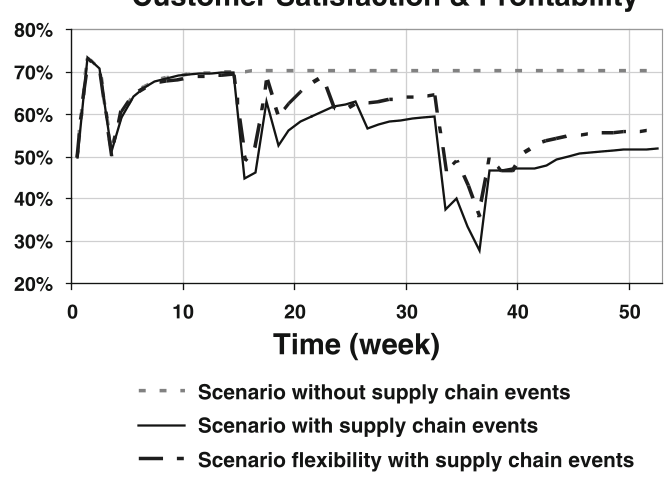
The simulations reveal that while flexibility is "costly" (more idle machines/labor), it creates a "Win-Win" by maintaining customer satisfaction, which is more critical in saturated buyer markets than maximizing short-term internal utilization.
Critical Analysis & Conclusion
This paper challenges the "Lean-only" mindset. In a BOSC environment, Volume Flexibility is not just an operational choice; it's a strategic necessity.
Key Takeaways:
- System Equilibrium: Disturbances don't just cause temporary blips; they can shift a supply chain into a new, lower-performing steady state if capacity is rigid.
- Hybrid Models: The future likely lies in a mix of Build-to-Stock (for common modules) and Build-to-Order (for final customization), providing a natural buffer against supply shocks.
- Limitations: The model is abstracted; real-world costs of hiring/firing or overtime for "flexible capacity" need more granular financial modeling.
Final Thought: For manufacturers, the next paradigm shift isn't about being leaner—it's about being "intellectually agile," using real-time Event Management (SCEM) to activate contingency capacity before the backlog becomes insurmountable.