
Beyond the Code: How First Impressions Shape the World of Open Source
Impression formation in online peer production: activity traces and personal profiles in GitHub
This paper investigates "impression formation" in GitHub, the world's largest online collaborative software community. By conducting qualitative interviews with 18 power users, it identifies how activity traces (commit history, forked projects) and personal profiles influence professional judgments of expertise and subsequent collaboration success.
TL;DR
On GitHub, your code doesn't always speak for itself. This seminal CSCW paper explores how project maintainers use your profile—your "geek cred," your commit history, and even your conversation style—to decide whether to accept your work. It turns out that open-source collaboration is as much about social signaling as it is about technical correctness.
The Problem: The "Stranger Danger" in Peer Production
Open-source software (OSS) is a global "commons." Anyone can show up and offer a patch. But for a project owner, every "Pull Request" from a stranger is a risk. Is this person a genius helping out, or a novice who just created three hours of debugging work for me?
The authors argue that maintainers suffer from extreme social uncertainty. Because they lack the formal hierarchies of a corporate office, they must rely on "activity traces" to form quick, often stereotypical impressions of strangers.
Methodology: Decoding the GitHub DNA
The research team interviewed 18 GitHub leaders, walking through their real-world interactions. They applied a distributed social cognition framework to answer: Why do we look at profiles?
The study identified three primary scenarios:
- Discovery: "Who is this person watching my project? Maybe they have other cool repos I should follow."
- Informing Interaction: "Should I be extra polite and 'hand-hold' this user, or can I be blunt because they are a seasoned pro?"
- Skill Assessment: "Do they know 'hardcore C,' or are they just a 'PHP web guy' trying to fix a low-level library?"
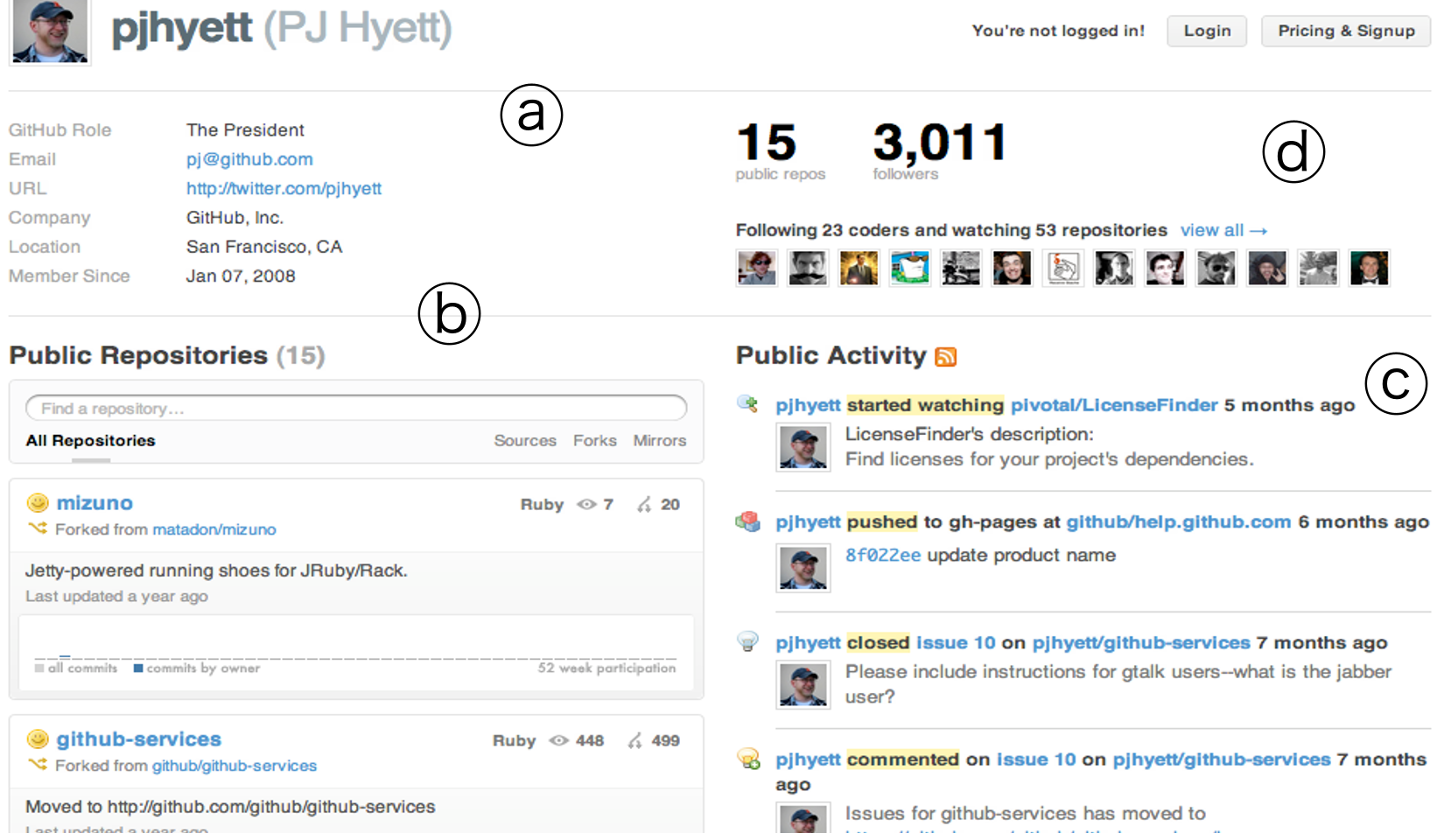 The anatomy of a GitHub profile functions as a digital résumé, signaling expertise through repository histograms and follow counts.
The "Person Model": Newcomers vs. Competent Peers
Maintainers don't see users as just usernames; they build mental archetypes:
- The Competent Peer: Validated by "Geek Cred" (e.g., using Pascal or Erlang, or owning a well-starred project). Maintainers trust these users and are more receptive to their complex architectural changes.
- The Novice: Identified by "flawed" project choices (e.g., using a database with known flaws) or a profile full of forks with no original code.
- The Newcomer: An empty profile. This is a double-edged sword. If the maintainer is in a "mentoring mood," they are gentler. If they are busy, an empty profile signals a "complainer" who reports bugs but can't fix them.
Experimental Insight: The Pull Request Logic
The most fascinating part of the study is the Pull Request Decision Flow. When the code's value is unclear, the decision to merge often shifts from the code to the person.
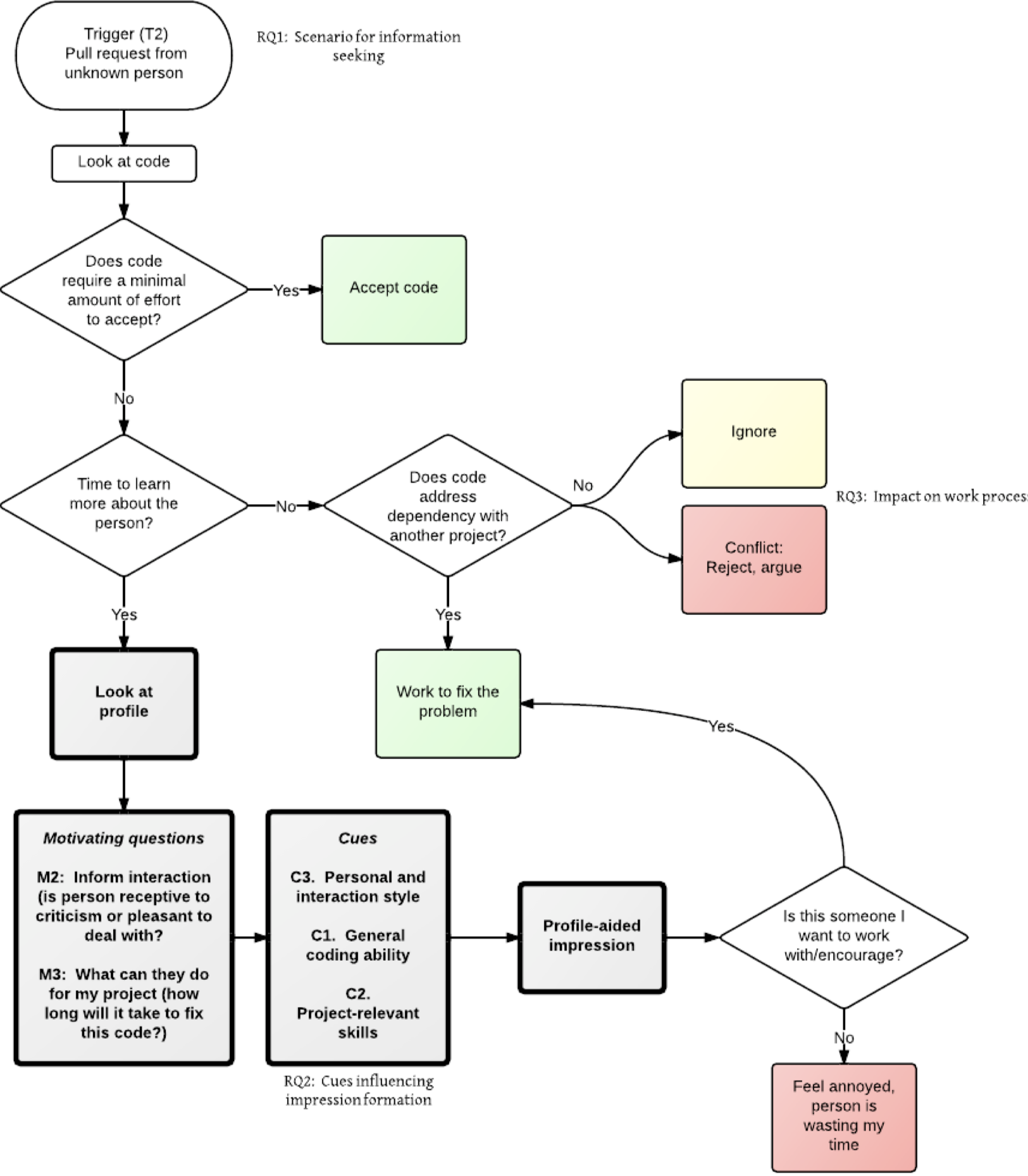 The decision tree maintainers follow: Perception of a contributor's expertise and "niceness" acts as a tie-breaker for technically ambiguous contributions.
A key finding: Imperfect code from a "talented newcomer" is often accepted with mentorship, while similar code from an "arrogant novice" is rejected.
Critical Insight & Industry Value
This paper highlights a major "Cold Start" problem in technical communities. If a brilliant developer joins a new platform like GitHub, their lack of "traces" might lead maintainers to treat them as unskilled novices, leading to "biased and inaccurate" judgments.
Takeaway for Designers: Tools shouldn't just show what was done (the code), but who did it in a way that surfaces true expertise quickly. This could involve cross-platform reputation (linking LinkedIn or StackOverflow) or summarizing "soft skills" (interaction civility).
Future Outlook: As AI agents start submitting code to GitHub, how will maintainers form "impressions" of bots? Will we see the same biases applied to "AI Personas"? The sociology of GitHub is just getting started.