
Beyond Randomness: A Secondary Classification Approach to Community Discovery
An improved algorithm for community discovery in social networks based on label propagation
This paper introduces an Improved Label Propagation Algorithm (ILPA) for community discovery in social networks, reimagining the task as a secondary classification problem. By combining Girvan-Newman (GN) structural initialization with local vertex similarity, the method achieves superior stability and accuracy over traditional heuristic clustering approaches.
TL;DR
Community discovery is the backbone of social network analysis, but classic methods like Label Propagation (LP) are notoriously "jittery" due to their random nature. This paper introduces an improved algorithm that treats community detection as a two-stage classification process. By using the Girvan-Newman (GN) algorithm for a structured start and a weighted propagation mechanism for the finish, the authors achieve higher stability and modularity scores (up to Q=0.69).
The Problem: The Chaos of Random Labels
In the world of social networks, communities are sets of vertices with dense internal connections and sparse external ones. The Label Propagation Algorithm (LP) is popular because it's fast and intuitive—nodes simply adopt the majority label of their neighbors.
However, LP has a "hidden soul" of randomness:
- Initial Bias: Labels are assigned randomly at the start.
- Tie-breaking: When multiple labels are equally frequent in a neighborhood, the choice is arbitrary.
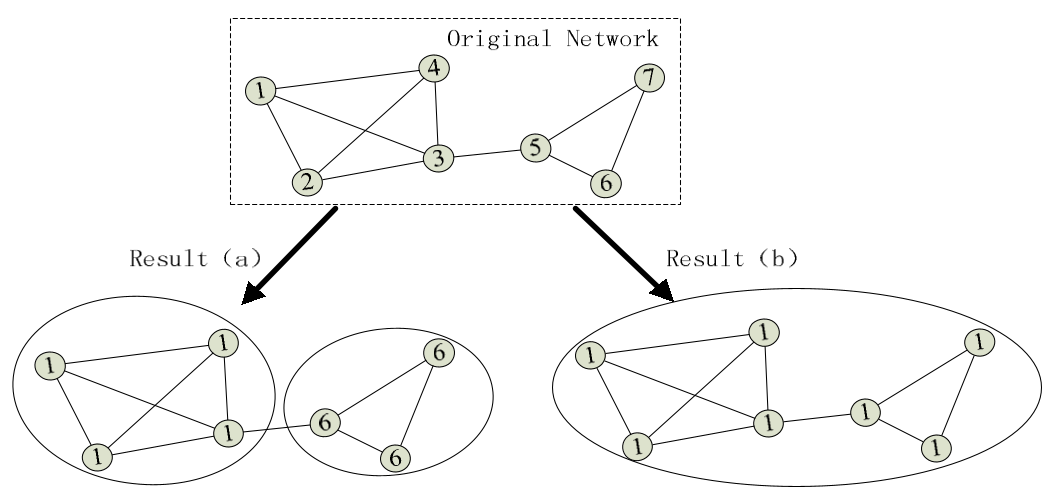
This leads to erratic results where the same network can yield different community structures in back-to-back runs, as visualized below:
The Insight: Secondary Classification
The authors argue that community formation isn't just about who you are connected to (Physical Relationship), but how similar you are to them (Psychological Attribute). They propose a Secondary Classification framework defined by the decision function:
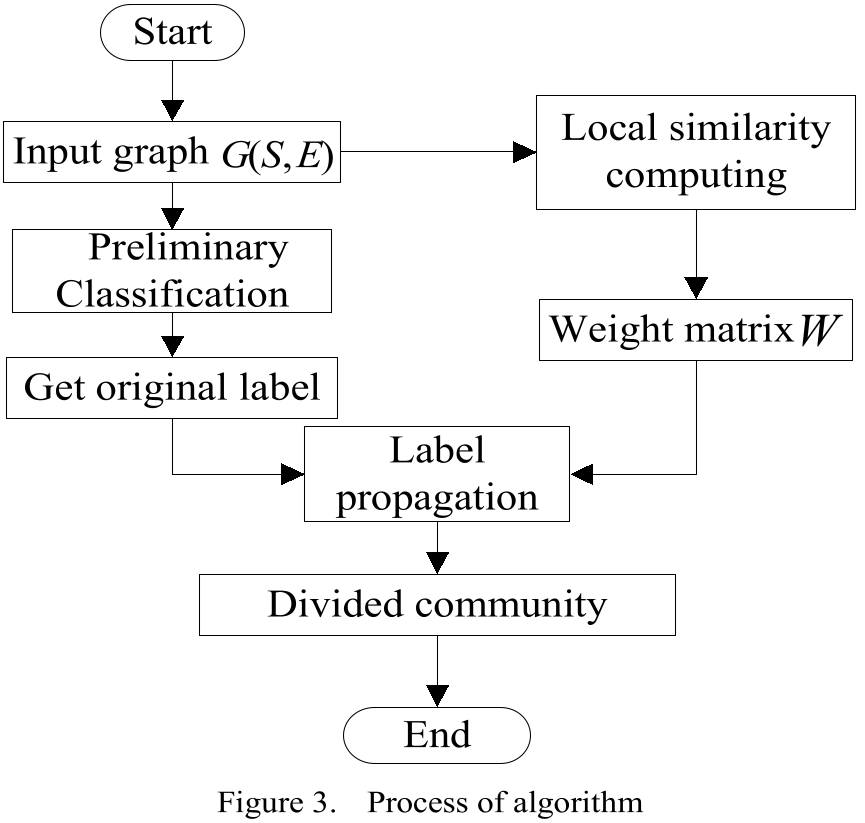
- Physical Initialization (): Instead of random labels, they use the Girvan-Newman (GN) algorithm. GN removes high-betweenness edges to find the "skeleton" of the network, providing a stable starting point.
- Psychological Propagation (): Labels propagate based on local similarity, calculated using linear fitting weights () rather than simple counting.
- Balance Parameter (): Allows tuning the influence of the initial global structure versus the local propagation.
Mathematical Convergence
One of the paper's strengths is the proof of stability. By defining a rate of change function and seeking its minimum, the authors prove that the iterative label update will converge to a stable state, resolving the primary complaint against traditional LP.
Experimental Results: Stability and Quality
The algorithm was tested on benchmark sets (Karate Club and College Football) and a real-world Arxiv dataset.
- Accuracy: In the benchmark tests, the improved algorithm consistently outperformed classic GN and LP, particularly when the parameter was set to moderately favor local propagation.
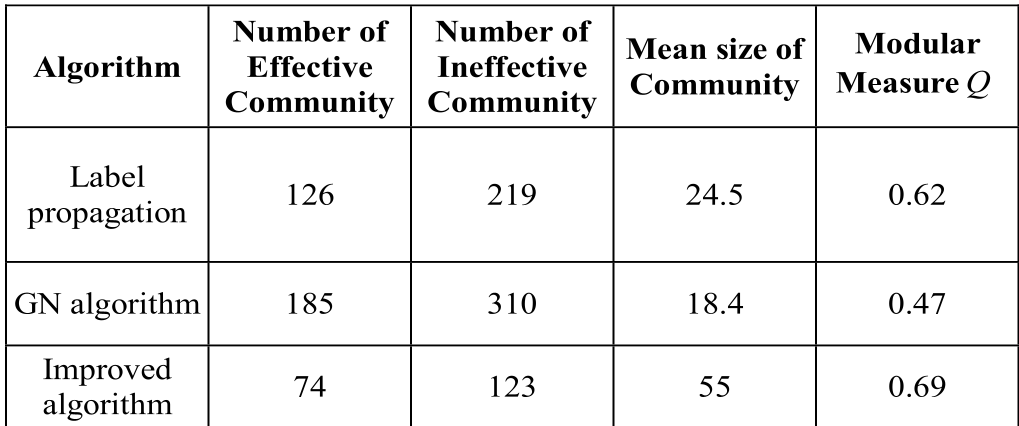
- Modularity (Q): On the large Arxiv dataset (5,242 nodes), the improved algorithm achieved a modularity of 0.69, significantly higher than GN's 0.47. It also reduced the number of "ineffective" (tiny/fragmented) communities, creating a more cohesive map of the network.
Comprehensive Analysis & Future Outlook
The beauty of this research lies in its hybrid nature. It acknowledges that social groups are formed by both the "hard" infrastructure of connections and the "soft" attributes of similarity.
Takeaway for Practitioners: If you are using Label Propagation for production-level community detection, stop relying on random initialization. Even a simplified structural pass (like GN or Louvain initialization) can provide the stability needed for reproducible clustering.
Limitations: While the algorithm is robust, the GN initialization step is computationally expensive for extremely large graphs (millions of nodes). Future work might look into replacing GN with more scalable structural descriptors while maintaining the "Secondary Classification" logic.