
Beyond Polar Mapping: Robust ISAR Classification via the Trace Transform
Improved Classification Performance Using ISAR Images and Trace Transform
This paper introduces a robust Inverse Synthetic Aperture Radar (ISAR) image classification scheme utilizing the Trace Transform (TT). By performing line-to-point mapping, the method extracts high-dimensional geometric features into compact "Trace Profiles" (TPs), achieving superior SOTA classification performance across diverse flight scenarios and image resolutions.
TL;DR
Radar targets are rarely "well-behaved." In Inverse Synthetic Aperture Radar (ISAR), the same aircraft can look radically different depending on its flight path and the radar's viewing angle. This paper introduces a Trace Transform (TT) based classification scheme that outperforms traditional methods by replacing point-sensitive polar mapping with robust line-to-point integrations. Even with low resolution and extreme image elongation, it maintains over 95% classification accuracy.
The Problem: The "Geometry Gap" in Radar Imaging
In the world of Automatic Target Recognition (ATR), ISAR images are a gold standard. However, they suffer from three major instabilities:
- IPP Variation: The 3D target is projected onto a 2D plane (Image Projection Plane) that depends on the target's rotation vector. A slight change in motion makes the image "stretch" or "shrink."
- Registration Errors: Finding the exact Center of Rotation (RC) is technically difficult. If the center is off, conventional Polar Mapping (PM) generates scrambled features.
- Low Cross-Range Resolution: Uncertain angular motion often leads to blurred or elongated cross-range profiles.
Existing SOTA methods like Polar Mapping assume a circular distribution. When a target becomes an elongated "streak" in the image, these circular grids lose critical high-frequency scattering data.
Methodology: The Power of Line-to-Point Mapping
The authors propose moving away from point-to-point mapping. Instead of asking "what is the value of this pixel?" they use the Trace Transform to ask "what is the total energy along this line?"
1. Finding the Major Axis
Instead of transforming the whole 360-degree space (which is computationally expensive), the system uses Principal Component Analysis (PCA) on the image coordinates to find the target's dominant orientation (the major axis).
2. Partial Trace Transform
The transform is only applied in a narrow angular window () around the major axis. This creates Trace Profiles (TPs)—1D signatures that represent the "trace" of the target.
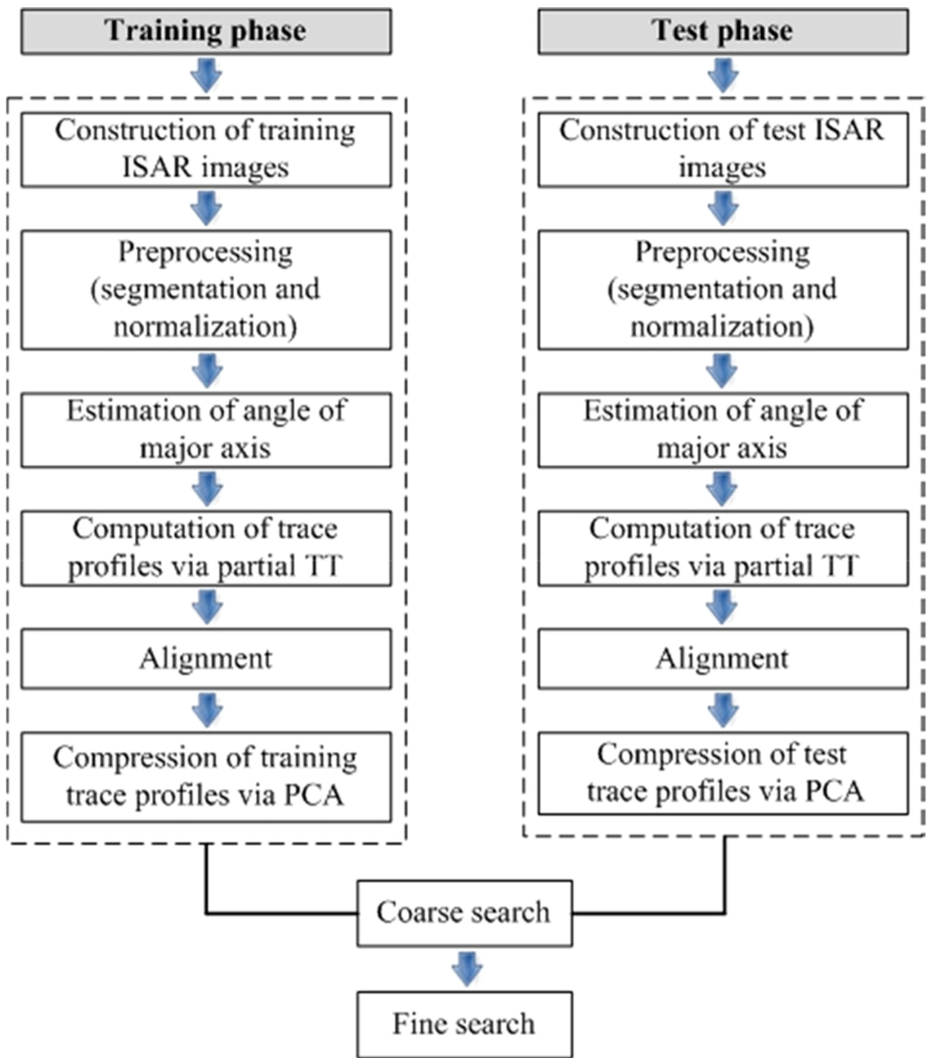 Figure: The proposed workflow from ISAR image to final classification using Trace Profiles.
3. Achieving Invariance
- Translation: Solved by a circular shifting process that aligns the TPs based on their first non-zero index.
- Rotation: Handled by the PCA-based axis alignment and a 180-degree flip-check during the matching phase.
Experiments: Stress-Testing the Robustness
The researchers tested the system against "SET-2," which simulated realistic flight scenarios (Boeing 737, F14, Su35, etc.) with mismatched resolutions and varying IPPs.
Performance under elongation
When the flight direction forced the target into an elongated shape (IPP2), the accuracy of Polar Mapping (PMA) crashed. The Proposed Trace Transform method (Proposed2) maintained nearly 98-100% accuracy.
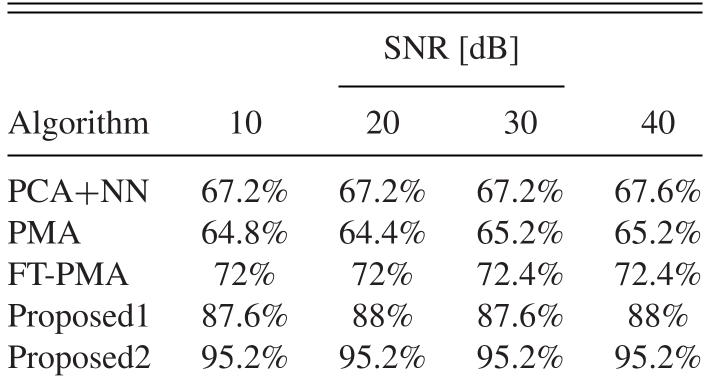 Table: Comparison demonstrating the Proposed2 method's dominance in low-resolution and high-noise environments.
Resilience to Blurring
Unlike PCA+NN which drops significantly as image blurring (L-order) increases, the Trace Transform's integrative nature acts as a natural noise filter, keeping accuracy high even when the target is out of focus.
Critical Analysis: Why it Works
The "magic" of this paper lies in the Inductive Bias of the Trace Transform. By integrating along lines, the method effectively "averages out" local scintillation and small phase errors while preserving the global geometric structure (the target's skeleton).
Limitations:
- The method relies on a successful segmentation of the target from the background. In ultra-low SNR environments where the target cannot be isolated, PCA-based axis estimation might fail.
- It assumes the target has a clear "major axis," which might be less distinct for symmetric targets like certain satellites or hovering rotorcraft.
Future Outlook
This work provides a critical link between classic signal processing and modern ATR. As we move toward more autonomous radar systems, the ability to extract resolution-invariant features will be key to classifying targets at the edge of detection range.