
Beyond ID3: Optimizing Decision Trees for Educational Data Mining
The Application of Improved Decision Tree Algorithm in Data Mining of Employment Rate: Evidence from China
This paper proposes an improved ID3 decision tree algorithm specifically for student employment rate prediction. By integrating "attribute measurement" and "information gain ratio," the method overcomes the bias toward multi-valued attributes and achieves faster model construction on large datasets.
TL;DR
This research tackles the inherent bias of the ID3 algorithm—its tendency to favor attributes with many values—by introducing an improved decision tree framework. By combining Attribute Measure and Information Gain Ratio, the authors created a faster, more logical model to predict student employment rates, highlighting "Social Experience" as a primary driver of career success.
Background: The Limitations of Classical ID3
In the landscape of Machine Learning, the ID3 (Iterative Dichotomiser 3) algorithm is a cornerstone of symbolic AI. However, in real-world applications like analyzing student employment, ID3 often fails by selecting "noisy" attributes simply because they have many categories (e.g., student IDs). This is not just a technical flaw; it leads to poor generalization and slow processing when dealing with massive institutional databases.
The Core Innovation: Dual-Criteria Optimization
The authors propose a refined entropy calculation to ensure the tree splits on truly significant features.
1. Attribute Measure (S)
Unlike standard ID3 which treats all attributes as equally "likely" to be useful, the authors introduce a weight . This measure is derived from probability statistics within the training set, reflecting the "effect degree" of an event.
2. Information Gain Ratio
To prevent the algorithm from over-branching, they adopt the Gain Ratio. By dividing the Information Gain by the SplitInfo (which measures the entropy of the attribute itself), the model normalizes the gain, ensuring that an attribute with hundreds of values doesn't automatically win the split.
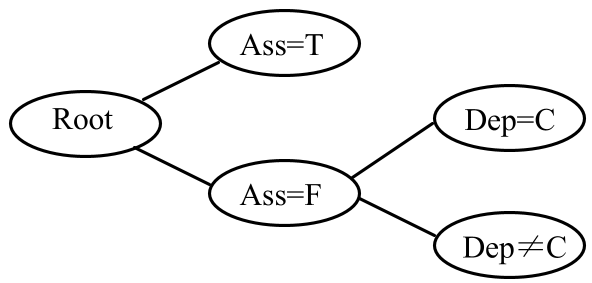
Experimental Analysis: What Drives Employment?
The model was trained on a dataset of 2,000 graduates. The results provide a fascinating look into the factors influencing the Chinese job market:
- The Power of Experience: Students with social experience saw an employment rate of 89.65%, compared to only 56.57% for those without.
- Specialty Matters: Within the "no experience" group, Computer science majors maintained a high employment rate (89.10%), whereas non-computer majors dropped significantly to 37.78%.
Efficiency Gains
The improved algorithm maintains the same classification accuracy as traditional ID3 but constructs the tree significantly faster. This makes it a superior choice for large-scale institutional data mining where "time-to-insight" is critical for policy adjustments.
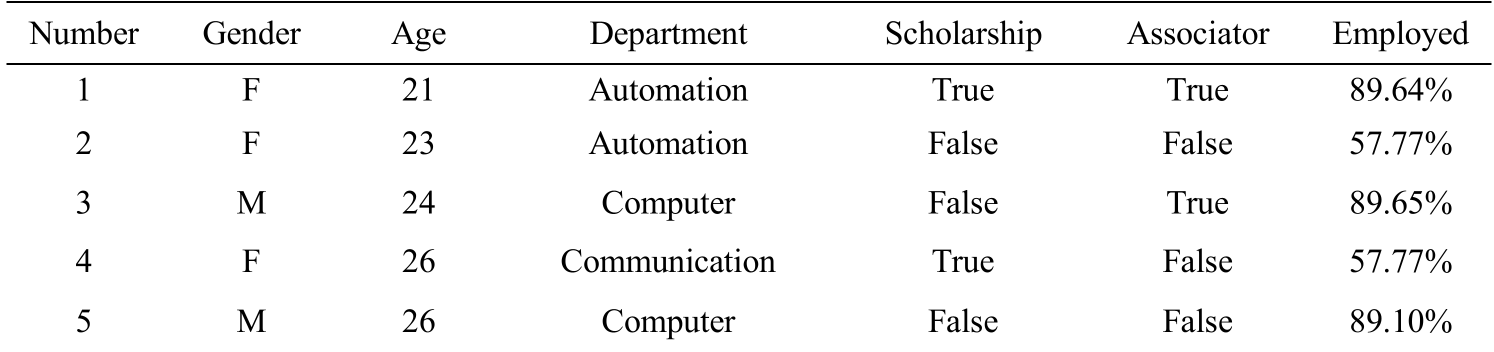
Critical Insight & Future Outlook
While the paper successfully addresses the "multi-value" bias, it primarily focuses on discrete categorical data. The next frontier for this specific employment model would be integrating Continuous Value Handling and Pruning Techniques to prevent overfitting on smaller sub-departments.
Takeaway for Educators: The data suggests that teaching resources should perhaps shift toward fostering "Social Experience" (internships and practical projects) and digital literacy, as these are the strongest indicators of postgraduate success in the model's decision path.
Conclusion
This work demonstrates that even classic algorithms like ID3 can be revitalized with simple statistical adjustments. For data scientists working in HR-tech or Education, the introduction of Attribute Measure provides a pragmatic way to inject domain knowledge (importance weights) into an automated tree-building process.